
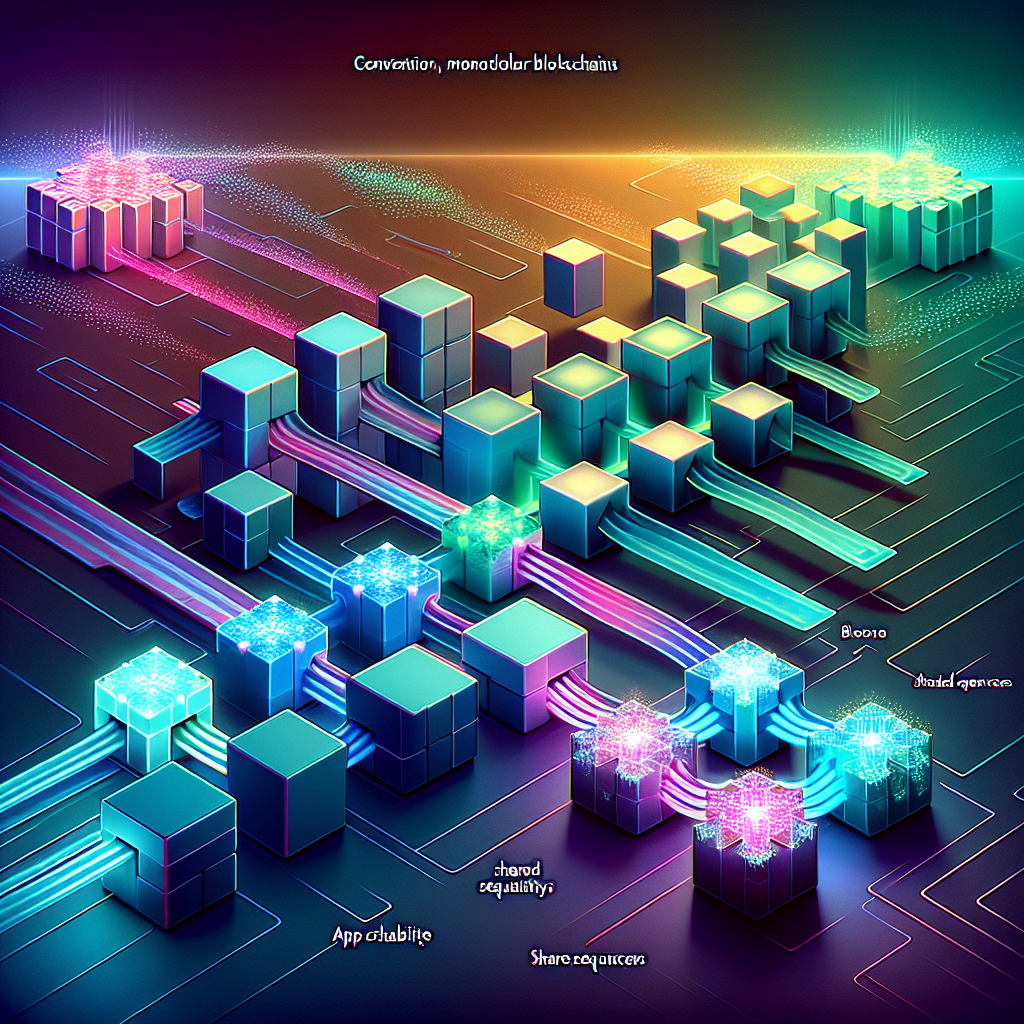
Modular Blockchains in Action: How App-Specific Chains and Shared Sequencers Are Transforming Scalability, Security, and User Experience in Web3 Today
Web3 has promised a future of open, permissionless digital economies. But for most users and developers today, the blockchain world still feels slow, clunky, and expensive. If you’ve ever waited five minutes for a DeFi transaction to confirm, or paid $40 in gas fees to mint an NFT, you’ve felt the pain firsthand.
For years, the hunt for scalable, user-friendly blockchains was dominated by “monolithic” chains—Ethereum, Solana, Avalanche—all trying to do everything at once. But as more builders and capital have poured into Web3, cracks have started to show: network congestion, security trade-offs, and fragmented liquidity. The result? A growing sense that the one-size-fits-all approach just doesn’t scale.
A new paradigm is taking shape, driven by two powerful ideas: modular blockchains and specialized infrastructure like shared sequencers. These aren’t just technical upgrades—they’re rewiring the entire stack and unlocking fresh possibilities for apps, builders, and users alike. If you care about where blockchain tech is actually headed, it’s time to dig into the modular movement.
The Modular Blockchain Revolution: A Quick Primer
Traditional blockchains—think Ethereum or Bitcoin—are monolithic by design. They handle everything from transaction ordering (consensus) to data storage (data availability) to executing application logic (smart contracts) on a single chain. This model is robust but limited; every function competes for the same blockspace, causing bottlenecks and high fees when demand surges.
Modular blockchains break this up into separate, specialized layers. Instead of one “do-it-all” chain, different layers handle different tasks:
- Execution: Running the actual app logic (e.g., smart contracts)
- Settlement: Resolving disputes and securing finality
- Consensus: Agreeing on the order of transactions
- Data Availability (DA): Ensuring all transaction data is published and accessible
By decoupling these modules, developers can mix and match components to suit specific needs. This modular approach is already reshaping the architecture of many next-gen chains and Layer 2 solutions.
App-specific chains (sometimes called “appchains”) take this further. Instead of deploying on a general-purpose chain like Ethereum, projects spin up their own dedicated blockchains, tailored for a single application or ecosystem. Meanwhile, shared sequencers are emerging as a new coordination layer, promising smoother interoperability and fairer access across the modular stack.
Let’s unpack how these concepts work, why they matter now, and what it means for the future of Web3.
From Monoliths to Modules: What’s Driving the Shift?
The monolithic approach made sense early on. Security and simplicity trumped everything else when blockchains were niche experiments. But as usage exploded—especially after DeFi Summer 2020—the limits became impossible to ignore.
Why modularity, and why now?
- Scalability is a breaking point: Ethereum’s base layer processes only 15–20 transactions per second (TPS). Even with Layer 2 rollups, demand routinely overwhelms blockspace, spiking fees and slowing apps.
- Developer flexibility: Not all apps need the same trade-offs. A high-speed game doesn’t need the same security guarantees as a billion-dollar DeFi protocol.
- Ecosystem fragmentation: New Layer 1s and Layer 2s have splintered liquidity and users across dozens of chains, making composability and UX more complex.
- Security specialization: Monolithic chains force all apps to accept the same security model, no matter how mismatched.
By modularizing the stack, developers and protocols can optimize for what matters most to them—speed, security, decentralization, cost, or user experience—without being boxed in by one chain’s design choices.
How Modular Blockchains and App-Specific Chains Work
Let’s make this concrete. In a modular blockchain world, you might see:
- Rollups (like Optimism, Arbitrum, or zkSync): These handle execution and settlement off-chain or on a separate layer, while using Ethereum as a security and data availability anchor.
- Data Availability Layers (like Celestia, EigenDA): Specialized chains that do nothing but store and make available the raw data for transactions, so rollups don’t need to bloat their own blockchains.
- Appchains (like dYdX’s Cosmos chain, Osmosis, or Axie Infinity’s Ronin): Projects spin up blockchains dedicated to a single app or ecosystem, customizing throughput, fees, and governance.
The Role of Shared Sequencers
One of the most exciting (but underappreciated) new components is the shared sequencer. In DeFi and gaming, “sequencing” means deciding the order in which transactions are included in a block. This matters immensely for user experience, fairness, and preventing manipulation (like MEV—maximal extractable value).
Traditionally, each rollup or appchain has its own sequencer. But this can cause:
- Fragmentation: Apps can’t easily interoperate or guarantee atomic cross-chain transactions.
- Fairness issues: Single sequencers can be points of censorship or MEV extraction.
Shared sequencers flip this script. They act as a neutral “ordering service,” shared across multiple rollups or appchains. This opens up:
- Cross-rollup atomicity: Letting users bundle transactions across apps or chains, with guarantees they’ll all succeed or fail together.
- MEV minimization: Fair sequencing and auction mechanisms reduce opportunities for manipulation.
- Faster finality: Users get near-instant feedback, improving UX.
Projects like Astria, Espresso Systems, and Radius are building early shared sequencer networks. The goal: make modular blockchains feel as seamless and composable as monolithic ones, but without the bottlenecks.
Real-World Examples: Modular Blockchains and Shared Sequencers in Practice
Theory is great, but what’s actually live or close to it? Here are some of the most prominent real-world deployments and pilots:
dYdX: From Ethereum Rollup to Cosmos Appchain
dYdX, once the largest Ethereum-based derivatives protocol, migrated its exchange to a custom appchain built on Cosmos. Why?
- Performance: The team needed sub-second trades and higher throughput than Ethereum L1 or L2s could reliably provide.
- Customization: With its own chain, dYdX controls fee markets, governance, and even validator incentives.
- Security: By customizing the validator set, they fine-tune the security model for high-stakes trading.
Since launching on Cosmos, dYdX has processed billions in daily volume with lower latency and fees, though the move brought new security and operational challenges.
Celestia: The Data Availability Layer
Celestia is pioneering the “data availability” module. Instead of running smart contracts, it focuses solely on making transaction data available for other blockchains and rollups. This enables dozens (eventually hundreds) of appchains or rollups to share a single, scalable DA layer while customizing their own execution and consensus.
Early adopters include rollups like Manta Network and Dymension, both leveraging Celestia’s DA layer for throughput and cost efficiency.
Radius and Astria: Shared Sequencers in Action
Radius and Astria are two of the first shared sequencer networks to go live in testnet. They coordinate transaction ordering across multiple rollups, providing atomic execution and fair sequencing. For users, this means:
- Swapping assets across rollups without worrying about inconsistent states
- Lower risk of front-running and MEV attacks
- Smoother, single-click DeFi interactions
While still early, these networks are onboarding partners and demonstrating real cross-rollup composability.
On-Chain Data and Adoption
- As of Q2 2024, Celestia claims over 30 rollups and appchains are actively integrating or piloting its DA services.
- Cosmos has seen a surge to over 60 appchains, with dYdX and Osmosis driving significant daily volumes.
- Shared sequencer testnets are processing thousands of cross-rollup transactions daily, with mainnet deployments targeted for the next 6–12 months.
Risks, Trade-Offs, and Open Questions
No new architecture comes without trade-offs. Modular blockchains and shared sequencers solve some problems but raise others—many still being worked out in the wild.
Technical Risks
- Coordination complexity: With many independent modules, ensuring reliability, liveness, and cross-chain consistency is much harder.
- Data availability attacks: If a DA layer fails or is attacked, all dependent rollups can stall or lose data.
- Sequencer centralization: If shared sequencers become bottlenecks or are captured by a few actors, new central points of failure emerge.
- Cross-chain MEV: While shared sequencers can reduce MEV, new forms of cross-chain arbitrage and manipulation are possible.
Economic and User Risks
- Tokenomics fragmentation: Appchains often launch their own tokens, which can dilute value and fragment incentives.
- Liquidity silos: Even with better interoperability, liquidity can still be scattered across chains.
- User confusion: Moving assets and interacting across many appchains and rollups can be daunting for non-experts.
Regulatory and Governance Risks
- Jurisdictional arbitrage: Appchains can be spun up in less regulated environments, raising compliance questions.
- Governance attacks: Smaller validator sets on appchains or sequencers may be more vulnerable to capture or collusion.
In short: Modular blockchains increase flexibility and scalability, but they also multiply the moving parts and points of failure. Careful design, monitoring, and community vigilance are essential.
Actionable Takeaways: What Builders, Users, and Investors Should Know
If you’re navigating the modular blockchain world—whether as a builder, trader, or policymaker—here are some practical steps and considerations:
For Builders
- Assess your app’s needs: Does it truly require a custom chain, or would a rollup or L2 deployment suffice?
- Prioritize UX: Make bridging, onboarding, and cross-chain operations as simple as possible for users.
- Engage with shared sequencer communities early: Standards are still forming, and early participation can help shape the tech stack.
- Monitor DA and sequencer security: Don’t just take modularity for granted; stress-test your dependencies.
For Investors
- Look for network effects: Appchains and DA layers with strong developer and user adoption are more likely to survive shake-outs.
- Tokenomics matter: Watch for unsustainable emissions or weak incentives in smaller appchains.
- Understand composability risks: Evaluate whether modular solutions actually improve, or just shift, fragmentation.
For Users
- Stay alert to bridging risks: Cross-chain interactions can expose you to new attack vectors; only use well-audited bridges and protocols.
- Watch for fees and delays: Modular chains can offer lower fees, but congestion or DA failures can still cause issues.
- Educate yourself: New models mean new risks and opportunities. Don’t assume all chains are equally secure or user-friendly.
For Policymakers
- Track emerging standards: Modular blockchains may require new regulatory frameworks around data responsibility, cross-chain compliance, and validator accountability.
- Prioritize interoperability and user protection: Fragmentation can increase complexity and risk for end users.
The Road Ahead: Modular Blockchains and the Next 24 Months
Modular blockchains and shared sequencers aren’t just technical fads—they’re a response to real bottlenecks and user pain points in today’s Web3 ecosystem. The move toward app-specific chains, specialized DA layers, and neutral sequencing is already reshaping how new protocols launch and scale.
Over the next 12–24 months, expect:
- More appchains and rollups to launch, especially in DeFi, gaming, and social, each optimized for distinct needs.
- Shared sequencer networks to move from testnet pilots to mainnet deployments, unlocking new cross-chain and cross-rollup applications.
- New standards and best practices to emerge, especially around DA reliability, composability, and fair sequencing.
- Growing pains as the ecosystem navigates new trade-offs, from security to liquidity to regulatory compliance.
If the modular thesis plays out, users may finally get a Web3 that’s both scalable and user-friendly, without sacrificing security. But as always in crypto, the devil is in the details—and the next year will be a proving ground for whether modular blockchains can deliver on their ambitious promise.
For builders, investors, and users alike, the message is clear: modularity is no longer just a buzzword. It’s where the most exciting (and challenging) action in blockchain is happening right now. Pay attention—or risk being left behind.
What to Do Next
- Complete KYC and security setup before funding.
- Use a test transaction first.
- Set risk limits and automate alerts.
Recommended Next Reads
- Benefits of Modular Blockchain Architecture:
modular-blockchain-benefits - How Shared Sequencers Work:
shared-sequencers-explained - App-Specific Chains vs. General-Purpose Chains:
app-specific-vs-general-chains
Sources and Further Reading
- Celestia: Modular Blockchain Network
- EigenLayer: Shared Security for Ethereum
- Polygon Supernets: Application-Specific Blockchains
FAQ
What are modular blockchains and how do they differ from monolithic blockchains?
Modular blockchains separate core functions—such as consensus, data availability, and execution—into distinct layers or modules. This contrasts with monolithic blockchains, which handle everything on a single chain. The modular approach allows for greater scalability, flexibility, and specialization, enabling developers to optimize each layer for specific needs.
How do app-specific chains and shared sequencers improve scalability and user experience in Web3?
App-specific chains are tailored blockchains designed for particular applications, reducing congestion and optimizing performance for their use case. Shared sequencers coordinate transaction ordering across multiple chains, increasing throughput and lowering latency. Together, they enhance scalability, reduce fees, and provide a smoother user experience.
Are modular blockchains more secure than traditional blockchains?
Modular blockchains can enhance security by allowing each layer to adopt the most robust security practices and by isolating risks. For example, app-specific chains can implement custom security measures, while shared sequencers can provide additional safeguards against manipulation. However, the overall security depends on the implementation and coordination between modules.
Stay Updated
Subscribe to your site newsletter for weekly market breakdowns, tool comparisons, and risk alerts.
Leave a Reply