
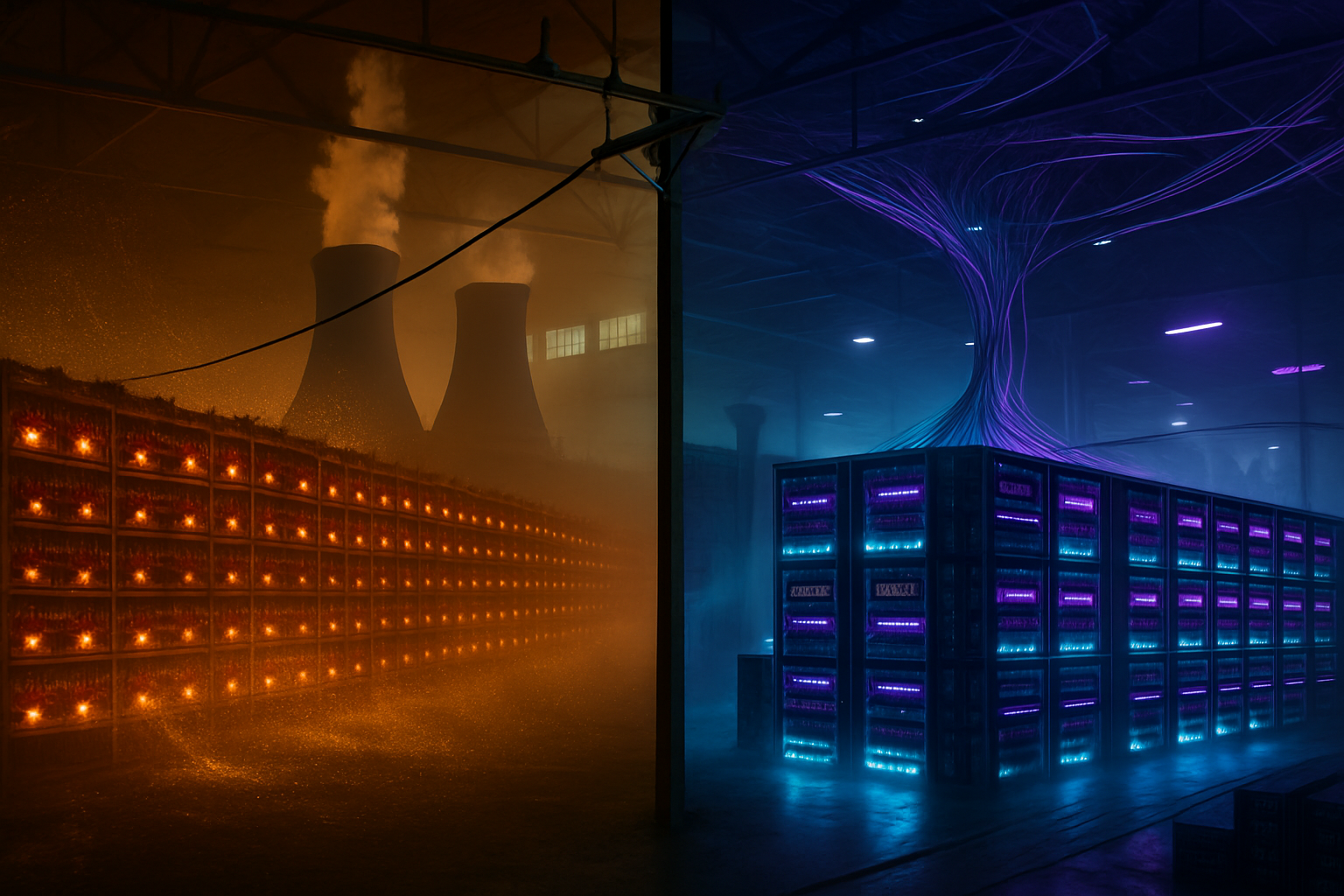
The Great Hash Rate Pivot: How Bitcoin Miners Are Betting the Farm on AI
The halving in April 2024 did exactly what it was designed to do. It cut the block subsidy from 6.25 to 3.125 BTC, squeezing every miner who hadn’t locked in cheap power, efficient rigs, or alternative revenue streams. For the optimists, this was just another four-year cycle to weather. For the realists running mid-tier operations in Texas or upstate New York, it was a wake-up call with a countdown timer.
Here’s the thing though: this isn’t another story about miners capitulating or going bankrupt. The smartest operators saw this coming years ago and started building something entirely different. They’re turning their massive, power-hungry facilities into something the tech world desperately needs right now: data centers capable of training and running the largest AI models on the planet. Core Scientific’s $3.5 billion deal with CoreWeave, Hut 8’s pivot to colocation contracts, and Terawulf’s nuclear-powered campuses aren’t isolated moves. They’re the leading edge of a structural transformation that could redefine what “Bitcoin mining” even means.
This matters because the economics of proof-of-work are being rewritten in real time. The miners who survive won’t necessarily be the ones with the most hash rate. They’ll be the ones who figured out how to sell compute to hyperscalers before the stranded power assets and tax-advantaged energy deals got snapped up by Amazon, Google, and Microsoft directly. The window is narrowing. And the consequences ripple out to everyone holding Bitcoin, investing in mining equities, or thinking about where the next generation of AI infrastructure gets built.
What Bitcoin Mining Actually Is, and Why It’s Running Out of Road
At its core, Bitcoin mining is a competition to convert electricity into valid blocks. Miners run specialized ASIC machines that perform quintillions of hash calculations per second, burning through enormous amounts of power for the chance to earn the block subsidy plus transaction fees. The difficulty adjustment keeps the average block time near ten minutes, which means when more miners join, the protocol makes the puzzle harder. It’s a zero-sum arms race where your margin depends almost entirely on your all-in cost per kilowatt-hour and your machine efficiency.
For years, the playbook was simple: find cheap power, buy the newest Bitmain or MicroBT rigs, scale fast, and pray Bitcoin’s price outpaces your operational burn. The 2021 bull market made this look easy. Public mining companies raised billions, built out aggressively, and many paid top dollar for hardware and power contracts that looked brilliant at $60,000 BTC but turned toxic when prices crashed below $20,000 in 2022.
The 2024 halving changed the math permanently. At current prices, the block subsidy alone doesn’t cover costs for miners paying above roughly $0.06 per kWh with mid-generation equipment. Transaction fees have ticked up thanks to ordinals and layer-2 activity, but they’re volatile and unpredictable. The industry needed a new narrative, and more importantly, a new revenue model.
Enter high-performance computing, or HPC. The same facilities that house thousands of ASIC miners—industrial buildings with robust electrical infrastructure, cooling systems, and proximity to cheap, often stranded power—are structurally similar to what AI companies need to run GPU clusters. The difference is that AI compute contracts typically run 3–5 years with fixed pricing, while Bitcoin mining revenue fluctuates daily. For capital markets and for operators trying to survive, that stability is worth almost anything.
The AI Infrastructure Crunch: Why Miners Suddenly Look Attractive
The demand for AI training and inference compute has exploded beyond what anyone planned for. OpenAI’s GPT-4, Google’s Gemini, Anthropic’s Claude—these models require tens of thousands of NVIDIA GPUs running in parallel for months. NVIDIA’s data center revenue hit roughly $47 billion in fiscal 2024, and the company still can’t manufacture fast enough to meet demand. The bottleneck isn’t just chips; it’s the physical infrastructure to power and cool them.
Hyperscalers like Amazon Web Services, Microsoft Azure, and Google Cloud are spending unprecedented capital—collectively an estimated $200+ billion in 2024 alone—on data center expansion. But building from scratch takes 2–3 years minimum, often longer when you factor in permitting, grid interconnection queues, and supply chain constraints for transformers and switchgear. The AI companies racing to train next-generation models don’t have that time.
This is where Bitcoin miners come in. They already have:
- Megawatts of contracted power, sometimes at rates locked in years ago before electricity prices spiked
- Operational electrical infrastructure: substations, switchgear, transmission lines
- Cooling systems designed for extreme heat density, albeit originally for ASICs rather than GPUs
- Real estate in locations hyperscalers might not have considered, including rural areas with stranded natural gas or excess nuclear capacity
- Speed to market: existing facilities can be retrofitted in months, not years
The catch, and it’s a significant one, is that AI data centers have different requirements than mining operations. GPUs are more sensitive to temperature fluctuations, need different networking architectures (InfiniBand or high-bandwidth Ethernet rather than basic internet connectivity), and require far more human staffing for maintenance and operations. Not every mining facility can make the jump. But the ones that can are suddenly sitting on assets worth multiples of their previous valuation.
Case Studies: Three Different Bets on the Same Play
Core Scientific and CoreWeave: The Blockbuster Template
In June 2024, Core Scientific announced a landmark deal with CoreWeave, the cloud provider that has become one of the largest consumers of NVIDIA GPUs outside the hyperscalers themselves. The agreement: CoreWeave would lease 200 megawatts of infrastructure across Core Scientific’s Texas facilities, with Core Scientific handling the physical operations. The contract runs 12 years and is valued at approximately $3.5 billion in total revenue. Core Scientific’s stock, which had traded below $1 during the 2022 bear market, surged over 40% on the news.
What’s notable here isn’t just the dollar figure. It’s the structure. Core Scientific isn’t selling its facilities; it’s operating them as a service provider for CoreWeave’s GPU clusters. This preserves optionality—if Bitcoin mining becomes more profitable again, Core Scientific still has other sites and can potentially renegotiate. More importantly, it validates a template: mining companies as infrastructure operators rather than commodity producers.
Core Scientific followed up with additional deals, including a partnership to host Bitmain’s own AI cloud services. By late 2024, the company projected that over 50% of its revenue would come from HPC rather than Bitcoin mining within two to three years. For a company that emerged from Chapter 11 bankruptcy in early 2024, this is a remarkable pivot.
Hut 8: The Colocation Middle Path
Hut 8 took a different approach, one that looks more conservative but might prove more durable. Rather than betting everything on massive GPU deployments, the Canadian miner diversified into colocation—essentially renting out data center space and power to customers who bring their own equipment.
In 2023 and 2024, Hut 8 signed multiple deals to host AI and cloud computing clients at its sites in Ontario and British Columbia. The company’s Medicine Hat facility, originally built for Bitcoin mining with 63 MW of capacity, began transitioning portions to HPC tenants. Hut 8 reported that HPC and colocation revenue reached approximately $30–35 million annually by mid-2024, still a fraction of its total but growing fast.
CEO Jaime Leverton has been explicit about the strategy: don’t try to become an AI company overnight, but monetize the infrastructure assets while learning the operational differences. Hut 8 also maintains significant Bitcoin holdings on its balance sheet—over 9,000 BTC as of late 2024—giving it exposure to upside without pure dependence on mining margins.
The trade-off is lower revenue per megawatt compared to operating GPUs directly. Colocation might generate $100–150 per kW-month, while AI compute services can command $300–500 or more. But Hut 8 avoids the massive capital expenditure of buying GPUs, the technical risk of operating unfamiliar hardware, and the customer concentration of depending on one or two large tenants.
Terawulf: The Nuclear Gamble
Terawulf’s story is perhaps the most audacious. The company built the Nautilus Cryptomine in Pennsylvania, a 300 MW facility powered directly by the Susquehanna nuclear plant through a behind-the-meter arrangement. Nuclear power offers what almost nothing else can in American energy: zero-carbon baseload generation with capacity factors above 90%, meaning the plant runs nearly continuously.
In 2024, Terawulf began pivoting substantial portions of this capacity toward HPC and AI workloads. The pitch to potential customers was compelling: carbon-free compute for companies with aggressive net-zero commitments, with power costs locked in through long-term contracts. Microsoft, Google, and Amazon have all made public commitments to match their energy consumption with clean power; nuclear-backed data centers offer a direct path.
Terawulf also expanded its Lake Mariner facility in New York, another site with access to low-cost hydroelectric and nuclear power from the grid. By late 2024, the company guided that it expected to have 200+ MW dedicated to HPC by mid-2025, with discussions ongoing for additional capacity.
The risk is concentration. Nuclear plants are reliable but not flexible; you can’t easily curtail or scale based on compute demand. And the capital intensity of nuclear-adjacent development is extreme. Terawulf’s ability to execute depends on continued access to construction financing in a higher interest rate environment, and on finding customers willing to pay premium rates for carbon-free compute.
The Mechanics: How This Actually Works (and Where It Breaks)
Converting a mining facility to HPC isn’t like swapping out lightbulbs. The process involves several technical and economic hurdles that separate viable candidates from expensive failures.
Power quality and redundancy: Bitcoin miners can tolerate brief power interruptions; ASICs simply restart. GPU clusters running distributed training jobs can lose hours or days of computation from a momentary outage. Facilities need UPS systems, backup generators, and potentially dual-feed power arrangements that most mining sites lack.
Cooling architecture: ASICs run hot but uniformly. NVIDIA’s H100 GPUs have more complex thermal profiles, and the latest Blackwell architecture is expected to push power consumption per rack to 120 kW or more. Traditional air cooling hits limits; many conversions require liquid cooling retrofits that cost millions and take months to install.
Networking: Training large AI models requires specialized interconnects. InfiniBand switches from NVIDIA’s Mellanox division, or high-bandwidth Ethernet alternatives, cost tens of thousands per port. Mining facilities typically have basic 1–10 Gbps internet; AI clusters need 400 Gbps and soon 800 Gbps internal fabrics.
Staffing and operations: Running a mining facility takes a lean crew. AI data centers need network engineers, systems administrators, security specialists, and customer-facing technical account managers. Labor costs can double or triple.
Contract structures: Mining revenue is variable and immediately liquid. HPC contracts are typically 3–5 year commitments with monthly or annual payments. This improves predictability but reduces flexibility. If Bitcoin prices surge and mining becomes more profitable, a locked-in HPC contract means leaving money on the table.
The facilities best positioned for conversion tend to be newer builds with excess physical space, robust electrical infrastructure designed with headroom, and locations in deregulated power markets where contract structures can be renegotiated. Older sites in remote locations with constrained grid access often can’t make the economics work.
The Risks Nobody’s Talking About Loudly Enough
This pivot looks inevitable in headlines. The reality is messier, with several underappreciated risks that could derail individual companies or the broader narrative.
Technical execution risk: Several mining companies have announced HPC transitions that haven’t materialized on schedule. The specialized knowledge to operate GPU clusters at scale is concentrated at hyperscalers and a few specialized providers. Mining executives who spent careers optimizing hash rate don’t automatically understand AI workload management. Expect some high-profile failures.
Customer concentration: Core Scientific’s $3.5 billion deal is transformative, but CoreWeave represents a single counterparty. If CoreWeave faces its own financing pressures—it’s raised billions in debt secured by GPU assets—or if NVIDIA’s supply constraints ease and competition intensifies, that revenue could prove less stable than advertised.
Power contract renegotiation: Many miners secured cheap power through strategies that won’t survive scrutiny. Some Texas operations participated in demand response programs that paid them to curtail during grid stress; AI customers expect 99.9% uptime. Other facilities relied on flared gas or stranded energy assets that may not scale to HPC’s continuous load requirements.
Regulatory and tax exposure: Bitcoin mining has enjoyed a relatively light regulatory touch in most U.S. jurisdictions. Data centers hosting AI workloads face different scrutiny: export controls on advanced chips, potential AI safety regulations, data privacy requirements, and different tax treatment. The IRS and state revenue departments are already examining whether HPC revenue qualifies for the same incentives that attracted miners.
Market timing risk: The AI infrastructure buildout could slow. If model training hits diminishing returns, if inference becomes more efficient, or if economic conditions force tech companies to cut capital expenditure, the demand for new data center capacity could soften just as miners complete expensive conversions. The miners would then be stuck with GPU-heavy facilities in a down market.
Bitcoin network implications: If significant hash rate permanently exits mining for HPC, Bitcoin’s security model changes. The difficulty adjustment handles gradual shifts, but a rapid transition could create temporary vulnerability. More subtly, if mining centralizes further among operators who didn’t diversify—often those with the absolute cheapest power—geographic and political concentration risks increase.
What This Means for Different Players: A Practical Guide
For Bitcoin Holders and Traders
The hash rate isn’t going to zero, but its composition is shifting. Monitor which large miners are diversifying versus doubling down on pure mining. Companies with substantial HPC revenue—Core Scientific, Terawulf to an extent—trade less as leveraged Bitcoin proxies and more as hybrid infrastructure plays. This changes their correlation to BTC price and their suitability for portfolio hedging.
Watch for difficulty adjustment dynamics. If HPC conversions happen faster than expected, difficulty could drop, temporarily improving margins for remaining miners. This creates potential short-term trading opportunities around earnings releases and operational updates.
Consider the long-term security budget. If transaction fees don’t replace diminishing block subsidies, and if hash rate becomes concentrated among fewer, purely financial operators, the political economy of Bitcoin changes. This is a multi-year concern, not a trading signal, but it should inform conviction levels.
For Mining Equity Investors
The valuation frameworks are breaking. Traditional metrics like cost per terahash or BTC mined per share don’t capture HPC revenue streams. New models need to value:
- Contracted HPC revenue (duration, counterparty credit quality, escalation clauses)
- Power contract terms and renewal risks
- Conversion capex and timeline execution
- Optionality value of remaining mining capacity
Be skeptical of companies announcing HPC pivots without concrete contracts or identifiable customers. The gap between press release and revenue recognition can be 12–18 months, and many announced deals never close.
Diversification within mining equities now matters more than ever. A portfolio of pure-play miners and hybrid operators hedges against divergent outcomes in both Bitcoin price and AI demand.
For Builders and Developers
If you’re building applications that need decentralized compute or that interact with mining infrastructure, understand that the physical layer is becoming more heterogeneous. Mining pools may have less total hash rate to work with; some may pivot themselves to coordinating distributed HPC resources.
The intersection of Bitcoin and AI is fertile ground. Projects exploring proof-of-useful-work, decentralized AI training, or tokenized compute resources are recruiting from the same talent pool and investor base as the pivoting miners. Expect increased competition for engineering talent and for power contracts.
For Policymakers and Regulators
The mining-to-HPC transition complicates simple narratives. These facilities aren’t purely “Bitcoin mines” anymore; they’re general-purpose compute infrastructure with national security implications given AI’s strategic importance. Export control enforcement, grid reliability planning, and tax incentive design all need updating.
Stranded power assets that were marginal for mining may become critical for AI competitiveness. States that attracted miners with generous incentives—Texas, Wyoming, New York—should evaluate whether those frameworks still serve intended goals as the customer base shifts from cryptocurrency to cloud computing.
The Next 12–24 Months: Scenarios and Signals
We’re in the early innings of a transformation that will play out through 2025 and 2026. Several specific developments will signal which trajectory dominates:
Contract velocity: If miners announce additional multi-billion dollar HPC deals at the pace of Core Scientific’s 2024 announcements, the transition accelerates. If announcements slow or customers demand more favorable terms, margin compression hits harder.
Hyperscaler direct builds: Watch Amazon, Microsoft, and Google’s capital expenditure guidance. If they accelerate direct data center construction and bypass miner partnerships, the “speed to market” advantage diminishes. If they continue partnering, it validates the miner-as-infrastructure model.
Nuclear and clean power access: Terawulf’s success or struggles will indicate whether carbon-free compute commands sufficient premium pricing. Other miners with nuclear or hydro access—TeraWulf isn’t alone—will follow similar strategies.
Bitcoin price and fee dynamics: A sustained run above $100,000 BTC changes the relative economics of mining versus HPC for undecided operators. Conversely, extended stagnation below $60,000 forces faster conversion.
Regulatory clarity: The 2024 U.S. election outcomes and subsequent SEC, CFTC, and Treasury guidance will shape whether miners face headwinds or tailwinds in their new identity as infrastructure providers.
My own view, offered with appropriate uncertainty: the hybrid model wins. Pure Bitcoin miners survive at the absolute lowest cost curve, likely under 5% of global hash rate. Pure HPC data center companies, built from scratch for AI, capture the premium tier. The middle ground—miners with operational expertise, existing power contracts, and flexible facilities—carves out a durable niche serving the second tier of AI companies and specialized workloads that hyperscalers won’t prioritize.
Core Scientific’s template gets replicated, but not universally. Hut 8’s colocation strategy proves steadier if less exciting. Terawulf’s nuclear bet either becomes the gold standard for carbon-free compute or a cautionary tale about capital intensity. And somewhere, a miner no one’s watching figures out how to dynamically switch between Bitcoin mining and AI inference based on real-time price signals, capturing the best of both worlds.
The hash rate economics that defined Bitcoin’s first fifteen years are giving way to something more complex, more intertwined with the broader digital economy, and arguably more interesting. The race isn’t just to find the cheapest kilowatt anymore. It’s to build the most adaptable infrastructure before the power contracts expire and the hyperscalers build around you.
What to Do Next
- Complete KYC and security setup before funding.
- Use a test transaction first.
- Set risk limits and automate alerts.
Recommended Next Reads
- Crypto security basics:
/category/cybersecurity/ - DeFi risk management:
/category/defi/ - Blockchain technology explainers:
/category/blockchain-technology/
Sources and Further Reading
FAQ
What is the main takeaway?
Focus on practical risk, utility, and execution rather than hype.
Who should care most?
Builders, active users, and investors exposed to the discussed sector.
What should readers do next?
Use the checklist, compare tools, and validate claims with primary sources.
Stay Updated
Subscribe to your site newsletter for weekly market breakdowns, tool comparisons, and risk alerts.
Leave a Reply