
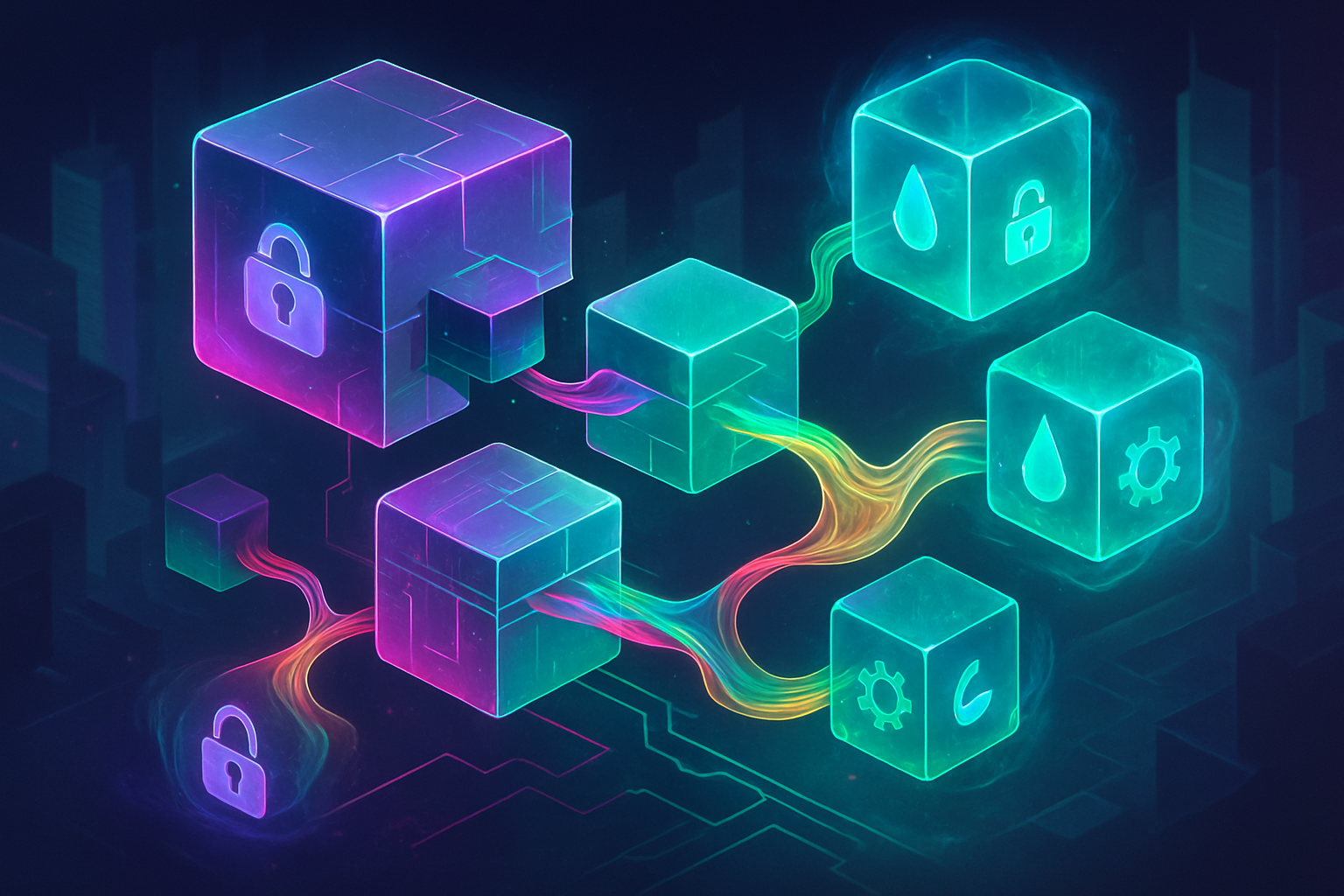
How Modular Blockchain Rollups Are Unbundling Liquidity and Security Layers: The New Landscape for DeFi Builders and Users
It feels like déjà vu: another week, another “next-generation” blockchain rollup goes live. But buried beneath the technical jargon and Twitter hype, something more fundamental is shifting. The hottest trend in blockchain isn’t just scaling—it’s unbundling. Liquidity, security, and execution, once glued together in monolithic chains, are now being pulled apart and reassembled like Lego bricks.
For developers and founders, the pitch is irresistible: launch your own customizable execution environment, pick your security guarantees, even decide whether you want to pool liquidity or keep it siloed. But for users? For DeFi protocols? The result is a landscape that’s both more flexible and more fragmented than ever before—one that raises new possibilities and new headaches in equal measure.
This is the new world of modular blockchain rollups. Here’s why it matters, how it works under the hood, and what it means for everyone from DeFi degens to institutional investors.
Modular Blockchains and the Unbundling of Layer 1s: A Primer
Not long ago, blockchains were all-in-one affairs. Ethereum, Solana, Avalanche—each bundled consensus, data availability, execution, and settlement into a single, vertically integrated system. This was great for simplicity and early adoption, but it also led to bottlenecks: every transaction competed for the same blockspace, every app shared the same risks, and network upgrades were slow and contentious.
Enter the modular blockchain thesis. Instead of building blockchains as self-contained stacks, modularity breaks the stack into specialized layers:
- Consensus: Decides the canonical order of transactions (e.g., Ethereum mainnet, Celestia).
- Data Availability: Ensures transaction data is accessible and verifiable (e.g., Celestia DA, EigenDA, Avail).
- Execution: Runs smart contracts and processes transactions (e.g., rollups like Arbitrum, Optimism, or custom “appchains”).
- Settlement: Where state transitions are finalized and disputes resolved (often the “base layer,” but increasingly flexible).
Rollups are the poster child for this approach. Instead of competing for blockspace on Ethereum, a rollup bundles transactions off-chain, posts data to a “data availability” layer, and relies on Ethereum (or another settlement layer) for security. But even within rollups, a new trend is emerging: unbundling liquidity and security. Developers are picking and choosing where these layers connect—and at what cost.
How Are Rollups Unbundling Liquidity and Security?
At the heart of this shift is a simple question: does every application need to share the same security and liquidity pool? Or can these be tailored?
Shared vs. Isolated Liquidity
- Shared liquidity: Multiple rollups or chains connect to the same settlement and data layer, allowing tokens and assets to move freely between them. This is the traditional vision for Ethereum L2s—think of Arbitrum, Optimism, and zkSync, all settling to Ethereum and (in theory) enabling easy asset movement.
- Isolated liquidity: Each rollup or “appchain” has its own pool, with custom bridges or protocols needed to move assets between them. This is common in Cosmos zones, Subnets, and emerging “app-specific” rollups.
Shared vs. Isolated Security
- Shared security: Rollups inherit security from a robust base layer (like Ethereum), piggybacking on its validator set and economic guarantees.
- Isolated security: A rollup or appchain might use its own validator set, or a smaller, delegated set (think Cosmos zones with Interchain Security, or rollups settling to non-Ethereum layers).
The modular stack lets developers mix and match:
- Want high security and easy interoperability? Settle to Ethereum, use a shared data layer, and plug into existing bridges.
- Want lower fees or custom logic? Settle to a cheaper or more customizable layer, or even build your own.
This flexibility is driving a gold rush in “rollup-as-a-service” platforms (like Caldera, Conduit, and AltLayer), data availability layers (Celestia, EigenDA, Avail), and settlement solutions (Ethereum, Polygon, even Bitcoin L2s).
Concrete Mechanisms: How Do Modular Rollups Work in Practice?
Let’s break down how these customizable rollups actually function, and what choices developers are making.
The Anatomy of a Modern Rollup
A modern rollup stack might look like this:
- Execution Layer: The rollup runs its own virtual machine (EVM-compatible, WASM, or otherwise) processing transactions and smart contracts.
- Data Availability Layer: Batched transaction data is posted to a DA layer for public verification.
- Settlement Layer: The rollup posts proofs (fraud or validity) to a settlement layer, which finalizes state changes and enforces security.
Developers now choose:
- Which DA layer? (Ethereum, Celestia, EigenDA, Avail, etc.)
- Which settlement layer? (Ethereum, Polygon, custom Cosmos chains, Bitcoin, etc.)
- How to bridge assets? (Native bridges, third-party protocols like Wormhole or Axelar, or custom solutions)
- How to incentivize validators/sequencers? (Shared staking, permissioned sequencers, decentralized sets)
Real-World Configurations
- Arbitrum Orbit: Lets projects launch their own rollup, settling to Arbitrum One or Nova (which themselves settle to Ethereum), with optional shared or isolated security.
- OP Stack (Optimism): Powers not only Optimism Mainnet but also Base (Coinbase’s L2), Zora Network, and others—each can choose which DA and settlement layers to use.
- Polygon CDK: Enables launching zk-powered chains with custom data availability and bridging, with plans for “shared liquidity” via the AggLayer.
The upshot: developers can optimize for cost, speed, sovereignty, or composability—but must also navigate new complexities in security and UX.
Case Studies: Examples and Data From the Field
Let’s look at how this trend is playing out in the wild.
1. Base (by Coinbase): Shared Security, Growing Liquidity
Base, launched by Coinbase using the OP Stack, settles to Ethereum and leverages Optimism’s shared security and bridge infrastructure. Just a year after launch, Base has surpassed $4 billion in TVL (as of June 2024, per L2Beat), with hundreds of apps and growing developer interest. Base’s focus on seamless onboarding (using Coinbase’s fiat ramps) and shared liquidity with Optimism and other OP Stack chains has made it a fast-growing ecosystem.
2. Zora Network: App-Specific, Fast-Moving
Zora, an NFT-focused chain, also uses the OP Stack but with custom features for creators and collectors. It settles to Ethereum but is experimenting with unique fee models and user experiences. Zora’s approach is more “app-specific,” prioritizing UX over maximal composability.
3. dYdX: From Shared Security to Appchain
dYdX, once one of the largest DeFi protocols on Ethereum, moved to its own Cosmos-based appchain. This gave it complete control over the execution environment and fee structure but at the cost of isolated liquidity—users must bridge assets to interact, and cross-chain composability is limited.
4. Celestia Rollups: Early Days, High Hopes
Celestia launched its modular DA layer in late 2023, with dozens of “sovereign rollups” deploying atop it. These rollups can choose their own settlement layers or operate with minimal cross-chain connectivity. TVL and usage remain modest compared to Ethereum L2s, but developer activity is surging.
Data Snapshot
- Ethereum L2 TVL (June 2024): Over $45 billion (L2Beat)
- Number of live rollups/appchains across major stacks: 100+ (aggregate estimate)
- Active users on Base, zkSync, Arbitrum, and Optimism: Each ranges from several hundred thousand to over 1 million MAU, depending on the month (various sources)
DeFi Fragmentation, Cross-Rollup Arbitrage, and the New User Experience
The modular rollup boom is a double-edged sword for DeFi.
The Good: Customization and New Opportunities
- Protocols can optimize for their specific needs—lower fees, custom governance, or unique app logic.
- Rollups can launch with targeted liquidity mining or incentives to bootstrap usage.
- Users may benefit from novel features, lower costs, or smoother onboarding (e.g., fiat onramps, gasless transactions).
The Bad: Liquidity Silos and Fragmented UX
- Fragmented liquidity: When assets are split across many rollups, AMMs and lending protocols can’t tap into the same deep pools, leading to higher slippage and less efficient markets.
- Cross-rollup arbitrage: Price discrepancies between rollups become common. Professional arbitrageurs can profit, but ordinary users may see worse execution.
- Bridging friction: Moving assets between rollups often requires bridges, which can introduce risks (smart contract bugs, exploits) and delays.
The Ugly: Composability Challenges
- “Money legos” that defined DeFi’s early days on Ethereum L1 are harder to replicate across many rollups.
- Protocols must decide whether to deploy on multiple rollups, fragmenting user bases and liquidity, or focus efforts on one stack.
Risks, Limitations, and Trade-Offs
The modular, pick-your-own-adventure approach isn’t a free lunch. Here are the main challenges:
Technical Risks
- Bridge vulnerabilities: Bridges remain prime targets for exploits—over $2 billion has been lost to bridge hacks in the past three years.
- Sequencer decentralization: Many rollups still use centralized or semi-centralized sequencers, which can censor transactions or extract MEV.
- Data availability attacks: New DA layers are still battle-testing their security. A successful attack could freeze or corrupt rollups built on top.
Economic and Liquidity Risks
- Liquidity fragmentation: Splintered pools make markets less efficient, especially for long-tail assets.
- Incentive misalignment: Competing rollups may engage in unsustainable incentive wars to attract users and capital.
Regulatory and User Risks
- Jurisdictional uncertainty: Some appchains may be more exposed to local regulations, especially if they are controlled by identifiable teams.
- UX complexity: Users now must manage multiple wallets, bridges, and networks—raising the risk of mistakes or loss.
Practical Guidance: What Should You Do Now?
Whether you’re a developer, trader, investor, or policymaker, here’s how to navigate this modular rollup world:
For Developers and Protocol Founders
- Map your priorities: Do you care more about composability and shared liquidity, or sovereignty and customization?
- Assess security trade-offs: Don’t compromise on security for marginal gains in control or cost.
- Plan for multi-chain deployment: Consider modular frameworks (OP Stack, Polygon CDK, Arbitrum Orbit) that support interoperability.
- Design for UX: Simplify bridging, onboarding, and wallet management wherever possible.
For Traders and Users
- Be bridge-savvy: Use only reputable, audited bridges. Double-check network and contract addresses.
- Watch for arbitrage: Price discrepancies create both risks (slippage, frontrunning) and opportunities (cross-rollup arbitrage).
- Stick to deep liquidity: When in doubt, prefer protocols with the largest, most active pools.
For Investors
- Monitor DA and settlement layers: The winners here may accrue value as the “base layer” for many rollups.
- Back teams with clear go-to-market: Protocols with strong distribution, incentives, and UX are more likely to gain traction.
- Diversify rollup exposure: Don’t bet on a single stack or ecosystem—each has different risks and upside.
For Policymakers and Observers
- Track cross-chain flows: Fragmentation complicates AML/KYC and surveillance—tools and standards need to evolve.
- Engage with standards bodies: Support efforts to standardize bridging, wallet UX, and security best practices.
Looking Ahead: The Next 12–24 Months
The rollup unbundling wave is just getting started. Over the next year or two, expect:
- An explosion of app-specific rollups: From DeFi to gaming to social, more projects will launch their own chains, testing the limits of liquidity fragmentation and custom UX.
- Major advances in cross-rollup interoperability: New bridge technologies, shared sequencer networks, and cross-chain messaging will make it easier—but not trivial—for assets and data to flow.
- A battle for the modular “base layer”: Ethereum, Celestia, EigenLayer, and others will compete to be the primary DA and settlement backbone for a new generation of chains.
- Continued risks and growing pains: Bridge hacks, UX friction, and regulatory uncertainty will persist, even as standards improve.
For users and builders, the stakes are high. The modular future promises more choice and innovation—but with it comes a need for vigilance, savvy, and adaptability. The next wave of DeFi won’t be built on a single chain or stack. It will be an ecosystem of chains, stitched together by new protocols and primitives, each providing trade-offs between liquidity, security, and flexibility. The winners will be those who master not just the tech, but the art of making modularity work for real users, in a world that’s never been more fragmented—or more full of possibility.
What to Do Next
- Save this guide and revisit it during your next allocation decision.
- Cross-check key metrics with public dashboards.
- Share with your team and define one execution step this week.
Recommended Next Reads
- Understanding Layer 2 Rollups:
layer-2-rollups-explained - DeFi Liquidity Fragmentation:
defi-liquidity-fragmentation - Cross-Chain Bridges and Security:
cross-chain-bridges-security
Sources and Further Reading
- Vitalik Buterin on Modular Blockchains
- Celestia: Modular Blockchain Networks
- Ethereum Foundation: Rollup-centric Roadmap
FAQ
What are modular blockchain rollups and how do they differ from traditional monolithic blockchains?
Modular blockchain rollups separate key functions like execution, settlement, and data availability, allowing developers to customize these layers instead of relying on a single, unified chain. This contrasts with monolithic blockchains, where all functions are tightly integrated, limiting flexibility.
How does the unbundling of liquidity and security layers impact DeFi protocols and users?
Unbundling allows DeFi protocols to choose between shared or isolated liquidity and security models. While this can increase flexibility and efficiency, it may also lead to liquidity fragmentation, making it harder for users to access deep markets and increasing the complexity of cross-rollup interactions.
What are the challenges and opportunities of cross-rollup arbitrage in a modular blockchain ecosystem?
Cross-rollup arbitrage offers opportunities for traders to profit from price discrepancies across rollups, but it also introduces technical challenges like bridging delays, higher transaction costs, and potential security risks. Effective arbitrage can help align prices and improve liquidity across the ecosystem.
Stay Updated
Subscribe to your site newsletter for weekly market breakdowns, tool comparisons, and risk alerts.
Leave a Reply