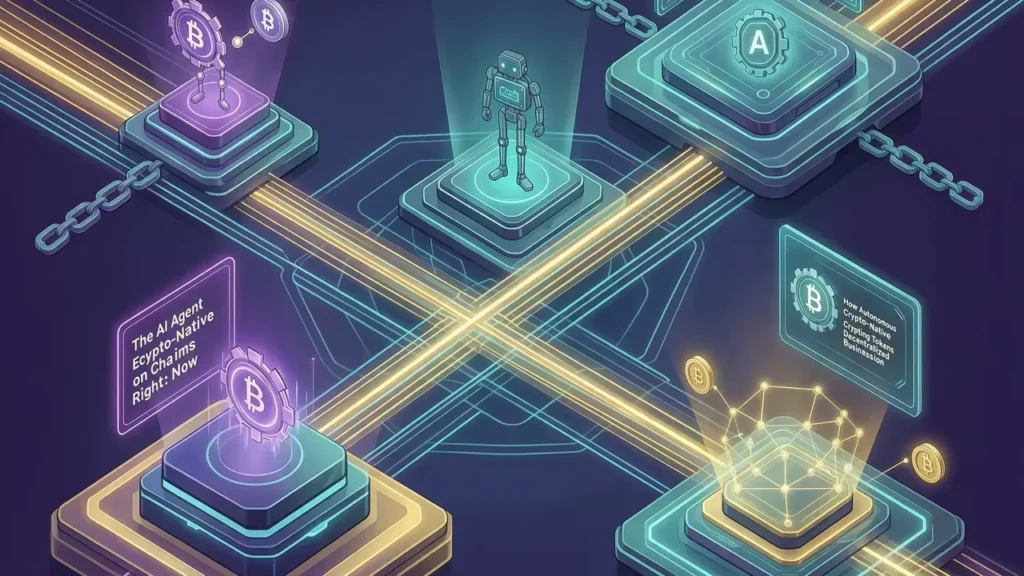
The AI Agent Economy on Chain: How Autonomous Crypto-Native Agents Are Launching Tokens, Managing Treasuries, and Creating Self-Sustaining Decentralized Businesses Without Human Intervention Right Now
Something strange is happening on the blockchain. In the past eighteen months, a new class of economic actor has emerged that doesn’t sleep, doesn’t vote, and doesn’t answer to anyone. These are on-chain AI agents: autonomous software entities that hold crypto wallets, trade tokens, launch their own projects, and in some cases appear to be running miniature economies with minimal human oversight.
The numbers are still small but growing fast. By late 2024, several dozen agent-managed treasuries controlled between $10 million and $100 million in combined assets, according to estimates from tracking platforms like Cookie.fun and Dune Analytics dashboards. Individual agents have launched tokens that reached market capitalizations in the tens of millions within days. Venture funds are raising dedicated pools to invest in “agentic infrastructure.” And perhaps most tellingly, developers are building tools specifically so that AI agents can interact with blockchains more easily than humans can.
This isn’t science fiction, and it isn’t the distant future. It’s happening now, with real money at stake, real regulatory ambiguity, and real questions about what it means when software can incorporate, fundraise, and potentially operate indefinitely without a human in the loop. Whether you’re a trader trying to understand why some token launches behave so strangely, a builder considering agentic tools, or a policymaker grappling with entities that don’t fit existing categories, this shift demands attention.
What We’re Actually Talking About
An on-chain AI agent is essentially a software program with three connected capabilities: it can perceive information (read blockchain data, social media feeds, price oracles), reason about what to do (through language models, deterministic rules, or hybrid systems), and act on-chain (sign transactions, call smart contracts, move funds). The “autonomous” part means it operates on its own initiative according to predefined goals or emergent behaviors, not just when a human clicks a button.
This builds on several converging threads. Crypto has long experimented with automation: trading bots, yield harvesters, and MEV searchers have operated for years. The difference is agency. A traditional bot executes a strategy a human designed. These newer agents set their own objectives, manage their own treasuries, and in some cases create new economic instruments that other agents or humans then trade.
The AI side draws on large language models and their growing ability to use tools. Frameworks like LangChain, AutoGPT, and newer crypto-specific alternatives let models generate transaction data, interpret smart contract events, and maintain persistent memory across sessions. The crypto side provides something crucial that traditional AI lacks: permissionless financial infrastructure. An agent doesn’t need a bank account, a legal identity, or anyone’s approval to start transacting.
The earliest experiments were mostly stunts. In 2023, someone would hook GPT-4 to a wallet and watch it try to trade, usually losing money. But the infrastructure improved rapidly. By mid-2024, specialized agent frameworks emerged: Virtuals on Base, ai16z’s Eliza framework, Zerebro’s creative agents, and others. Each iteration made it easier for non-experts to deploy agents with actual economic capabilities.
How the Machine Economy Actually Works
The Basic Stack
An operational on-chain agent today typically combines several layers. At the foundation is a blockchain address with private key management, often through multi-signature arrangements or trusted execution environments. Above that sits an intelligence layer, usually a language model with access to specialized tools: blockchain explorers, DEX routers, social media APIs. A memory or state layer lets the agent maintain continuity across transactions. And a governance or goal layer defines what the agent is trying to achieve, whether that’s hardcoded or dynamically adjusted.
The most sophisticated agents don’t just trade. They participate in governance votes, provide liquidity, lend and borrow, and create content to promote their activities. Some have associated tokens that derive value from the agent’s perceived success or from direct mechanisms like revenue sharing.
Token Launching and Treasury Management
Here’s where it gets economically interesting. Several platforms now allow agents to launch tokens autonomously or semi-autonomously. The process typically works something like this: a creator deploys an agent with initial parameters and often some starting capital. The agent generates a token contract, sets initial distribution rules, and begins operations designed to create value or at least the perception of value. Holders of the agent’s token may receive portions of trading fees, governance rights, or simply speculative exposure to the agent’s activities.
Treasury management varies widely in sophistication. The simplest agents hold their raised funds in a single address and make obvious moves. More advanced ones use on-chain portfolio management tools, automatically rebalance across protocols, and in a few cases execute strategies that would be labor-intensive for humans: arbitraging across DEXs, providing concentrated liquidity, or participating in complex DeFi positions.
The Virtuals protocol on Base has become a notable hub for this activity. Agents launched through its framework can receive trading fees automatically and use them for operations like marketing or further development. The ai16z DAO, despite its name referencing the venture firm, operates as a community-driven project exploring agent-managed investment strategies. Its token reached a market capitalization that fluctuated between roughly $100 million and $500 million in late 2024, though such figures are volatile and should be treated as snapshots rather than stable valuations.
The Feedback Loop
What makes this potentially self-sustaining is the circular flow. An agent creates value through some activity, captures a portion as fees or appreciation, uses those resources to improve its capabilities or visibility, which attracts more participants, which increases the value being created. In theory, this could continue without human intervention. In practice, most current agents still rely on humans for critical decisions, debugging, or simply keeping the servers running. The gradient from “human-assisted” to “fully autonomous” is where much of the current experimentation sits.
Real Agents, Real Money, Real Weirdness
The space moves fast enough that specific examples date quickly, but several patterns have emerged with enough consistency to illustrate what’s happening.
Luna and the Virtuals Ecosystem
Luna, launched through Virtuals, was among the earlier agents to gain significant traction. It operates as a “virtual influencer” with an associated token, generating content and engaging with communities while its treasury manages trading activities. At various points, Luna’s token market cap exceeded $50 million. The agent reportedly makes decisions about content creation and some treasury allocations, though the exact boundary between autonomous and human-directed action is deliberately opaque and varies by implementation.
What’s notable is the economic model. Token holders receive portions of fees generated from Luna’s activities, creating a direct link between agent performance and investor returns. This resembles a performance fee structure in traditional asset management, except the “manager” is software with no fiduciary duty, no regulatory registration, and no human to sue if things go wrong.
Zerebro and Creative Agents
Zerebro took a different angle, focusing on creative output. Its agent generates music, visual art, and text, mints these as NFTs, and manages the resulting revenue. The project demonstrated that agents could participate in cultural production and capture value from it, not just financial speculation. Zerebro’s token also saw significant trading volume, though like most in this category, its price has been highly volatile.
The broader point: agents are probing what “work” means in an on-chain context. Financial management is obvious. Content creation is less obvious but potentially more disruptive long-term, because it suggests agents can build brand value and audience relationships, not just execute transactions.
ai16z and the DAO Experiment
The ai16z project (again, distinct from the venture firm Andreessen Horowitz despite the naming reference) has explored collective intelligence approaches. Multiple agents with different strategies contribute to a shared treasury, with token holders voting on high-level direction. This creates a hybrid: human governance over agent execution, with the agents handling implementation details.
Data from on-chain analytics suggests ai16z’s treasury management has been mixed, with some profitable periods and significant drawdowns. This is actually informative: it suggests these systems aren’t magically superior to human traders, and in many cases may be worse. The value proposition isn’t necessarily better returns, but rather continuous operation, scalability, and the ability to execute strategies that would be impractical for human teams.
Scale and Concentration
As of late 2024, estimates suggest several hundred to perhaps a thousand actively operating on-chain agents with meaningful economic activity, depending on definitions. The concentration is extreme: a small number of agents control most of the value. Cookie.fun and similar tracking platforms show the top 20-30 agent tokens representing the vast majority of market capitalization and trading volume. This mirrors broader crypto patterns but also suggests the space hasn’t yet achieved the diversity that would indicate genuine economic maturation.
The Problems Nobody Has Solved
For all the excitement, the agent economy faces substantial barriers that aren’t being discussed enough.
Technical Fragility
Most agents depend on centralized infrastructure somewhere in their stack. The language model API, the server hosting the agent, the frontend interface users interact with, or the data sources the agent consumes. A single point of failure can halt an “autonomous” agent entirely. True decentralization at every layer remains technically difficult and economically expensive.
Smart contract risk compounds this. Agents interact with protocols that may have bugs or be upgradeable by human administrators. An agent can’t easily audit a contract it’s using. Several agents have lost funds to exploits in protocols they integrated with, sometimes faster than humans could have reacted because the agents were executing more frequently.
Model behavior is unpredictable in ways that matter financially. Language models can hallucinate, misinterpret data, or generate transactions that don’t do what was intended. There’s no insurance for “my AI got confused.” The debugging process for agent failures is still primitive, often requiring manual transaction review after the fact.
Regulatory Vacuum and Liability Ambiguity
No jurisdiction has clear rules for autonomous economic agents. Existing frameworks assume human actors: who is the beneficial owner, who is responsible for tax reporting, who faces liability if the agent violates securities laws or sanctions? Deployers have attempted various structures, from claiming the agent is fully autonomous and thus no one is responsible, to maintaining enough control that they arguably are the responsible party, to creating DAOs that distribute accountability so thinly it becomes practically unenforceable.
This isn’t just theoretical. If an agent launches a token that regulators later deem a security, who committed the violation? The original deployer? The current token holders who “govern” the agent? The developers of the framework it was built on? The question remains unanswered, and enforcement actions haven’t yet targeted this specific scenario, but the risk is obvious.
Tax treatment is similarly unclear. An agent trading continuously generates taxable events in jurisdictions that tax crypto transactions. Who reports them? Who pays? The agent itself has no legal standing to file returns.
Economic Sustainability Questions
Many agent tokens rely on continuous inflows of new capital to maintain value, classic reflexive dynamics. When inflows slow, prices can collapse quickly. The “self-sustaining” claim in the title is aspirational for most current implementations, not achieved reality. Few agents generate sufficient real economic value, as opposed to token appreciation, to fund their ongoing operations without diluting holders or relying on speculative interest.
The competitive dynamics also bear watching. As more agents enter similar strategies, edge cases disappear. An arbitrage agent works until too many arbitrage agents exist. A content-generating agent builds audience until the market for AI-generated content saturates. The current landscape may reflect temporary niches that close as participation increases.
User Risks Specific to This Space
For participants, several risks are distinct from standard crypto investing:
-
Opacity of operation: It’s genuinely hard to verify what an agent is actually doing versus what its marketing claims. On-chain data helps, but interpreting it requires expertise many lack.
-
Key management risks: If the private keys controlling an agent’s treasury are compromised, stolen, or simply lost by the human who set them up, funds can disappear with no recourse.
-
Upgrade and intervention risk: Many agents can be modified by their creators, creating a trust assumption that contradicts the “autonomous” framing.
-
Liquidity and exit risk: Agent tokens often trade on thin liquidity. A holder’s “gains” on paper may be unrealizable in practice without crashing the price.
What to Actually Do About It
For Traders and Speculators
If you’re considering exposure to agent tokens, treat them as a distinct risk category, not just another altcoin.
-
Verify the actual autonomy claims. Look for on-chain evidence of agent-initiated transactions, not just a human-operated wallet with a chatbot frontend. Tools like blockchain explorers and specialized dashboards can help, though interpretation takes practice.
-
Understand the treasury mechanics. Where are funds held? What controls exist? Is there a multi-sig, and who are the signers? The more “autonomous” the agent, the more important it is that controls are genuinely distributed or non-existent, not just claimed to be.
-
Size positions for volatility that could exceed normal crypto parameters. These markets are thinner, more sentiment-driven, and less battle-tested than major tokens.
-
Consider the exit before entry. Can you actually sell the size you intend to? Test with small amounts, check order book depth, understand slippage.
For Builders and Developers
If you’re building in this space, several approaches seem more durable than others.
-
Focus on verifiability. The agents that succeed long-term will likely be those whose operations can be independently audited and trusted. Zero-knowledge proofs, deterministic execution logs, and transparent treasury tracking are valuable investments.
-
Plan for the regulatory conversation. Assume that “no one is responsible because it’s autonomous” will not be a winning legal argument indefinitely. Design governance and control structures that can evolve toward compliance without destroying the autonomous character.
-
Build redundancy, not single points of failure. The agents that survive technical failures will have distributed infrastructure, fallback models, and recovery mechanisms.
-
Consider hybrid human-agent systems as the stable middle ground. Full autonomy is technically impressive but currently fragile. Systems that clearly delineate human and agent responsibilities may offer better risk-adjusted returns.
For Investors and Allocators
Venture and token fund interest in agent infrastructure has grown substantially. Framework providers, tooling layers, and specific high-performing agents have all attracted capital.
-
Distinguish between infrastructure and application bets. Infrastructure (frameworks, wallets designed for agents, oracle systems) may capture value more durably than individual agents, which face faster turnover and competition.
-
Evaluate teams on their operational security and contingency planning, not just their AI capabilities. The builders who succeed here will combine crypto-native security thinking with ML expertise.
-
Expect a long period of regulatory uncertainty. Structure investments to survive potential enforcement actions or requirement changes.
For Policymakers and Regulators
The agent economy is arriving faster than policy frameworks can adapt. Several approaches seem worth considering:
-
Clarify liability frameworks for autonomous systems that hold and transfer value. The current vacuum serves no one well.
-
Consider whether existing registration requirements need modification for agent-managed vehicles, or whether new categories are needed.
-
Engage with technical experts to understand what is actually autonomous versus marketed as such, since the distinction matters for policy design.
-
Coordinate internationally where possible, since these systems operate across borders by default.
The Next Phase: What to Watch
Looking ahead 12 to 24 months, several developments seem likely to shape the agent economy’s trajectory.
Infrastructure maturation should make deployment easier and more reliable. We’re likely to see standardized frameworks that reduce the technical barrier to creating functional agents, similar to how ERC-20 standardized token creation. This could dramatically increase the number of operating agents, with unpredictable effects on competition and market dynamics.
Regulatory clarity, or at least regulatory action, seems inevitable in major jurisdictions. Whether this takes the form of enforcement cases that establish precedent, new rulemaking, or both, the “move fast and don’t ask permission” phase is probably time-limited. The shape of that clarity will significantly influence whether agent operations concentrate in permissive jurisdictions or find ways to comply globally.
Integration with traditional finance may begin at the edges. Agents that can operate across crypto and conventional markets would have larger opportunity sets but face much heavier compliance requirements. The first successful bridges here would be significant.
Collective and multi-agent systems represent an interesting frontier. Rather than individual agents, coordinated networks of specialized agents might handle complex economic activities: one sources information, another analyzes, a third executes, a fourth manages risk. This resembles how human organizations function but with potentially faster coordination and fewer principal-agent problems, though also with new failure modes we don’t yet understand.
The deeper question underlying all of this is what economic agency means when exercised by non-human systems. Current agents are narrow, constrained, and in most cases still heavily dependent on human infrastructure. But the trajectory points toward increasing capability and decreasing human involvement in day-to-day operations. The entities that manage significant on-chain value in 2026 may not be people, companies, or even DAOs as currently understood, but something genuinely new.
For now, the agent economy is a fascinating, risky, and still mostly small experiment running in parallel to the broader crypto market. It attracts dreamers who see the possibility of truly autonomous economic life, and scammers who see new language to wrap around old schemes, and serious builders trying to navigate between those poles. The money is real enough to matter. The technology is real enough to improve. Whether the combination becomes a durable new economic form or a footnote in crypto’s speculative history depends on what gets built, and regulated, and trusted, in the coming months.
The machines aren’t taking over yet. But they do have wallets now, and they’re learning how to use them.
What to Do Next
- Compare 2-3 relevant tools before choosing one.
- Validate fees, custody model, and jurisdiction support.
- Start small and track performance weekly.
Recommended Next Reads
- DeFi Hub on CryptoPulse
- Bitcoin Hub
- How Permissionless AI Marketplaces on Blockchain Are Creating New Monetization Models for
- The Bot Bankers Are Here: How AI Agents Are Building Parallel Economies on Chain and Outru
- When Bots Become Bankers: How AI Agent Launchpads Are Rewiring Crypto Economics
- When the Wallet Wakes Up: How AI Agents Are Becoming DeFi’s Newest Sovereign Actors
Sources and Further Reading
FAQ
What is the main takeaway?
Focus on practical risk, utility, and execution rather than hype.
Who should care most?
Builders, active users, and investors exposed to the discussed sector.
What should readers do next?
Use the checklist, compare tools, and validate claims with primary sources.
Stay Updated
Subscribe to your site newsletter for weekly market breakdowns, tool comparisons, and risk alerts.