
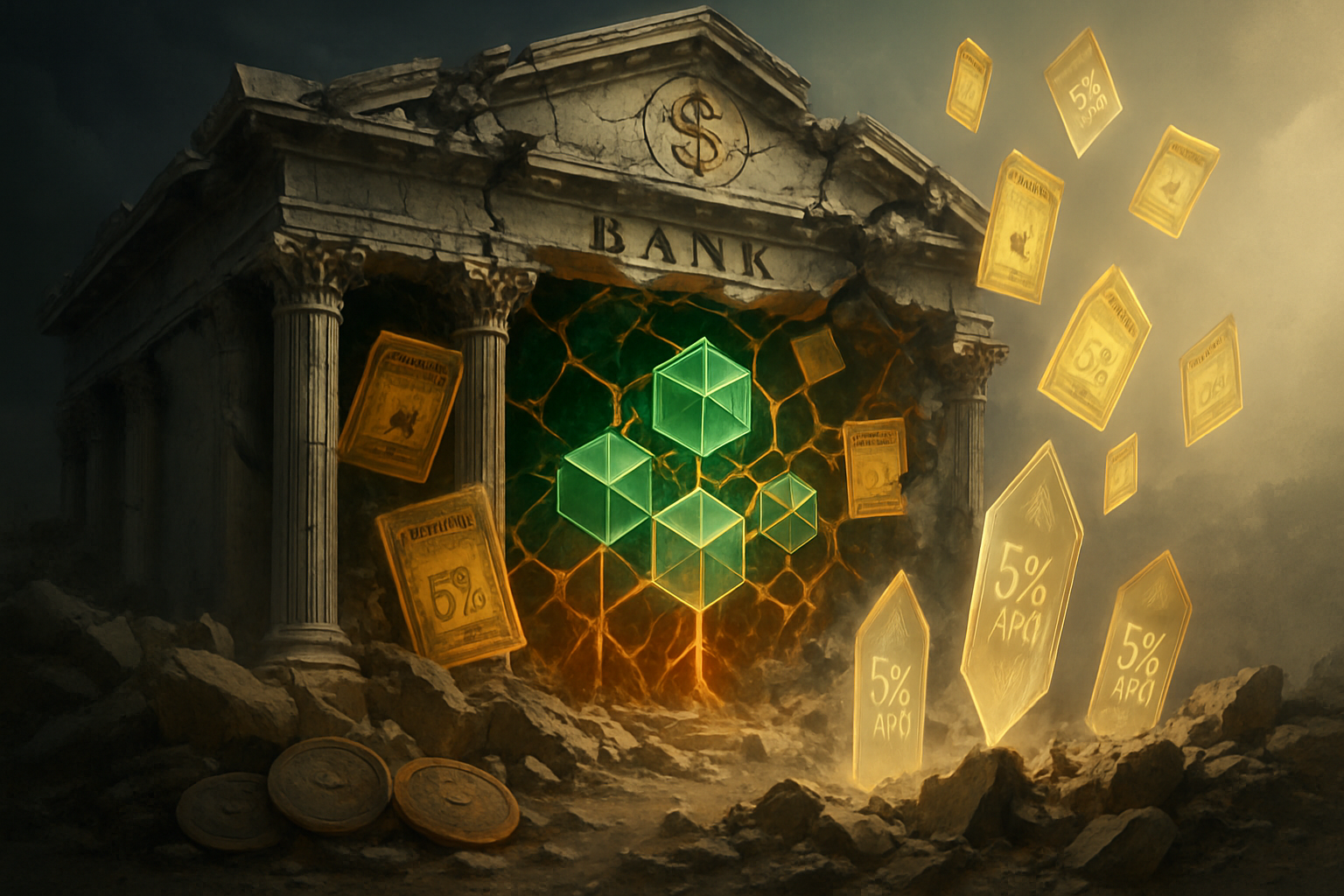
The End of Free Money: How Tokenized Treasuries Are Dismantling the Stablecoin Empire
For years, the deal was simple. You parked your dollars in USDT or USDC, and the issuers pocketed the yield. Tether and Circle sat on hundreds of billions in Treasury bills and reverse repos, collected the interest, and kept it all. Users got price stability, instant settlement, and access to DeFi. What they didn’t get was a dime of the risk-free return their own collateral was generating.
That arrangement worked fine when rates hovered near zero. Nobody cared much about forfeiting 0.1% APR. But with Treasury yields holding above 4.5% and money market funds paying 5% or more, the math has turned brutal. A billion dollars in USDC now represents roughly $50 million in annual yield that Circle captures entirely. Multiply across the $170 billion stablecoin market, and you’re looking at perhaps $7-8 billion in yearly income flowing to issuers while users eat opportunity cost.
The walls are finally cracking. BlackRock’s BUIDL fund, Franklin Templeton’s OnChain U.S. Government Money Fund, and Circle’s own USYC product are offering something radically different: tokenized, on-chain exposure to actual Treasury and money market instruments, with yield passing through to holders. These aren’t stablecoins in the traditional sense, but they’re increasingly filling the same functional role while paying users what they previously gave up. The stablecoin trilemma, that stubborn tradeoff between capital efficiency, decentralization, and price stability, is being solved not by better algorithmic design but by traditional finance barging onto the blockchain with better economics.
What Tokenized Money Market Funds Actually Are
Let’s get precise about the mechanics before diving into implications.
A tokenized Treasury or money market fund is a regulated investment vehicle whose shares exist as digital tokens on a blockchain. Each token represents a fractional claim on a pool of short-term U.S. government debt, typically T-bills with maturities under one year, plus maybe some overnight repo. The underlying assets sit with custodians like BNY Mellon or State Street. The tokens themselves trade on-chain, settle in minutes, and can integrate with smart contracts.
This differs fundamentally from conventional stablecoins in two ways. First, the net asset value fluctuates slightly, typically within a tight band around $1.00, because the fund holds actual securities that accrue interest daily rather than promising a fixed redemption value. Second, and crucially, the yield flows to token holders, not the issuer.
BlackRock’s USD Institutional Digital Liquidity Fund, ticker BUIDL, launched in March 2024 on Ethereum with seeding from Securitize. It holds cash, T-bills, and repo agreements. Minimum investment is $1,000, a dramatic drop from traditional institutional fund minimums. Franklin Templeton’s FOBXX, trading as BENJI tokens, has been running since 2021 and recently expanded to additional blockchains. Circle’s USYC, introduced in late 2024, represents a particularly interesting case, a stablecoin issuer itself pivoting to yield-bearing products.
These products occupy a regulatory middle ground. They’re securities under U.S. law, meaning issuers must register with the SEC, file periodic reports, and restrict transfers to verified investors in many cases. The compliance overhead is substantial. But the payoff is legitimacy: these funds don’t face the existential legal uncertainty that shadows USDT and USDC.
The Stablecoin Trilemma and Why It Mattered
The “stablecoin trilemma” refers to the apparent impossibility of simultaneously achieving three goals: price stability (peg maintenance), capital efficiency (not overcollateralizing), and decentralization (no single point of control or censorship).
Algorithmic stablecoins like the failed Terra/Luna system pursued capital efficiency and decentralization, abandoning stability. Crypto-collateralized stablecoins like DAI achieved stability and some decentralization but require massive overcollateralization, making them capital-inefficient. Fiat-backed stablecoins like USDT and USDC nailed stability and efficiency but centralized control with issuers who could freeze funds, blacklist addresses, and unilaterally change terms.
For most practical purposes, the market chose stability and efficiency over decentralization. USDT and USDC dominated. The trilemma seemed resolved by simply accepting centralization as the cost of doing business.
What tokenized money market funds reveal is that this resolution was always temporary and economically exploitative. Users accepted centralization not because they valued issuer control, but because no alternative offered comparable stability with functional DeFi integration. The yield extraction was a hidden tax, invisible when rates were zero, increasingly intolerable as they rose.
The new products don’t fully decentralize, BlackRock and Franklin Templeton remain centralized entities. But they redistribute the economic surplus. Users now capture the yield their capital generates, which changes the competitive calculus entirely.
The Numbers: How Big, How Fast, How Real
Tokenized Treasury and money market products have grown from negligible amounts in 2022 to roughly $15-20 billion in total value locked as of early 2025, depending on measurement definitions. That’s still small against the $170 billion stablecoin market, but the growth trajectory matters more than absolute size.
BlackRock’s BUIDL crossed $500 million within months of launch and reportedly approached $1 billion by late 2024. Franklin Templeton’s FOBXX, with a longer track record, sits in similar territory. Circle’s USYC, despite launching later, benefits from existing distribution through Circle’s infrastructure and partnerships.
More revealing than AUM figures is usage patterns. BUIDL tokens have been integrated as collateral in DeFi protocols including Curve and, through various structuring arrangements, in lending markets. Ondo Finance’s OUSG, which tokenizes BlackRock’s BUIDL into a more accessible form, has seen significant adoption as a collateral asset. The composability is real, if still limited compared to USDC.
The yield differential is stark. As of early 2025:
- Traditional stablecoins in DeFi lending: 2-4% variable, with smart contract risk
- Tokenized T-bill products: 4.5-5.2%, with fund-level risk and regulatory compliance
- Direct money market funds (off-chain): 4.8-5.3%, with two-day settlement and no DeFi access
The on-chain tokenized products split the difference, offering most of the yield with most of the blockchain functionality. For treasury managers, DeFi protocols, and sophisticated holders, this is increasingly irresistible.
Tether’s reported $13 billion profit for 2024, largely from Treasury yield on unremunerated liabilities, illustrates what’s at stake. Every dollar migrating from USDT to BUIDL or USYC represents yield Tether no longer captures. Circle, more attuned to competitive pressure, moved first with USYC, essentially cannibalizing its own stablecoin business before someone else did.
Why Incumbents Are Trapped
USDT and USDC face a structural bind that won’t yield to simple product tweaks.
Tether’s model depends on yield extraction. The company has no equity investors to answer to in traditional ways, operates from El Salvador with limited regulatory transparency, and has built an extraordinarily profitable business on the spread between what it earns and what it pays, which is zero. Distributing yield to USDT holders would eliminate most of that profit. Tether has experimented with loyalty programs and gold-backed variants, but a true yield-bearing USDT would require transforming its entire capital structure.
Circle’s position is more complex and more precarious. As a U.S.-regulated entity preparing for or pursuing public market access, it faces pressure to demonstrate sustainable economics. Yet its primary product, USDC, is commoditized. Paying yield would require SEC registration as an investment company or similar structure, fundamentally changing USDC’s regulatory treatment. USYC represents Circle’s attempt to capture the yield-bearing segment without destroying USDC’s utility as a payment token. Whether this two-product strategy works depends on whether users actually want non-yielding stablecoins for anything beyond short-term settlement.
The deeper problem for both issuers is that their core innovation, blockchain-based dollar transfer, has been separated from their economic moat, which was always regulatory arbitrage and scale advantages in custody. Tokenized funds replicate the blockchain functionality while offering superior economics. The moat is filling in.
Real-World Adoption and Use Cases
The migration isn’t hypothetical. Several concrete patterns are emerging.
DeFi protocol treasuries: Protocols like Arbitrum and Optimism hold substantial stablecoin reserves for ecosystem development. Some have begun converting portions to yield-bearing tokenized instruments, treating them as “enhanced cash” rather than operational balances. The composability challenge, how to use these assets in governance or grants while earning yield, remains active but solvable.
Corporate treasury management: Companies with crypto-native balance sheets, exchange operators, mining firms, and blockchain foundations, face the same yield forfeiture as individual holders. Several have publicly disclosed or been reported to hold tokenized T-bill positions. The 5% pickup on a $100 million treasury is $5 million annually, material even for large entities.
On-chain lending collateral: This is where the competitive threat becomes existential for stablecoins. If BUIDL or USYC becomes acceptable collateral in major lending protocols, borrowers can post yield-generating assets to borrow against, reducing the net cost of leverage. USDC posted as collateral generates nothing. The same value in USYC generates 5%. Over time, rational actors migrate.
Cross-border settlement: A less visible but significant use case involves international businesses using tokenized instruments for B2B payments where the value remains in dollars for days or weeks between receipt and deployment. The yield accrual during holding periods, previously captured by correspondent banks or stablecoin issuers, now flows to the transacting parties.
Ondo Finance deserves mention as an important intermediary. By wrapping BUIDL into OUSG with additional liquidity provisions and DeFi integrations, Ondo has effectively created a “stablecoin-like” instrument that pays yield while maintaining broader usability than the underlying fund shares. This layering suggests how the ecosystem may evolve, with specialized protocols handling the translation between regulated fund structures and DeFi’s permissionless environment.
Risks, Limitations, and What Could Go Wrong
The yield isn’t free, and the products aren’t magic. Several categories of risk deserve careful attention.
Regulatory and compliance risk
Tokenized funds are securities, full stop. This means:
- Transfer restrictions may apply, requiring KYC/AML verification for holders
- Secondary trading can trigger broker-dealer registration requirements
- Cross-border distribution faces complex jurisdictional questions
- The SEC has not provided comprehensive guidance, leaving enforcement risk
Some products maintain “whitelists” of approved addresses, breaking composability with permissionless DeFi. Others use structuring workarounds of uncertain durability. A regulatory crackdown or clarification that restricts on-chain transferability would significantly impair utility.
Technical and operational risk
Smart contract vulnerabilities in tokenization infrastructure, bridge protocols, or DeFi integrations could lead to losses unrelated to the underlying Treasury assets. The multi-party custody chains, issuer, transfer agent, custodian, blockchain oracle, create operational complexity and potential failure points.
Liquidity and redemption risk
Unlike stablecoins promising immediate 1:1 redemption, money market funds process redemptions with timing that varies by structure. Some tokenized products offer same-day settlement; others may take 24-48 hours for large redemptions. During market stress, gates or liquidity fees could apply, though this is rare for government money market funds.
Yield compression risk
The entire value proposition depends on elevated short-term rates. If the Federal Reserve returns to near-zero policy, the 5% yield compresses toward zero, and the competitive pressure on stablecoin issuers diminishes. This is a genuine scenario, though perhaps less likely in the near term than previously assumed.
Concentration and counterparty risk
BlackRock and Franklin Templeton are systemically important entities, but concentration among few providers creates systemic vulnerability. The “BlackRock of blockchains” joke contains a real concern about whether we’re simply replicating traditional finance’s too-big-to-fail structure on new infrastructure.
Tax and accounting complexity
Yield from tokenized funds is typically ordinary income, not capital gains, and may require specialized reporting. The daily accrual mechanics create tracking challenges. Institutional adopters need robust accounting integration that many lack.
Practical Guidance: What to Actually Do
For different participants, the strategic response varies.
For individual holders and traders
-
Audit your stablecoin holdings: Calculate what you’re forfeiting. $10,000 in USDC at 5% forgone yield is $500 annually, more than most credit card rewards programs.
-
Understand the tradeoffs: Tokenized funds aren’t drop-in replacements. Check whether your exchange, wallet, or DeFi protocol supports them. Verify redemption mechanics and any holding period requirements.
-
Consider hybrid approaches: Maintain operational balances in traditional stablecoins for immediate needs, move longer-term holdings to yield-bearing instruments. The break-even depends on your transaction frequency and the specific products’ liquidity.
-
Tax planning: Consult a crypto-knowledgeable tax advisor. The yield characterization matters for timing and rate.
For DeFi builders and protocol developers
-
Evaluate collateral integration: Adding USYC or BUIDL as collateral types could attract treasury deposits and improve protocol economics. The technical integration is usually straightforward; legal review of whether your protocol triggers securities law is not.
-
Build yield-passing mechanisms: If you maintain protocol-owned liquidity or insurance funds, holding tokenized instruments rather than stablecoins directly improves sustainability.
-
Prepare for fragmentation: The stablecoin market may bifurcate between payment-optimized and yield-optimized instruments. Design for interoperability rather than assuming a single dominant dollar token.
For institutional treasury managers
-
Pilot programs: Most major tokenized funds accept substantial minimums but offer test allocations. The operational learning, custody setup, accounting integration, is nontrivial and benefits from early experimentation.
-
Counterparty diversification: Don’t concentrate with a single issuer or blockchain. The products are new enough that failure modes remain partially unknown.
-
Policy documentation: Update investment policies to explicitly address digital asset holdings. Regulators and boards increasingly expect this.
For policymakers and regulators
-
Clarify the boundary: The distinction between payment stablecoins and yield-bearing tokenized funds needs clearer regulatory treatment. Current ambiguity stifles innovation and compliance simultaneously.
-
Consider competitive implications: U.S. regulatory posture affects whether dollar-denominated blockchain instruments remain dominated by American entities or migrate offshore. The stakes for dollar internationalization are real.
-
Investor protection calibration: Securities regulation appropriate for unsophisticated investors may overfit for blockchain-native users. Tailored frameworks, perhaps through safe harbors or limited-purpose designations, could improve outcomes.
The Next 12-24 Months: Scenarios and Trajectories
Several developments seem probable, though timing remains uncertain.
Yield-bearing instruments capture 15-25% of current stablecoin market value. This implies $25-40 billion in tokenized money market products, up from roughly $15-20 billion now. The migration accelerates if rates stay elevated and major DeFi protocols complete collateral integrations.
USDC undergoes significant structural change. Circle likely faces a strategic decision: continue competing as a commodity payment token with thinning margins, or transform toward a yield-distribution model that requires different regulatory treatment. The USYC experiment will inform this choice. A public listing, if it occurs, would intensify pressure for visible growth and profitability.
Tether’s market share erodes from above 60% toward 50% or below. This isn’t collapse; Tether retains enormous utility in specific corridors and among users prioritizing pseudonymity. But the yield-sensitive institutional and DeFi segments migrate, and the growth story stalls.
Regulatory clarity arrives, unevenly. The U.S. likely enacts stablecoin legislation that distinguishes payment tokens from securities, potentially requiring yield-bearing products to register under Investment Company Act provisions. Europe’s MiCA framework may offer earlier clarity, creating regulatory arbitrage opportunities. Asia’s varied approaches continue fragmenting the global market.
New hybrid products emerge. The most interesting innovations may combine instant redemption with yield passthrough, perhaps through structured products or insurance wrapping. These attempt to capture stablecoin-like usability with fund-like economics, though they introduce complexity and potential regulatory reclassification.
The “stablecoin” category itself fragments. We may stop using the term as a single category, instead distinguishing payment tokens, yield instruments, synthetic dollars, and collateralized debt positions. The umbrella was always too broad; economic differentiation forces precision.
What won’t happen is a simple replacement of USDT by BUIDL. The use cases differ, the user bases overlap only partially, and regulatory constraints prevent seamless substitution. But the directional pressure is unmistakable. The era of free money for stablecoin issuers, and free money from central banks that enabled user indifference, is ending simultaneously. The blockchain dollar is becoming a competitive market where yield flows to capital rather than intermediaries.
For a decade, crypto promised to disintermediate traditional finance. In this corner of the market, traditional finance is disintermediating crypto’s own intermediaries. The irony shouldn’t obscure the substance: users are finally getting paid for the use of their money. The rest is detail, negotiation, and the messy work of building new financial infrastructure on old regulatory foundations.
What to Do Next
- Save this guide and revisit it during your next allocation decision.
- Cross-check key metrics with public dashboards.
- Share with your team and define one execution step this week.
Recommended Next Reads
- Crypto security basics:
/category/cybersecurity/ - DeFi risk management:
/category/defi/ - Blockchain technology explainers:
/category/blockchain-technology/
Sources and Further Reading
FAQ
What is the main takeaway?
Focus on practical risk, utility, and execution rather than hype.
Who should care most?
Builders, active users, and investors exposed to the discussed sector.
What should readers do next?
Use the checklist, compare tools, and validate claims with primary sources.
Stay Updated
Subscribe to your site newsletter for weekly market breakdowns, tool comparisons, and risk alerts.
Leave a Reply