
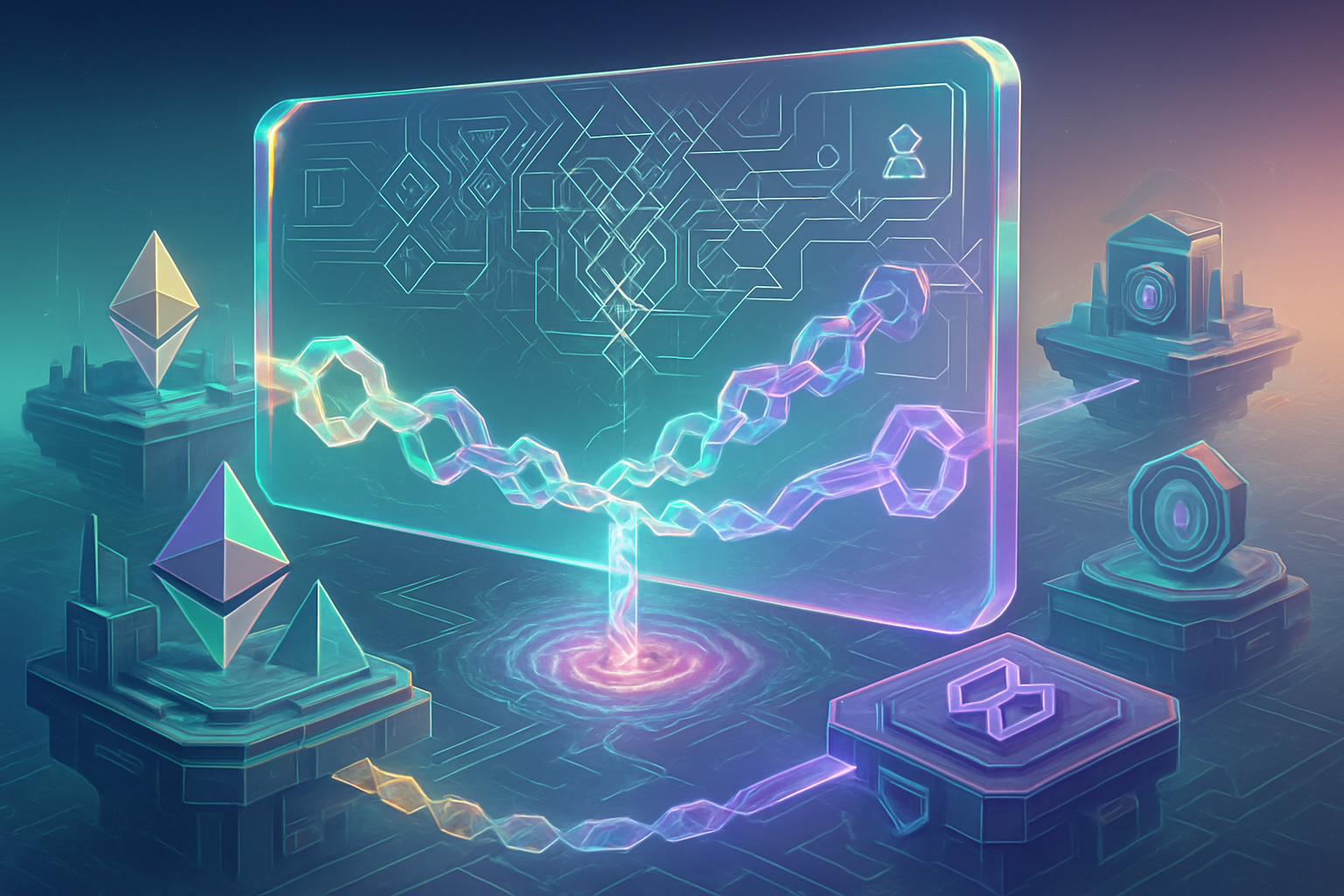
Chain Abstraction Explained: How Unified Crypto Interfaces Are Streamlining Multi-Chain Access, Bridging User Fragmentation, and Powering the Next Phase of DeFi Growth Today
The crypto world is teeming with activity. Every week, new blockchains, rollups, and appchains launch, each promising faster transactions, lower fees, or some unique feature. Yet, beneath this vibrant innovation, a stubborn problem has festered: fragmentation. For users, developers, and investors alike, the explosion of chains has made navigating DeFi more like hopping between isolated islands than exploring a connected ecosystem.
If you’ve ever tried to move your tokens from Ethereum to Arbitrum, swap assets on Solana, or manage your NFT portfolio across Polygon and Base, you’ve felt the friction firsthand. Each chain has its own wallets, tokens, bridges, and quirks—creating a confusing, error-prone mess for even experienced hands. For newcomers, it’s often a non-starter.
But that’s changing. A new movement—chain abstraction—is gaining momentum, promising to flatten the landscape and make the underlying blockchain rails fade into the background. Think of it as the “one interface to rule them all” moment for crypto: a way to interact with any chain, from any wallet or app, without worrying about technical differences. And it’s not just hype. Early implementations are already live, quietly eating away at the pain points that have held DeFi back.
So what is chain abstraction, why is it arriving now, and what does it actually mean for users, builders, and the future of open finance? Let’s dig in.
Background: The Rise of Multi-Chain Chaos
To understand the push for chain abstraction, you have to grasp how we got here.
Crypto’s earliest days were simple: Bitcoin, then Ethereum, each with their own communities and rules. But by 2024, the landscape has exploded. There are now hundreds of layer-1s and layer-2s, each optimized for different use cases—Ethereum for security and composability, Solana for speed and throughput, Cosmos and Polkadot for application-specific chains, Avalanche for subnet flexibility, and so on. Layer-2 scaling solutions like Optimism, Arbitrum, and zkSync have further splintered liquidity and user attention.
The result? Even simple tasks—like swapping tokens or using a DeFi lending protocol—can require juggling multiple wallets, bridging assets, paying different gas tokens, and learning new interfaces. For developers, building dApps that work seamlessly across chains means wrestling with different APIs, state models, and sometimes even programming languages.
Previous attempts to solve this—like bridges and aggregators—have helped, but only partially. They often expose users to extra risk, add latency, or require still more manual steps. The real breakthrough is arriving with chain abstraction: the idea that the complexity of chains should be invisible to users and developers alike.
What Is Chain Abstraction? The Big Idea
At its heart, chain abstraction is about making blockchain infrastructure modular and interchangeable. It means designing wallets, apps, and protocols so users don’t have to care which chain they’re on—or even know what a chain is.
Here’s what that looks like in practice:
– Unified Wallets: A user can use a single wallet interface to hold, send, and receive assets from any chain. The wallet handles the complexity behind the scenes.
– Cross-Chain dApps: Decentralized apps work identically regardless of which chain the user’s assets are on. The app abstracts away chain-specific details (like gas tokens or transaction formats).
– Seamless Asset Movement: Assets can be moved, swapped, or interacted with across chains in one click, without the user worrying about bridges, relayers, or manual steps.
– Programmable Interoperability: Developers can write smart contracts or dApps that interact with multiple chains using a single toolkit or API.
If this all sounds a lot like the early days of the internet—when you needed to know which network a site was on, until browsers and TCP/IP made it seamless—that’s no accident. Chain abstraction is to blockchains what TCP/IP was to networking: an invisible layer that makes everything “just work.”
Why Now? Catalysts and Convergence
Several forces have converged to make chain abstraction both necessary and possible.
1. The End of Single-Chain Dominance
For most of crypto’s history, Ethereum was the default home of DeFi. But as gas fees soared and throughput bottlenecks emerged, users and projects began migrating to alternative chains and L2s. In 2023–2024, Ethereum’s share of DeFi TVL dropped below 50% for the first time, with Solana, BNB Chain, Arbitrum, and others picking up the slack. Liquidity and innovation are now genuinely multi-chain.
2. User Experience Crisis
For retail users, the proliferation of chains has made crypto harder, not easier. Newcomers face a dizzying array of wallets, network settings, and token standards. Even experienced users make costly mistakes—sending tokens to the wrong chain, losing assets to buggy bridges, or getting phished by fake cross-chain tools.
3. Maturing Infrastructure
Key building blocks for chain abstraction have arrived:
– Account abstraction (ERC-4337 and others) makes wallets programmable and upgradeable, so they can support complex actions across chains.
– Generalized messaging protocols like LayerZero, Wormhole, and Axelar allow data and value to move securely between chains.
– Intent-based architectures (e.g., UniswapX, CowSwap) let users express what they want to do, and let the backend figure out the best way to execute—regardless of which chain the assets are on.
4. Institutional and Developer Demand
Enterprises and mainstream developers want to build apps that “just work,” without managing a spaghetti of chain-specific integrations. As Web3 moves beyond early adopters, the tolerance for janky UX has evaporated.
How Chain Abstraction Works: Mechanisms and Technologies
Chain abstraction isn’t a single product or protocol—it’s an emerging design pattern. Let’s unpack the main mechanisms powering this shift.
Unified Wallets and Account Abstraction
Projects like Safe (formerly Gnosis Safe), ZeroDev, and Candide are turning wallets into programmable smart accounts. These “smart contract wallets” can:
– Aggregate balances across chains
– Pay gas in any token (not just the native token of each chain)
– Batch multiple transactions (even across chains) into a single action
– Add recovery and security features
Account abstraction allows wallets to act as a user’s “control center,” coordinating actions behind the scenes without constant manual intervention.
Cross-Chain Messaging and Interoperability
Protocols like LayerZero, Wormhole, Axelar, and Hyperlane are building the “plumbing” for secure communication between chains. They let dApps and wallets:
– Transfer assets directly between chains without using legacy bridges
– Synchronize data (e.g., balances, contract states) in real time
– Trigger actions on one chain based on events on another
These protocols are moving from simple asset bridges to generalized messaging layers, making true cross-chain composability viable.
Intent-Based Execution
Instead of requiring users to specify how a transaction should happen, intent-based protocols let users specify what they want to achieve (“swap X for Y at the best rate, wherever it exists”). The backend—powered by solvers and aggregators—finds the optimal route, which may span multiple chains, bridges, or liquidity sources.
UniswapX, CowSwap, and others are pioneering this model. It’s a paradigm shift: users focus on outcomes, not technical steps.
Chain-Agnostic Application Layers
Emerging frameworks (e.g., Socket, Li.Fi) let developers build dApps that work across chains by default. These toolkits handle the messy details—chain selection, bridging, gas abstraction—so apps can offer a consistent experience.
Real-World Examples: Chain Abstraction in Action
These concepts aren’t vaporware—they’re already reshaping DeFi and crypto UX. Here’s how:
1. Smart Wallets: Safe, Candide, and ZeroDev
Safe is the leading smart contract wallet, now securing billions in assets. With recent upgrades, Safe accounts can interact with multiple chains, aggregate balances, and even pay gas fees in ERC-20 tokens. Candide and ZeroDev go further, letting users batch transactions and interact with dApps across chains from a single interface.
2. Cross-Chain Swaps: LI.FI and Socket
LI.FI and Socket are aggregation protocols that enable users to swap tokens between any two chains with one click. Instead of manually bridging, swapping, and handling different tokens, the user simply specifies what they want to receive. The protocol routes the transaction across the best bridges, DEXs, and liquidity sources. As of early 2024, LI.FI supports 20+ chains and over a dozen bridges, processing millions in weekly volume.
3. Intent-Based Trading: UniswapX and CowSwap
UniswapX allows users to express a trading “intent” (e.g., swap ETH for USDC at the best possible rate). Solvers compete to fulfill the trade, and the best route—potentially involving multiple chains and liquidity pools—is executed automatically. CowSwap offers similar functionality, abstracting away the underlying chain and optimizing for price and MEV protection.
4. Cross-Chain Governance: Axelar and LayerZero
Protocols like Axelar and LayerZero enable DAOs and DeFi protocols to manage treasuries, voting, and actions across multiple chains. For example, a DAO on Ethereum can execute a proposal that triggers events on Cosmos or Avalanche, all from a single governance interface.
Risks, Limitations, and Trade-Offs
Chain abstraction promises a smoother experience, but it’s not a free lunch. Here’s what to watch out for:
Technical Risks
- Increased Attack Surface: Abstraction layers, cross-chain messaging, and aggregation protocols all introduce new points of failure. Hacks or bugs in these components can have outsized consequences.
- Bridge and Messaging Security: Most major cross-chain exploits in recent years have targeted bridges. Generalized messaging protocols must be audited, battle-tested, and closely monitored.
- Complexity Under the Hood: While abstraction simplifies the user experience, it consolidates complexity in the backend. Debugging and incident response can become harder.
Economic and User Risks
- Slippage and Fees: Aggregators and intent-based protocols may introduce hidden costs—extra slippage, routing fees, or MEV capture—unless transparently disclosed.
- Fragmented Liquidity: Even with abstraction, liquidity may remain fragmented across chains, affecting pricing and execution quality.
Regulatory and Policy Risks
- Compliance Uncertainty: Abstraction layers may obscure the chain of custody for assets, complicating AML/KYC compliance.
- Jurisdictional Risks: As assets and actions move more freely across chains, questions about legal jurisdiction and enforcement become thornier.
Trade-Offs
- Trust Assumptions: Some abstraction solutions rely on trusted relayers or validators, creating new trust points.
- Potential Centralization: As with any aggregation, there’s a risk of new “middleware” providers becoming centralized chokepoints.
Practical Advice: Navigating the Chain Abstraction Era
Whether you’re a user, builder, investor, or policymaker, chain abstraction changes the playbook. Here’s how to adapt:
For Users and Traders
- Choose Smart Wallets: Opt for wallets that support account abstraction and cross-chain actions (e.g., Safe, Candide). This reduces manual error and broadens your options.
- Stay Informed: Understand the security model and risks of any abstraction or aggregation tool you use. Don’t blindly trust new protocols, especially with large sums.
- Monitor Fees: Abstraction layers may introduce extra fees or slippage. Compare execution quality across platforms.
For Builders and Developers
- Leverage Abstraction Toolkits: Use frameworks like LI.FI, Socket, or ZeroDev to build chain-agnostic apps. Don’t reinvent the wheel.
- Prioritize Security: Abstraction multiplies the attack surface. Invest in audits, bug bounties, and defense-in-depth.
- Design for Simplicity: Hide complexity from users, but surface relevant information (e.g., which chains are used, total fees) for transparency.
For Investors
- Assess Moats: Projects that embrace chain abstraction may capture outsized user growth. But watch for defensibility—are they building unique IP, or just integrating others’ protocols?
- Evaluate Risk: Abstraction layers can be lucrative, but also risky. Diversify exposure and monitor for technical or regulatory blowups.
For Policymakers and Regulators
- Update Frameworks: Chain abstraction challenges traditional AML/KYC paradigms. Regulators should study new models for tracing and compliance in a multi-chain world.
- Engage Early: Work with builders to ensure that abstraction layers are designed with compliance and user safety in mind.
Looking Ahead: The Next 12–24 Months of DeFi Growth
Chain abstraction isn’t just a technical upgrade—it’s a paradigm shift that could unlock the next phase of mainstream crypto adoption. By making chains invisible, it sets the stage for:
– More intuitive wallets and apps that rival Web2 in usability
– A Cambrian explosion of cross-chain DeFi protocols, DAOs, and NFT platforms
– Institutional flows that can move seamlessly across chains without bespoke integrations
But the transition won’t be painless. Security, liquidity fragmentation, and regulatory uncertainty remain real challenges. The winners will be those who can deliver seamless experiences without sacrificing trust or transparency.
If the last ten years were about building blockchains, the next few are about making them disappear—so users can focus on what matters: outcomes, not infrastructure. Chain abstraction is leading the charge, turning crypto’s “islands of innovation” into a true digital continent. The journey has only just begun.
What to Do Next
- Complete KYC and security setup before funding.
- Use a test transaction first.
- Set risk limits and automate alerts.
Recommended Next Reads
- Multi-chain DeFi strategies:
multi-chain-defi-strategies - How blockchain bridges work:
blockchain-bridges-explained - Top DeFi wallets for cross-chain access:
top-defi-wallets-cross-chain
Sources and Further Reading
- Vitalik Buterin on Chain Abstraction
- Polygon Chain Abstraction Whitepaper
- Chainlink: The Future of Cross-Chain Interoperability
FAQ
What is chain abstraction in the context of crypto and DeFi?
Chain abstraction refers to technology and interfaces that allow users to interact with multiple blockchains seamlessly, without needing to manage separate wallets, tokens, or bridges for each chain. It simplifies the user experience by making the underlying blockchain infrastructure invisible, enabling unified access to DeFi services across different networks.
How do unified crypto interfaces help reduce user fragmentation?
Unified crypto interfaces aggregate access to multiple blockchains into a single platform or wallet. This reduces user fragmentation by eliminating the need for separate tools and processes for each blockchain, making it easier for users to manage assets, execute transactions, and interact with DeFi protocols across chains.
Why is chain abstraction important for the future growth of DeFi?
Chain abstraction is crucial for DeFi growth because it lowers barriers to entry, enhances user experience, and fosters greater liquidity and innovation. By streamlining access to multiple blockchains, it encourages broader participation and enables developers to build more powerful, interoperable applications.
Stay Updated
Subscribe to your site newsletter for weekly market breakdowns, tool comparisons, and risk alerts.
Leave a Reply