
Decoding DePIN: How Decentralized Physical Infrastructure Networks Are Monetizing Real-World Resources and Building Web3’s Next Trillion-Dollar Market Today
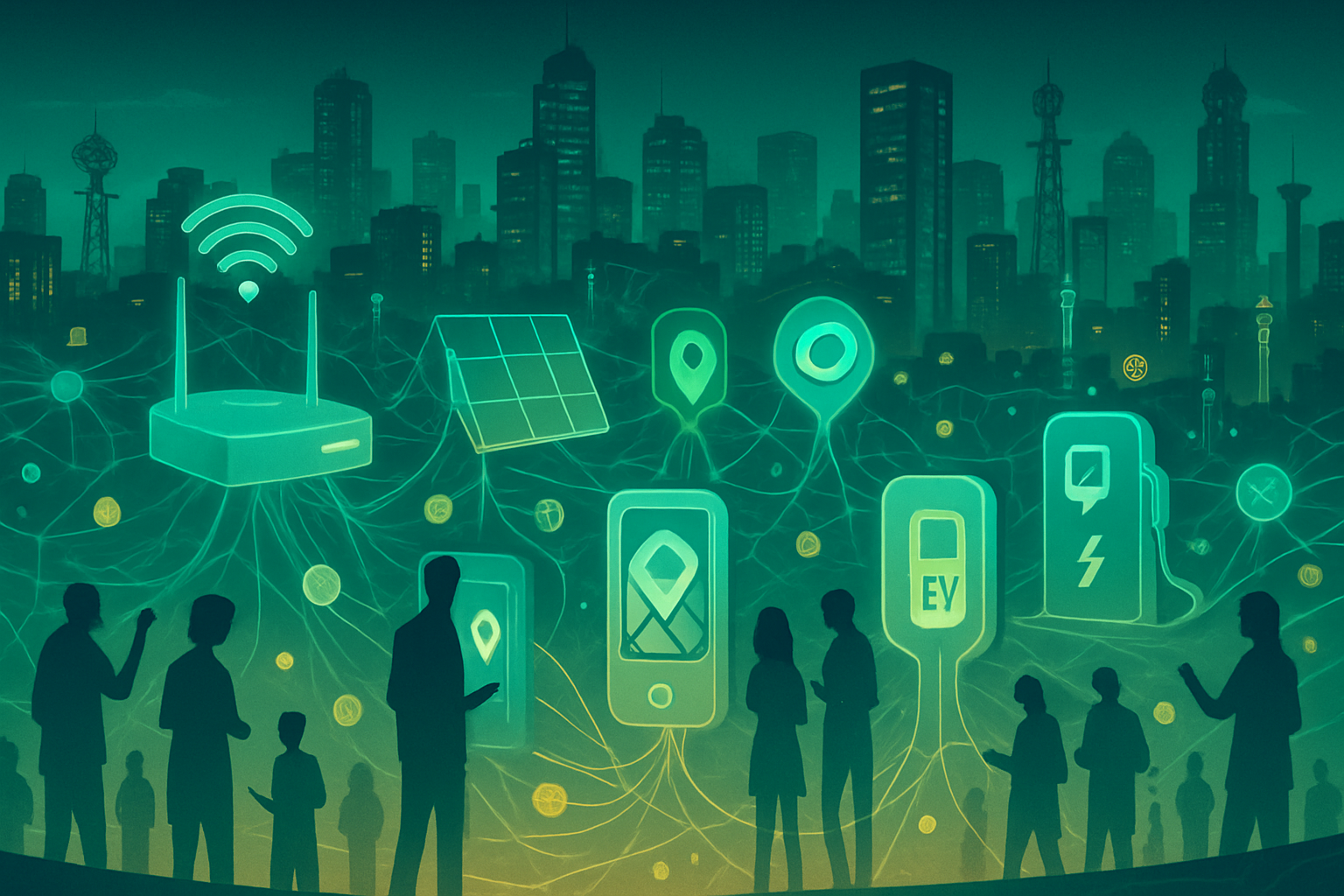
Picture a world where your Wi-Fi router, solar panel, or even the GPS chip in your car isn’t just drawing power or providing connectivity—it’s earning you money. Now multiply that by millions of devices, from weather sensors to EV chargers, collaborating in open, tokenized networks that anyone can join. That’s not science fiction anymore. It’s happening right now, and it’s called DePIN: Decentralized Physical Infrastructure Networks.
Suddenly, the internet’s plumbing and backbone—connectivity, storage, energy, mobility—are being rebuilt from the ground up. Not by massive corporations with billion-dollar balance sheets, but by thousands of regular people who deploy hardware, provide real-world services, and earn crypto in return. The stakes? A shot at upending how the physical world is funded, owned, and monetized—potentially unlocking a trillion-dollar market.
But this isn’t just about high-minded ideals or clever tokenomics. It’s a live experiment with billions of dollars in play, thousands of active users, and a parade of technical, regulatory, and business risks. For crypto enthusiasts, investors, and policymakers alike, DePIN is both a massive opportunity and a minefield. Getting it right could make Web3 indispensable. Getting it wrong could turn the hype into another expensive lesson.
Let’s break down what’s really happening in DePIN, how it works, where it’s already making a mark, and what you need to know if you want to participate—or just avoid getting burned.
What Is DePIN? The Basics and Why It Matters
DePIN stands for “Decentralized Physical Infrastructure Networks.” At its core, it’s about using blockchain incentives—usually tokens—to crowdsource the deployment, operation, and maintenance of real-world infrastructure. Instead of a single company building and owning, say, a Wi-Fi network or a fleet of sensors, a DePIN project lets anyone contribute hardware and get paid for providing reliable, measurable services.
Key traits of DePIN projects:
- Token incentives: Participants earn crypto for providing resources or services (e.g., bandwidth, storage, energy).
- Open participation: Anyone meeting the technical requirements can join as a resource provider.
- On-chain coordination: Service proofs and payments are enforced by smart contracts, not by trust in a central operator.
- Real-world impact: The services delivered have tangible, measurable effects outside the digital realm.
This approach isn’t entirely new. Filecoin and Helium, for example, have been experimenting with decentralized storage and wireless networks for years. But the field exploded in 2022–2023, as token models matured, hardware costs fell, and demand for alternative infrastructure grew—especially amid rising distrust of centralized tech giants.
Why Is DePIN Booming Now?
A few converging trends explain the sudden momentum:
- Souring on Big Tech: Privacy scandals, platform lock-in, and regional censorship have made the case for more open, user-owned networks.
- Crypto’s search for utility: As pure speculation faces headwinds, projects that connect tokens to real-world value are gaining attention.
- Cheaper hardware and IoT growth: It’s easier and cheaper than ever to deploy connected devices—and millions already exist, waiting to be “activated” by new incentives.
- Regulatory tailwinds and risks: Policymakers are both scrutinizing and encouraging decentralized infrastructure, depending on the sector.
How DePIN Projects Work: Unpacking the Mechanics
To really grasp DePIN’s potential, you need to understand how these networks coordinate trust, measure contributions, and distribute rewards—all in the messy, unpredictable physical world.
Core Components of a DePIN Network
- Resource Providers: Individuals or businesses that supply hardware or services (e.g., run a hotspot, host a server, operate a charger).
- Users/Consumers: People or applications that pay (often via tokens) to use the network’s services (e.g., connect to Wi-Fi, store files, charge vehicles).
- Blockchain Layer: Where service proofs, payments, and rules are enforced. This is the trust layer that makes the system work without a central arbiter.
- Proof Mechanisms: Technical systems (e.g., proofs of coverage, storage, or bandwidth) that verify real-world activity and performance.
- Tokenomics: The incentive model—how tokens are minted, distributed, and spent—to balance supply, demand, and growth.
A Walkthrough: The DePIN Lifecycle
Let’s take a Wi-Fi sharing network as an example:
- Deployment: Anyone buys and installs a compatible hotspot device. They stake (lock) some tokens as a security deposit.
- Operation: The device runs autonomously, providing Wi-Fi access to users. It reports uptime and coverage proofs to the blockchain.
- Verification: Smart contracts validate the data—was real coverage provided? Was data served? Was it reliable?
- Payment: The device owner receives tokens as a reward, proportional to their contribution and usage.
- Consumption: End-users pay tokens (often via a simple app) for secure, on-demand Wi-Fi access.
This basic pattern repeats across storage networks (Filecoin, Arweave), sensor networks (WeatherXM, DIMO), EV charging (C+Charge), and more. The details—how trustless proofs work, how slashing deters cheating, how rewards are calibrated—differ by project, but the skeleton is the same.
Real-World DePIN in Action: Who’s Building What, and Where’s the Value?
The ecosystem is evolving fast, but a handful of projects have already reached meaningful scale. Let’s dig into a few examples, with up-to-date numbers and hard lessons learned.
Helium: Crowdsourced Wireless at Scale
- What: A global, user-operated wireless network for IoT and (now) cellular devices.
- How: Anyone can deploy a Helium hotspot, which provides LoRaWAN or 5G coverage and earns HNT tokens.
- Scale: Over 1 million hotspots deployed worldwide as of early 2024, with major U.S. cities blanketed.
- Challenges: Early earnings overhyped; location spoofing and “gaming” the proof system led to reward dilution; pivoted to Solana blockchain for scalability.
Takeaway: Helium proved DePIN could bootstrap real networks at global scale—but maintaining quality, sustainability, and economics is brutally hard.
Filecoin and Arweave: Decentralized Storage for the Real World
- Filecoin: Pays miners for providing storage and retrieval services, with over 14 exabytes of capacity. Used by Web3 apps, NFT projects, and even traditional industry.
- Arweave: Focuses on “permanent” archival storage; data is stored indefinitely for a one-time fee and secured by a network of miners.
- Adoption: Over $100 million in cumulative storage deals on Filecoin; Arweave hosts everything from NFT metadata to public datasets.
Takeaway: Decentralized storage is no longer niche. It’s part of the backbone for Web3, but competing with cloud giants on price, speed, and reliability remains a slog.
WeatherXM: Democratizing Weather Data
- What: A network of user-owned weather stations that collect hyperlocal data, rewarded in WXM tokens.
- Scale: Over 5,000 stations deployed across 80+ countries as of Q1 2024.
- Impact: Data is used by weather services, insurers, and researchers. The network claims better accuracy and granularity than many public sources.
Takeaway: DePIN models can unlock new markets—like local weather data—by making it profitable for regular people to contribute.
Other Notables
- DIMO: Vehicle data sharing, where drivers earn tokens for sharing telemetry.
- HiveMapper: Decentralized mapping, using dashcams to crowdsource street-level imagery.
- C+Charge: Tokenized EV charging infrastructure, aiming to incentivize green mobility.
Risks, Limitations, and Trade-Offs: The Fine Print
DePIN is not a panacea. For every success story, there’s a graveyard of projects that failed to reach critical mass or ran into insurmountable challenges. Here’s what you need to watch out for:
Technical and Economic Risks
- Sybil attacks and spoofing: When earnings are tied to proofs, people will find ways to fake them. Helium, for instance, saw rampant location spoofing.
- Centralization drift: If rewards favor those with more capital, a few big operators can dominate—undermining the “decentralized” promise.
- Tokenomics blowups: Poorly designed incentives can lead to inflation, unsustainable yields, or “pump and dump” dynamics.
- Hardware reliability: Physical devices break, are hacked, or get outdated. Managing at scale is messy.
Regulatory and Legal Risks
- Token classification: Many DePIN tokens look like securities in the eyes of regulators. Ongoing crackdowns could limit access or increase compliance costs.
- Data privacy: Collecting or sharing data (especially personal or location info) raises GDPR and other privacy law issues.
- Critical infrastructure: Some sectors (telecom, energy, mobility) face heavy government oversight and licensing requirements.
User and Adoption Risks
- Chicken-and-egg problem: Networks need both supply and demand. Many DePINs struggle to attract real users willing to pay for the services.
- UX hurdles: Setting up hardware, managing wallets, and dealing with on-chain payments is still too complex for most non-crypto users.
- Trust and reputation: Bad actors and unreliable services can poison the well for everyone.
Practical Guide: How to Engage with DePIN—Without Losing Your Shirt
Whether you’re a trader, builder, investor, or policymaker, DePIN offers new ways to participate—but also new pitfalls. Here’s a checklist to help you navigate the landscape:
For Potential Resource Providers (Node Operators)
- Research hardware requirements: Only buy devices from reputable sources. Look for projects with clear, transparent onboarding.
- Model your ROI: Don’t trust “passive income” hype. Calculate your real costs (hardware, power, maintenance) versus projected rewards.
- Understand proof mechanisms: If you can’t explain how the network verifies your contributions, you can’t assess the risks.
- Diversify: Don’t put all your eggs in one project. Many networks will fail or contract over time.
For Investors
- Assess tokenomics: Look for projects with credible demand, sustainable emission schedules, and clear utility for the token.
- Track real-world adoption: Ignore “potential” and focus on actual paying usage (not just hardware counts or token price).
- Monitor regulatory signals: Pay attention to legal developments in your jurisdiction, especially around token sales and data privacy.
- Beware of hype cycles: Many DePIN tokens have seen wild price swings and speculative bubbles. Stay skeptical.
For Builders and Developers
- Prioritize UX: Make onboarding, payments, and device management as simple as possible.
- Plan for adversarial environments: Assume that participants will try to game the system; build robust proof and slashing mechanisms.
- Engage with regulators early: Especially in critical sectors, proactive compliance can mean the difference between scaling and being shut down.
- Foster community: DePIN is ultimately about crowdsourcing—support and incentivize your early adopters.
For Policymakers
- Balance innovation and oversight: DePIN can expand access and resilience, but also raises security and consumer protection challenges.
- Clarify token status: Clear guidance on token classification and AML/KYC requirements can unlock responsible growth.
- Support open standards: Encourage interoperability and data portability to avoid new “walled gardens” in decentralized clothing.
Looking Ahead: DePIN and the Next 12–24 Months
DePIN is no longer a theory or a niche experiment. It’s a fast-growing, high-stakes battleground where crypto’s promise meets real-world friction. Over the next year or two, the winners won’t just be the projects with the slickest apps or the most aggressive token emissions—they’ll be the ones that solve for real demand, reliable service, and regulatory clarity.
Expect to see:
- Consolidation: Many copycat projects will fade, while a handful of networks reach escape velocity and mainstream adoption.
- Hybrid models: Traditional companies and DePIN projects will increasingly collaborate, blending Web2 reach with Web3 incentives.
- Policy breakthroughs and setbacks: The next big regulatory moves—especially in the US, EU, and Asia—will be make-or-break for entire sectors.
- Real user focus: Token rewards will shrink as networks mature, forcing projects to compete on service quality and actual utility.
Whether DePIN becomes Web3’s next trillion-dollar market or fizzles into another cautionary tale depends on execution, not just vision. But one thing is clear: the infrastructure of the future is being built now, and for the first time, anyone can own a piece of it.
For those willing to do their homework and embrace the risks, DePIN is a frontier worth watching—and maybe, just maybe, participating in.
What to Do Next
- Save this guide and revisit it during your next allocation decision.
- Cross-check key metrics with public dashboards.
- Share with your team and define one execution step this week.
Recommended Next Reads
- How to Earn Crypto with DePIN:
how-to-earn-crypto-depin - Top DePIN Projects to Watch:
top-depin-projects - Web3 and the Future of Infrastructure:
web3-future-infrastructure
Sources and Further Reading
FAQ
What is DePIN and how does it work?
DePIN stands for Decentralized Physical Infrastructure Networks. It refers to networks where individuals deploy and operate physical devices—like routers, sensors, or chargers—and are rewarded with crypto tokens for providing real-world services such as connectivity, storage, or energy. These networks are open, permissionless, and use blockchain technology to coordinate and monetize infrastructure at scale.
How can individuals earn money through DePIN?
Individuals can earn money by contributing their physical resources—such as Wi-Fi routers, solar panels, or GPS-enabled devices—to DePIN networks. By providing services like data transmission, energy production, or location verification, participants receive crypto tokens as rewards, turning everyday hardware into income-generating assets.
Why is DePIN considered a potential trillion-dollar market?
DePIN has the potential to disrupt traditional infrastructure industries by democratizing ownership and monetization. By enabling anyone to participate and earn from real-world resources, DePIN can scale rapidly, reduce costs, and unlock new economic opportunities, making it a strong candidate for Web3’s next trillion-dollar market.
Stay Updated
Subscribe to your site newsletter for weekly market breakdowns, tool comparisons, and risk alerts.
Leave a Reply