
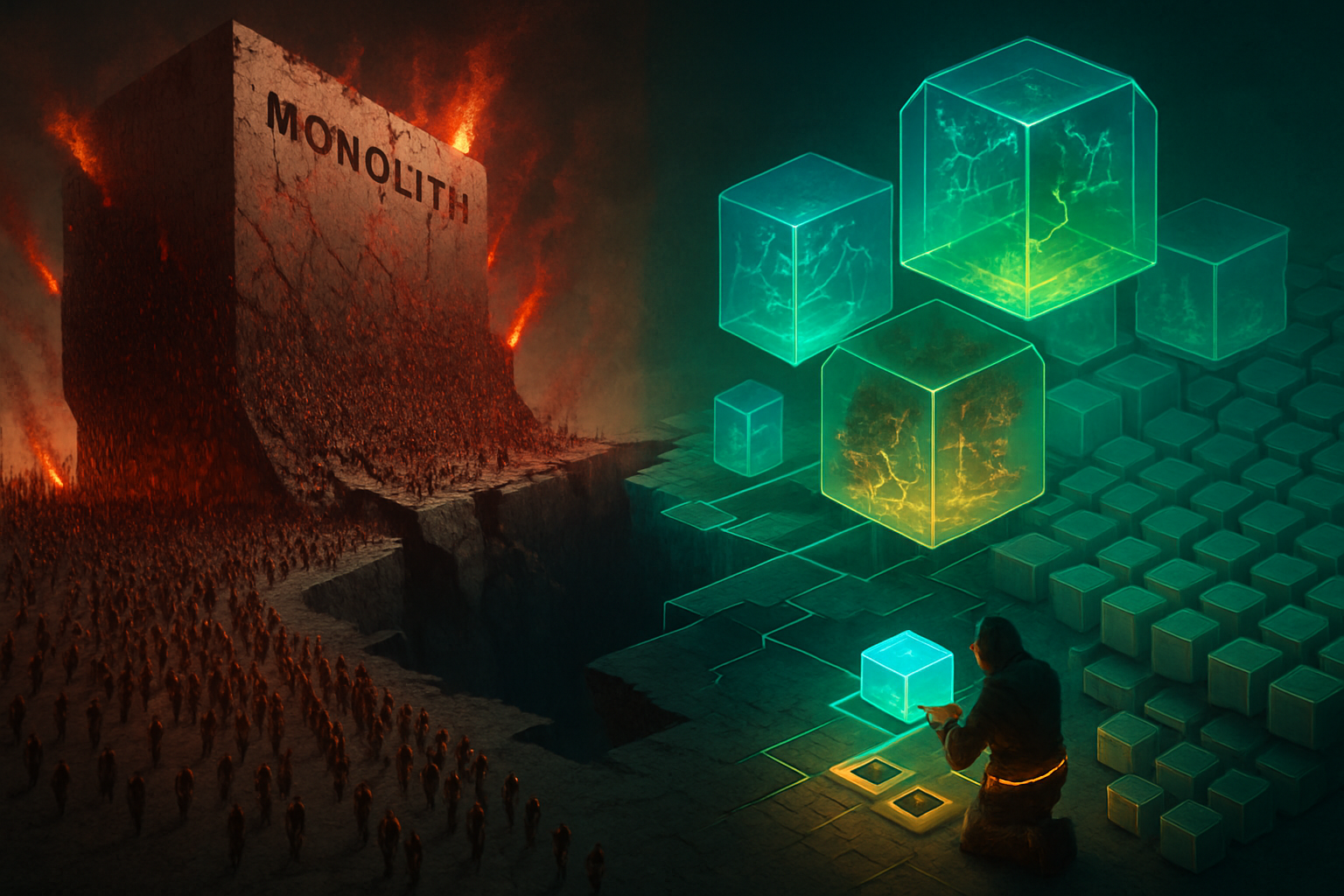
Modular Blockchain Execution Layers: How Rollup-as-a-Service Platforms Are Democratizing App-Specific Chains, Cutting Deployment Costs, and Sparking a Developer Exodus From Monolithic L1s Right Now
The Ethereum mainnet gas crisis of 2021 wasn’t just expensive. It was clarifying. When a simple token swap could cost $80 and minting an NFT might run you more than the artwork itself, developers faced an uncomfortable truth: sharing a global computer with thousands of other applications means your users pay for everyone else’s popularity. The boom and bust cycles of DeFi summer, NFT mania, and memecoin frenzies didn’t just spike fees temporarily. They exposed a structural vulnerability in how we had been building blockchains for over a decade.
Something had to give. And it has.
Over the past eighteen months, a quiet infrastructure revolution has accelerated into a full-blown migration. Developers who once committed years and millions of dollars to launch standalone layer-1 blockchains are now spinning up custom execution environments in weeks for a fraction of the cost. The tool making this possible, rollup-as-a-service (RaaS), is rapidly becoming the default path for serious application teams. The numbers tell part of the story: over 100 app-specific rollups have launched or been announced since early 2023, with infrastructure providers like Caldera, Conduit, and AltLayer collectively raising more than $50 million in venture funding to meet demand that keeps outpacing supply.
This isn’t merely a technical optimization. It’s a fundamental restructuring of how blockchain networks get built, who gets to build them, and what “decentralization” actually means in practice. The teams leaving monolithic L1s aren’t just fleeing high fees. They’re chasing something more valuable: sovereignty without isolation, customization without compromise, and the ability to optimize every layer of the stack for their specific use case. Whether this exodus strengthens the broader ecosystem or fragments it into incompatible silos remains the open question that will define the next phase of crypto infrastructure.
What We Mean by “Modular” and Why the Timing Matters
To understand what’s happening, it helps to recall how blockchains were originally architected. Bitcoin, Ethereum, and their early competitors were “monolithic”: a single network handled data availability, consensus, settlement, and execution all in one place. This design choice made sense for bootstrapping decentralized networks when the technology was young. It also created unavoidable tradeoffs. The same computers processing your DeFi transaction were also storing every cat picture NFT ever minted, validating consensus, and maintaining the historical record. No wonder things got congested.
The modular thesis, articulated most influentially by Celestia’s Mustafa Al-Bassam and others in the Ethereum research community, proposes a cleaner separation of concerns. Let specialized layers handle what they’re good at. A data availability layer like Celestia, EigenDA, or Ethereum itself ensures transaction data is published and accessible. A settlement layer, typically Ethereum mainnet, provides finality and dispute resolution. And the execution layer, where the actual computation happens, can be optimized independently for whatever the application needs.
Rollups were the first major expression of this modularity. By executing transactions off the main chain, batching them, and posting compressed data back to Ethereum, rollups inherited security while dramatically expanding throughput. Arbitrum and Optimism proved the model. But they were still general-purpose environments, sharing blockspace among all comers.
RaaS takes the next logical step. It abstracts away the formidable engineering required to launch and maintain a rollup, letting teams deploy application-specific chains with custom parameters. Want a gaming chain with sub-second block times and account abstraction built in? A DeFi protocol that needs MEV protection and private mempools? A compliance-focused institutional network with native KYC hooks? These are now configuration options, not multi-year engineering projects.
The timing isn’t accidental. Several converging factors have created this inflection point. The Ethereum merge and subsequent upgrades made data availability cheaper through proto-danksharding (EIP-4844), cutting rollup operating costs by roughly 5-10x depending on usage patterns. The OP Stack and Arbitrum Orbit frameworks matured from experimental codebases into production-ready foundations. And perhaps most importantly, a generation of developers who cut their teeth on Ethereum during the boom years have accumulated the expertise and capital to build more sophisticated infrastructure.
How RaaS Actually Works: From Framework to Flying Chain
The mechanics deserve closer attention because they reveal both the power and the limitations of the current generation of tools.
At the base layer sit the rollup frameworks. Optimism’s OP Stack, Arbitrum Orbit, zkSync’s ZK Stack, and the Polygon CDK represent the major open-source toolkits. Each makes different architectural bets. The OP Stack and Arbitrum Orbit use optimistic fraud proofs, accepting transactions as valid by default with a challenge period for disputes. The ZK-based alternatives generate cryptographic proofs of correct execution, offering faster finality but with more complex proving infrastructure and, currently, higher costs for certain operations.
RaaS providers like Caldera, Conduit, and Gelato’s RaaS offering sit atop these frameworks. They handle the operational heavy lifting: sequencer deployment and maintenance, prover infrastructure for ZK rollups, bridge contracts, block explorers, indexers, and the DevOps orchestration that keeps everything running. What might take a team of five to ten engineers six to twelve months to build and operate becomes, in theory, a few weeks of integration work.
The economics are starkly different from launching an L1. A standalone blockchain requires bootstrapping a validator set, incentivizing participation through token emissions, and maintaining network security through the value of the native token. This is the “security budget” problem that has plagued countless L1 launches. App chains and rollups, by contrast, inherit security from their settlement and data availability layers. The cost becomes operational, not capital-intensive.
Consider the concrete example. A gaming studio launching a standalone L1 might need $10-50 million in token value staked to achieve meaningful economic security, plus ongoing inflationary rewards to validators. The same studio launching an OP Stack rollup through Caldera pays roughly $10,000-50,000 monthly in sequencer and infrastructure costs, with security derived from Ethereum. The difference isn’t just financial. It’s strategic. The studio can focus resources on game development rather than token economics and validator recruitment.
The customization options are extensive and growing. Teams can select their data availability layer (Ethereum, Celestia, EigenDA, or others), choose between optimistic and ZK proving systems, configure gas tokens (ETH, their own token, or stablecoins), implement custom precompiles for specialized operations, and tune throughput parameters. Some providers offer “shared sequencing” for atomic composability between rollups in their network. Others are experimenting with decentralized sequencer sets to reduce single points of failure.
The Migration in Motion: Who’s Actually Moving and Why
The developer exodus from monolithic L1s isn’t uniform. It’s concentrated in specific sectors where the benefits of customization outweigh the costs of leaving shared environments.
Gaming has emerged as the most visible early adopter. The thesis is straightforward: blockchain games need high throughput, low latency, and predictable costs. A player won’t wait 12 seconds between actions or pay $3 to craft a sword. Immutable X, launched as a ZK-rollup for NFTs, demonstrated the demand. Now more ambitious projects are going further. Proof of Play, the studio behind the on-chain RPG Pirate Nation, launched its own Arbitrum Orbit chain after experiencing constraints on shared infrastructure. The move let them optimize for their specific transaction patterns and implement features like session keys for gasless gameplay.
DeFi protocols represent a more cautious but potentially more consequential migration. Here the calculus differs. Composability, the ability to seamlessly interact with other protocols, has been Ethereum’s killer feature. Moving to an isolated chain risks stranding capital and fragmenting liquidity. Yet several factors are pushing teams to consider app chains anyway. MEV extraction has become a tax on users that sophisticated protocols want to control or eliminate. Custom fee structures and tokenomics become possible. And for derivatives and perp protocols, the ability to handle high-frequency trading with custom matching engines is compelling.
dYdX’s migration from Ethereum to its own Cosmos-based chain, completed in late 2023, remains the most closely watched case. The decentralized derivatives exchange had outgrown StarkEx, the ZK-rollup it originally used. It needed throughput for its orderbook model that shared L2 infrastructure couldn’t guarantee. The move wasn’t to a RaaS rollup, strictly speaking, but it validated the app-chain thesis for sophisticated DeFi. More recently, protocols like Aevo and Lyra have explored rollup-based approaches for similar reasons.
The institutional and enterprise segment is quieter but growing rapidly. R3’s Corda and Hyperledger Fabric dominated enterprise blockchain for years, but they’re increasingly seen as legacy technology. Financial institutions exploring tokenized assets and settlement systems want the security guarantees of public networks without the regulatory exposure of deploying on fully permissionless chains. RaaS offers a middle path: chains with compliant validator sets, transaction screening, and audit trails, settled to Ethereum for finality. Projects like Libre by Nomura’s Laser Digital and various bank-led initiatives are exploring this model.
The data, while incomplete, supports the narrative shift. Electric Capital’s 2023 developer report noted that while overall crypto developer numbers declined, rollup and L2 ecosystems showed relative resilience. Venture funding for infrastructure outpaced application funding in 2023 for the first time, suggesting capital is betting on the picks-and-shovels of modular infrastructure. And the sheer proliferation of announced chains, from Base and Blast to the dozens of less prominent app-specific rollups, indicates demand that supply is racing to meet.
The Risks Nobody’s Talking About Enough
For all the excitement, the RaaS and app-chain model carries substantial risks that deserve honest examination. Some are technical, others economic, and several touch on the fundamental values that drew many to crypto in the first place.
Technical and operational risks
The sequencer problem is the most acute. Most RaaS-deployed rollups today use a single sequencer operated by the provider or the application team. This is a centralization vector with real consequences. A sequencer can censor transactions, extract MEV, or simply go offline. The “training wheels” phase of rollup decentralization, as Vitalik Buterin has termed it, is supposed to be temporary. But the path to decentralized sequencer sets remains technically challenging and economically uncertain. Teams are experimenting with shared sequencing layers like Espresso and Astria, and with proof-of-stake sequencer rotations, but these are early.
Bridge security presents another vulnerability. App chains need to communicate with the broader ecosystem, and bridges have historically been the weakest link in crypto security. The canonical bridges between rollups and their settlement layers are better audited than the ad-hoc bridges of the past, but they still represent concentrated risk. A bug in the OP Stack’s bridge contracts would affect every chain built upon it.
Data availability guarantees vary by implementation. Posting call data to Ethereum provides strong guarantees but at higher cost. Using alternative DA layers like Celestia or EigenDA reduces expenses but introduces new trust assumptions. If the DA layer fails to make data available, users may be unable to reconstruct the chain state and withdraw funds. These tradeoffs are often obscured in marketing materials.
Economic and ecosystem risks
Fragmentation of liquidity and user experience is the macro concern. The vision of a unified, composable financial system fragments when every application lives on its own chain. Cross-chain messaging protocols like LayerZero, Axelar, and native rollup interoperability solutions are improving, but they add latency, cost, and complexity. The user who once connected to Ethereum and accessed everything now faces a labyrinth of bridges, different gas tokens, and inconsistent wallet experiences.
The business model for RaaS providers themselves remains unproven. Infrastructure companies have historically struggled in crypto. The margins on sequencer operations are thin, and the path to profitability likely requires massive scale or significant value capture from the chains they serve. Consolidation seems probable, with the risk that provider failure could strand dependent chains.
Regulatory and governance concerns
App chains with custom governance and validator sets may face securities law implications that shared infrastructure avoids. If a rollup’s sequencer set is permissioned and controlled by a single entity, regulators may view it differently than a permissionless L2. The legal status of custom gas tokens, particularly when they accrue value to the application team, remains uncertain in most jurisdictions.
Perhaps deepest is the philosophical tension. Much of crypto’s ideological foundation rests on credible neutrality, the idea that infrastructure should be a public good accessible without discrimination. App chains with KYC requirements, transaction censorship, or preferential treatment for certain users challenge this vision. The technology enables both more open and more closed systems. Which predominates is a choice the community is making now, often implicitly.
What to Actually Do: A Practical Guide for Different Participants
The modular transformation isn’t a spectator sport. Whether you’re trading, building, investing, or regulating, the landscape is shifting in ways that demand concrete responses.
For developers and founders
If you’re considering where to deploy, start with an honest assessment of whether you actually need an app chain. The decision matrix should include:
- Throughput requirements: Do you need sustained TPS above what shared L2s offer?
- Latency sensitivity: Is sub-second finality genuinely critical to your use case?
- Customization needs: Do you require features impossible on general-purpose chains?
- MEV and ordering: Does your application suffer from MEV in ways only custom sequencing can address?
- Economic model: Can you capture value more effectively with custom fees and tokenomics?
If the answer to several of these is yes, evaluate RaaS providers on dimensions beyond marketing:
- Framework maturity: Is the underlying stack battle-tested with significant total value secured?
- Decentralization roadmap: What’s the credible path to escaping training wheels?
- Interoperability: How does the chain connect to broader liquidity and users?
- Provider stability: What’s the financial health and commitment level of the RaaS operator?
- Exit options: How portable is your deployment if you need to switch providers or frameworks?
Consider starting on a shared L2 for product-market fit, then migrating to an app chain once usage patterns clarify actual requirements. The cost of premature optimization in infrastructure is high.
For traders and users
The proliferation of chains creates both opportunity and hazard. Your checklist for engaging with new rollups:
- Verify the security model: Is it optimistic or ZK? What’s the challenge period or proving time?
- Check sequencer status: Is it centralized? What’s the liveness guarantee?
- Understand bridge risks: Which bridge are you using, and what’s its security history?
- Monitor costs holistically: Low gas fees may mask expensive bridging or withdrawal delays
- Assess ecosystem maturity: Are there reliable block explorers, indexers, and developer tools?
For significant positions, consider the withdrawal path. Can you exit to Ethereum mainnet without the sequencer’s cooperation? This “forced withdrawal” capability is a key security indicator that many users overlook.
For investors
Infrastructure bets in the modular stack require distinguishing between genuine moats and temporary advantages. Frameworks with network effects, like the OP Stack’s growing superchain ecosystem, may sustain value better than undifferentiated RaaS operations. Data availability layers compete on cost and security guarantees; the winners likely consolidate.
Application-specific chains can create value capture mechanisms previously impossible, but tokenomics require scrutiny. Does the custom gas token accrue sustainable value, or is it a friction-inducing gimmick? Is the sequencer revenue model transparent?
Perhaps most importantly, assess interoperability plays. The chains that solve fragmentation without reintroducing centralization may capture significant value as the modular ecosystem matures.
For policymakers and regulators
The modular architecture challenges existing regulatory frameworks designed for monolithic networks. Key considerations:
- Clarify how app chains with permissioned sequencers or validator sets should be classified
- Address the consumer protection implications of fragmented user experiences and bridge risks
- Consider whether infrastructure providers warrant any special oversight or liability frameworks
- Evaluate how anti-money laundering obligations apply across chain boundaries
The risk is that regulation designed for simpler architectures either misses novel risks or inadvertently drives innovation toward jurisdictions with less thoughtful oversight.
The Road Ahead: Twelve to Twenty-Four Months
Looking forward, several dynamics seem likely to shape the modular execution layer landscape.
The sequencer decentralization race will intensify. Teams that promised “eventually” will face pressure to deliver concrete timelines as competition and regulatory scrutiny increase. Shared sequencing layers may emerge as critical infrastructure, potentially recentralizing what was supposed to be distributed. The tension between performance and decentralization won’t resolve cleanly.
ZK proving costs will continue falling, potentially shifting the balance from optimistic to ZK rollups for new deployments. But the complexity of ZK systems means optimistic approaches retain advantages in time-to-market and flexibility that matter for many applications.
Ethereum’s own evolution remains the wildcard. Further data availability upgrades, potentially including full danksharding, will reduce costs for all rollups. But if Ethereum’s roadmap stalls or competing DA layers achieve sufficient network effects, the settlement layer landscape could fragment beyond the current Ethereum-centric model.
The user experience problem demands solutions. Current wallet and bridging experiences are inadequate for a world of hundreds of chains. Account abstraction, chain abstraction, and intent-based architectures are promising directions, but their adoption timeline remains uncertain. The team that solves this elegantly may capture more value than any individual chain.
Most fundamentally, the industry faces a values question. The modular thesis enables both more decentralized, open infrastructure and more controlled, permissioned environments. The early pattern suggests significant movement toward the latter for mainstream adoption. Whether this represents necessary pragmatism or a betrayal of core principles will be debated fiercely and matters enormously for the industry’s long-term legitimacy.
The developer exodus from monolithic L1s is real, it’s accelerating, and it’s structurally justified by the economics and capabilities now available. Whether the destination is genuinely better, or merely differently compromised, is the work of the coming years. The infrastructure is being laid. What gets built upon it, and who gets to participate, remains ours to determine.
What to Do Next
- Compare 2-3 relevant tools before choosing one.
- Validate fees, custody model, and jurisdiction support.
- Start small and track performance weekly.
Recommended Next Reads
- Crypto security basics:
/category/cybersecurity/ - DeFi risk management:
/category/defi/ - Blockchain technology explainers:
/category/blockchain-technology/
Sources and Further Reading
FAQ
What is the main takeaway?
Focus on practical risk, utility, and execution rather than hype.
Who should care most?
Builders, active users, and investors exposed to the discussed sector.
What should readers do next?
Use the checklist, compare tools, and validate claims with primary sources.
Stay Updated
Subscribe to your site newsletter for weekly market breakdowns, tool comparisons, and risk alerts.
Leave a Reply