
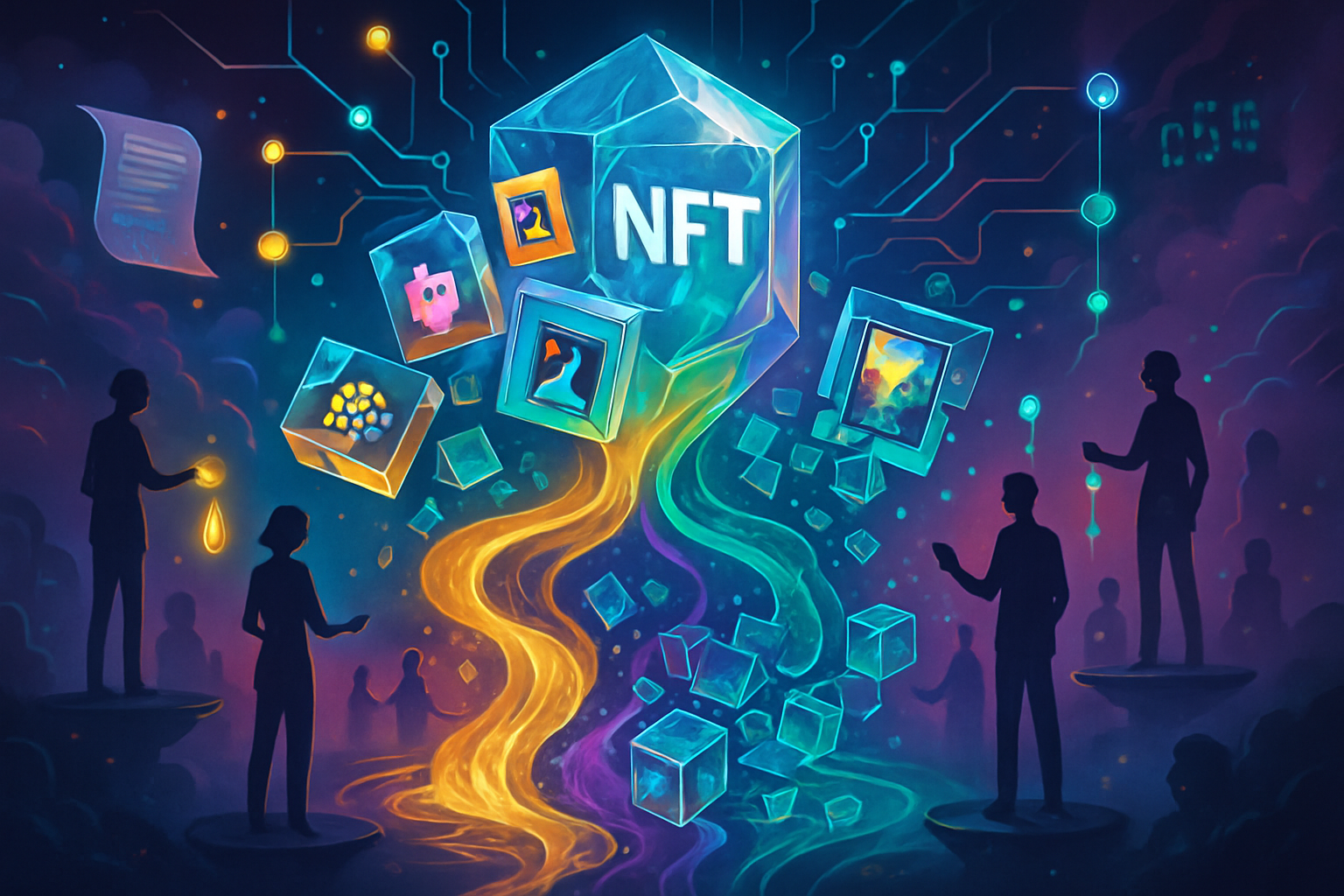
NFT-Fi Emerges: How NFT-Collateralized Lending, Fractionalization, and Advanced Royalties Are Transforming Digital Asset Markets and Investor Strategies Right Now
NFTs aren’t just profile pictures or digital baubles anymore. A new financial layer—dubbed NFT-Fi—is quietly reshaping how value flows through the digital asset economy. What started as a marketplace for rare collectibles is evolving into a complex ecosystem, where NFTs are collateral, assets are split into fractions, and royalties flow in programmable, investor-friendly ways. The implications stretch from DeFi traders to gaming studios, from digital artists to institutional investors.
Here’s the bottom line: NFT-Fi is unlocking liquidity, risk management, and entirely new business models for assets that were, until recently, stuck in digital “vaults.” The NFT market is becoming more like a capital market, with lending, borrowing, and hedging mechanisms that mirror (and in some ways surpass) what’s possible in traditional finance.
But the story isn’t all upside. These innovations come with new risks, messy regulatory questions, and technical complexity that can trip up even seasoned crypto users. Whether you’re a trader, builder, or policymaker, understanding NFT-Fi is quickly becoming necessary table stakes.
Let’s unpack what’s actually happening, why it matters right now, and how the next wave of NFT finance could upend digital asset strategies across the board.
NFT-Fi: From Collectibles to Financial Infrastructure
NFT-Fi refers to a suite of protocols and platforms that bring financial primitives—like lending, borrowing, liquidity pools, and income streams—to NFTs. Where NFTs started as static digital collectibles (think CryptoPunks or Bored Apes), they’re now being actively used as collateral, split into tradable fractions, and embedded with programmable royalty structures.
Why now? The NFT market’s explosive growth in 2021–2022 left a lot of holders “asset-rich, cash-poor.” Billions of dollars worth of NFTs were sitting idle, non-fungible and non-tradable except at the mercy of thin secondary markets. Meanwhile, DeFi showed what happens when you can unlock liquidity from idle assets. NFT-Fi builds on this momentum, applying DeFi’s composability and automation to the world of unique digital property.
NFT-Fi’s roots go back at least to early 2021, when projects like NFT20 and NFTX first experimented with putting NFTs into liquidity pools. Since then, a wave of new protocols—BendDAO, NFTfi, Arcade, and more—have expanded the toolkit, while platforms like Fractional and Tessera are making it possible to own a “slice” of blue-chip NFTs.
How NFT-Collateralized Lending Works
At the heart of NFT-Fi is the ability to use NFTs as collateral for loans—turning illiquid JPEGs into liquid capital. Here’s how the mechanism usually works:
- Borrower deposits an NFT into a protocol’s smart contract.
- Lender offers a loan (typically denominated in ETH, USDC, or another stable token) against the NFT, at a specific interest rate, duration, and loan-to-value (LTV) ratio.
- If the borrower repays the loan plus interest, the NFT is returned. If not, the lender can seize the NFT.
This process is managed by smart contracts, often with peer-to-peer matching (lenders and borrowers negotiate directly) or pooled lending (many lenders fund loans, risks are shared). Some protocols add features like buy-it-now “instant liquidity” or automated liquidation auctions.
Key players and protocols:
– NFTfi: Peer-to-peer NFT lending and borrowing since 2020, with over $500 million in cumulative loan volume by early 2024.
– BendDAO: Pool-based lending and instant liquidity for top NFT collections, with dynamic interest rates and real-time liquidation.
– Arcade: Focuses on high-value NFTs and bundles, supporting more complex loan structures.
Why it matters:
NFT-collateralized lending transforms NFTs from static collectibles into productive assets. Holders can access liquidity without selling, traders can leverage positions, and lenders can earn yield—albeit with new risks.
Fractionalization: Dividing Blue Chips for the Masses
Fractionalization takes a single, expensive NFT and splits ownership into thousands (or millions) of fungible tokens. Now, instead of needing 50 ETH to buy a CryptoPunk, you can own 0.001% for a few bucks.
How it works:
– The NFT is locked in a smart contract (often called a vault).
– The contract issues ERC-20 tokens representing fractional ownership.
– These tokens can be traded on DEXs like Uniswap, giving instant liquidity and price discovery.
Leading platforms:
– Tessera (formerly Fractional.Art): One of the earliest and most widely used platforms, with hundreds of millions in fractionalized NFT value.
– Unic.ly: Blends NFT vaults with AMM-based trading and governance.
Why it matters:
– Democratizes access: More people can participate in blue-chip NFT markets.
– Boosts liquidity: NFT fractions trade like fungible tokens, with tighter spreads and deeper order books.
– Enables new products: Index funds, NFT baskets, and even DeFi collateralization of NFT fractions become possible.
But fractionalization isn’t just about speculation. It’s also being used to coordinate DAOs (e.g., group purchases of rare NFTs) and to power new forms of community ownership.
Advanced Royalties: Programmable Income Streams
NFTs introduced the concept of on-chain royalties—automatic payments to creators each time an NFT is sold. NFT-Fi is pushing this further, enabling programmable royalties that can be split, redirected, or even securitized.
How it works:
– NFT smart contracts specify royalty rules (e.g., 5% of every sale goes to the creator, 2% to an investor, etc.).
– Royalties can be split among multiple parties, routed to DAOs, or bundled and sold as future income streams.
Recent innovations:
– Sound.xyz and Royal: Let musicians issue NFTs with programmable splits, so fans and investors can share in streaming or resale revenue.
– Manifold and Zora: Offer creator tools for customizing royalty logic, supporting everything from multi-party splits to on-chain governance.
Why it matters:
– Aligns incentives: Creators, investors, and communities can share upside in flexible ways.
– Enables new financial products: Future royalty streams can be bundled and sold, similar to financial derivatives in traditional markets.
– Mitigates platform risk: Royalties enforced at the protocol level are harder for marketplaces to bypass (though this remains a hotly debated issue).
Real-World Examples and Data
Let’s look at some numbers and case studies that show NFT-Fi’s real impact:
- NFTfi’s 2023–2024 loan volume: The platform facilitated over $500 million in cumulative loans, with the average loan-to-value for blue-chips like Bored Apes hovering around 30–50%. Default rates have ranged from 8–15%, depending on market volatility.
- BendDAO’s instant liquidity: At peak NFT bull runs, BendDAO’s lending pools held over $50 million in supplied liquidity, with some users accessing loans in under a minute. Liquidations of high-profile NFTs (e.g., Mutant Apes) made headlines, revealing both the power and risk of automated NFT lending.
- Tessera’s fractionalized NFTs: In late 2023, a “Golden Ape” was fractionalized into 1,000,000 ERC-20 tokens, each trading at ~$2.50. Within days, over $1.5 million in volume passed through secondary markets, with hundreds of unique wallet holders participating.
- Royal’s music royalties: In 2023, rapper Nas released royalty-backed NFTs for two singles, raising over $500,000 and giving fans pro-rata claims to future streaming revenue. The experiment drew interest from both music and crypto investors.
These examples are just the tip of the iceberg. Platforms like Arcade, Unic.ly, and Sudoswap are rolling out new NFT-backed financial products almost weekly, from perpetual lending pools to “NFT tranches” that slice risk and reward.
Risks, Limitations, and Trade-Offs
NFT-Fi is not a free lunch. The new financial tools come with meaningful risks and trade-offs—some technical, some regulatory, some economic.
Technical Risks
- Smart contract vulnerabilities: Bugs or exploits in NFT-Fi protocols can lead to catastrophic losses, as seen in early DeFi hacks.
- Oracle and pricing risk: NFT values are notoriously volatile and thinly traded. Inaccurate pricing or manipulation can lead to bad loans and forced liquidations.
- Liquidity crunches: During market downturns, lenders may be left holding NFTs with little immediate market value.
Regulatory and Legal Risks
- Securities law gray zones: Fractionalized NFTs (especially when sold as investment products) may be treated as securities in some jurisdictions, triggering registration and compliance requirements.
- Royalties enforcement: Some marketplaces have sidestepped royalty payments, undermining protocol-level promises and sparking debates about enforceability.
- AML/KYC requirements: NFT lending and fractionalization platforms may come under scrutiny for facilitating pseudonymous financial activity.
Economic and User Risks
- Default and liquidation: Borrowers risk losing valuable NFTs if markets move against them or if they fail to repay loans.
- Market manipulation: Thinly traded NFT fractions are susceptible to wash trading, pump-and-dump schemes, or price manipulation.
- Overleverage: Easy access to NFT-backed loans can lead to risky leverage, echoing DeFi’s boom-and-bust cycles.
Practical Steps and Advice for Traders, Builders, and Investors
If you’re considering dipping a toe into NFT-Fi, here are concrete steps to navigate this fast-moving terrain:
For Traders and NFT Holders
- Assess your risk appetite: Treat NFT-backed loans as high-risk, high-reward. Only collateralize NFTs you’re willing to lose.
- Diversify across protocols: Don’t put all assets in a single platform. Protocol risk is real.
- Monitor loan terms: Watch the LTV, interest rate, and liquidation threshold. Avoid taking loans with razor-thin margins.
- Understand pricing mechanisms: Be wary of protocols using opaque or easily manipulated price oracles.
For Builders and Entrepreneurs
- Prioritize security audits: Every smart contract should undergo rigorous, independent audits. Bug bounties add another layer of protection.
- Design for transparency: Make loan terms, interest rates, and royalty splits easily visible and auditable.
- Build with regulatory flexibility: Assume that securities law may evolve to cover NFT-Fi products. Modular, upgradable contracts can help adapt to changing rules.
For Investors and Institutions
- Demand robust due diligence: Scrutinize protocol security, governance structures, and legal opinions before allocating capital.
- Treat NFT fractions as speculative: Most fractionalized NFTs are illiquid, volatile, and not yet widely accepted as collateral.
- Consider portfolio fit: NFT-Fi exposure should be a small, experimental part of a broader digital asset strategy.
For Policymakers and Regulators
- Engage early with builders: Collaborative policy development can foster innovation while safeguarding consumers.
- Clarify NFT and fractionalization rules: Clear guidance on what constitutes a security or financial instrument will help the industry mature responsibly.
Looking Forward: The Next Wave of NFT-Fi and Digital Asset Markets
NFT-Fi is still in early innings. The financialization of NFTs will almost certainly accelerate as protocols mature, security improves, and regulatory clarity emerges. Over the next 12–24 months, we’re likely to see:
- Deeper integration with DeFi: NFT-backed loans, liquidity pools, and tranches will blend with broader DeFi markets, creating new arbitrage and hedging strategies.
- Institutional participation: As risk management and compliance tools improve, expect more funds and family offices to experiment with NFT-collateralized products.
- Programmable assets: NFTs will increasingly represent not just digital art or collectibles, but gaming assets, IP licenses, music royalties, and even real-world assets—each with customizable financial flows.
- New business models for creators: Programmable royalties and fractional ownership will let artists, musicians, and developers tap into direct, recurring income and community co-ownership.
But the path won’t be linear. Some NFT-Fi experiments will fail or be co-opted by incumbents; others will spark regulatory pushback or technical blowups. The winners will be those who balance innovation with prudence, and who build for both liquidity and resilience.
For participants at every level, now is the time to learn, experiment cautiously, and watch closely as NFT-Fi moves from the cutting edge to the center of digital asset markets. The future of NFTs isn’t just about what you own—it’s about what you can do with what you own, and how quickly that value moves through an increasingly programmable financial world.
What to Do Next
- Complete KYC and security setup before funding.
- Use a test transaction first.
- Set risk limits and automate alerts.
Recommended Next Reads
- NFT lending platforms:
nft-lending-platforms-guide - Fractional ownership of NFTs:
fractional-nft-ownership-explained - Understanding NFT royalties:
nft-royalties-how-they-work
Sources and Further Reading
- CoinDesk: NFT-Fi Is Quietly Reshaping the NFT Market
- Bankless: The Rise of NFT-Fi
- The Block: NFT Lending Explained
FAQ
What is NFT-Fi and how does it differ from traditional NFT markets?
NFT-Fi refers to the integration of financial mechanisms such as lending, borrowing, and fractional ownership into the NFT ecosystem. Unlike traditional NFT markets, where NFTs are primarily bought and sold as collectibles, NFT-Fi allows users to use NFTs as collateral for loans, split ownership into fractions, and receive programmable royalties, thereby unlocking liquidity and new investment strategies.
How does NFT-collateralized lending work?
NFT-collateralized lending allows NFT owners to use their digital assets as collateral to secure loans, typically in cryptocurrencies. If the borrower fails to repay, the lender can claim the NFT. This process provides liquidity to NFT holders without requiring them to sell their assets outright.
What are the risks and challenges associated with NFT-Fi?
NFT-Fi introduces risks such as smart contract vulnerabilities, price volatility, and regulatory uncertainty. The technical complexity of these platforms can also lead to user errors or exploitation. Additionally, fractionalization and advanced royalty structures may complicate ownership rights and revenue distribution.
Stay Updated
Subscribe to your site newsletter for weekly market breakdowns, tool comparisons, and risk alerts.
Leave a Reply