Stablecoin Blacklists: How Issuer Freezes Hit DeFi
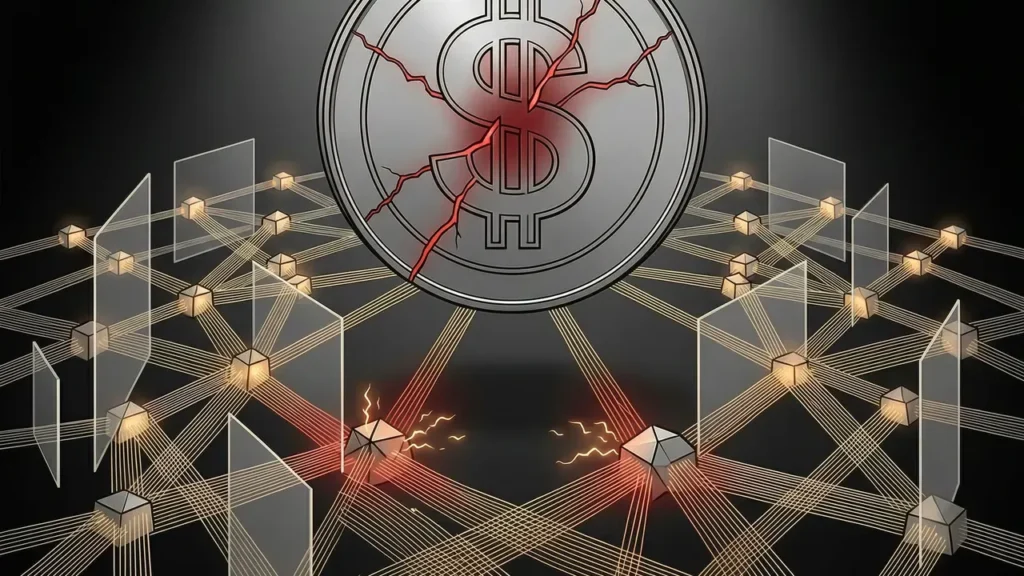
Stablecoins were supposed to be the neutral settlement layer of decentralized finance. A dollar token that moves at internet speed, programmable and permissionless. But the blacklist mechanism embedded in most major stablecoins introduces a single point of failure that can cascade through DeFi protocols in ways many users do not fully understand.
This tension has become acute. Regulatory pressure on issuers has intensified since 2022, with sanctions designations and law enforcement requests growing more frequent. Simultaneously, DeFi has deepened its reliance on centralized stablecoins: USDC and USDT together constitute roughly 80-90% of stablecoin liquidity across major DeFi protocols, according to DeFiLlama dashboard data. When an issuer freezes an address, the effects ripple through lending pools, DEX liquidity, and yield strategies that assumed those tokens were fungible and spendable.
Understanding how blacklists operate, where they create systemic risk, and how to evaluate exposure is now essential for anyone participating in DeFi beyond superficial speculation.
What Blacklists Actually Are
A stablecoin blacklist is an administrative function that allows the issuer to block specific blockchain addresses from sending or receiving tokens. This is not a protocol-level freeze of a smart contract; it is a targeted intervention at the token contract level.
The Technical Mechanism
Most major stablecoins implement blacklisting through a modifier in their ERC-20 contract. In Circle’s USDC and Tether’s USDT, the pattern is similar: a privileged address (controlled by the issuer) maintains a mapping of blocked addresses. Any transfer function call checks this mapping before execution. If either the sender or recipient is blacklisted, the transaction reverts.
The implementation details matter:
- USDC: Uses a
Blacklistablecontract withblacklist(address)andunblacklist(address)functions. As of Circle’s publicly available contract documentation, the blacklister role is a single address, though it can be changed by the contract owner. - USDT: Tether’s Ethereum contract similarly includes
addBlackListandremoveBlackListfunctions. Tether has historically been less transparent about the specific address controlling this function, though blockchain analysis firms have tracked its usage.
Once an address is blacklisted, any tokens held at that address become effectively frozen. The owner cannot transfer them, and no one can send tokens to them. The tokens still exist on-chain; they are not burned. They simply become non-transferable.
The Legal Trigger
Issuers typically freeze addresses in response to one of three stimuli:
- Sanctions compliance: Office of Foreign Assets Control (OFAC) designations require immediate action. The Tornado Cash sanctions in August 2022 led Circle to blacklist 38 addresses and Tether to blacklist approximately 40, according to blockchain analytics reports from Elliptic and TRM Labs.
- Law enforcement requests: Subpoenas or requests from agencies investigating fraud, hacks, or other illicit activity.
- Voluntary action: Issuers may freeze addresses associated with high-profile exploits before formal legal process, as Tether did with multiple DeFi hack-related addresses in 2021-2022.
The critical point: there is no judicial review before a freeze occurs. The issuer acts unilaterally, often within hours of receiving information.
How Freezes Propagate Through DeFi
The blacklist mechanism was designed for simple wallet-to-wallet transfers. DeFi’s composability creates second-order effects that issuers did not architect for.
Lending Protocols: The Compound Example
When a blacklisted address participates in a lending protocol, the protocol’s accounting can desynchronize from economic reality.
Consider a simplified scenario based on Compound’s architecture (documented in Compound’s GitHub repository and whitepaper):
- Address A supplies 1,000,000 USDC to Compound and receives cUSDC
- Address A is blacklisted by Circle
- Address A cannot redeem cUSDC for USDC, because the underlying USDC transfer would fail
- The cUSDC tokens themselves remain transferable (they are Compound’s contract, not USDC’s)
- Another user, Address B, buys cUSDC on a secondary market, perhaps at a discount, unaware of the underlying freeze
- Address B now holds a claim on frozen collateral
In practice, Compound and similar protocols have governance mechanisms to handle this, but resolution is slow and uncertain. The protocol must either find a technical workaround (difficult with USDC’s blacklist at the token level) or wait for potential unblacklisting.
DEX Liquidity Pools: Impermanent Freeze
Automated market makers present a different problem. When a blacklisted address holds LP tokens or has active positions:
- Uniswap V2/V3 pools containing USDC or USDT continue to function for non-blacklisted addresses
- However, if a blacklisted address is a significant LP, that liquidity becomes permanently locked in the pool from that address’s perspective
- More problematically, if a blacklisted address interacts with a router or aggregator contract in a way that causes the final transfer to fail, the entire transaction reverts, potentially causing unexpected failures for other users
The Tornado Cash sanctions in 2022 provided a natural experiment. Multiple addresses that had interacted with the mixer were blacklisted. Some held positions in Curve pools. Because Curve’s contracts do not filter participants at the token level, the pools themselves continued operating, but affected users could not withdraw their proportional share of USDC or USDT.
Yield Aggregators and Vaults
Yield strategies that route through multiple protocols compound the risk. A vault might deposit into Compound, which lends to Aave, which is used by a trader who gets blacklisted. The vault’s share tokens represent a claim on a portfolio that now includes frozen or impaired assets. Attributing the loss to specific depositors becomes a governance and accounting challenge.
Concrete Cases and Scale
Quantifying blacklist frequency and impact requires piecing together on-chain data and issuer disclosures.
Tether’s Historical Pattern
Tether has been more prolific in blacklisting than Circle, though less transparent. According to analysis by The Block Research and Dune Analytics dashboards tracking Tether’s blacklisting events:
- From 2017 through early 2024, Tether blacklisted over 1,000 addresses on Ethereum alone
- The total value frozen across these addresses has varied widely, from negligible amounts to individual freezes exceeding $100 million (notably the Poly Network hack recovery in 2021, where Tether froze approximately $33 million USDT)
- Tether has also demonstrated willingness to unblacklist: following resolution of some law enforcement matters, addresses have been removed from the blacklist
Circle and Regulatory Compliance
Circle publishes less granular data but has shown responsive compliance behavior:
- The August 2022 OFAC sanctions led to same-day blacklisting of Tornado Cash-associated addresses
- Circle’s reserve attestations (published monthly with Grant Thornton) do not separately account for frozen tokens, suggesting they remain in the reported reserve totals
- In 2023, Circle blacklisted addresses associated with the Multichain bridge collapse following law enforcement guidance
Magnitude in Context
The total value frozen at any time is a small fraction of circulating supply—likely under 0.1% based on available data. However, the concern is not aggregate value but systemic placement. A freeze of a major market maker’s address, a large lending pool collateral position, or a cross-chain bridge contract could disrupt markets disproportionately.
Risks, Limitations, and Trade-offs
For Users
- Counterparty exposure by proxy: Holding USDC or USDT means accepting Circle or Tether as a counterparty with unilateral freeze authority, even if you never interact with them directly
- Downstream contamination: Receiving tokens from a soon-to-be-blacklisted address, or interacting with a protocol that does, can create frozen positions with no recourse
- Jurisdiction shopping is limited: Issuers operate under multiple regulatory regimes simultaneously; an address might be frozen for U.S. sanctions compliance even if the user has no U.S. nexus
For Protocol Builders
- Composability assumptions break: Contracts assuming all ERC-20 tokens are equally transferable fail when major stablecoins have transfer-blocking logic
- Governance latency: Protocols cannot upgrade as quickly as issuers can freeze; emergency responses are constrained by timelocks and multisig structures
- Insurance and risk pricing: Few DeFi insurance protocols cover blacklist-related losses explicitly, making risk pricing difficult
For the Ecosystem
- Centralization pressure: The existence of blacklist functionality creates incentives for regulators to push more activity through issuers rather than on-chain governance
- Competitive moat: The compliance infrastructure that lets issuers respond quickly to legal requests is expensive to replicate, disadvantaging newer stablecoin competitors
- Stablecoin fragmentation risk: If different issuers blacklist different addresses based on varying regulatory interpretations, liquidity fragments across “clean” and “potentially tainted” token pools
What Blacklists Do Not Solve
Blacklists are ineffective against sophisticated evasion:
- Pre-freeze movement: Addresses can transfer tokens before blacklisting if the operator acts quickly upon sensing risk
- Peeling chains: Automated tools can split funds across many addresses faster than manual blacklist updates
- Non-issuer stablecoins: Decentralized alternatives like DAI (now mostly USDC-backed), RAI, or LUSD have different trust assumptions but their own limitations
Evaluating Your Exposure: A Practical Framework
For investors, builders, and power users assessing stablecoin blacklist risk:
Understand your stablecoin’s governance
- Who can freeze? (Single address? Multisig? What threshold?)
- What is published policy on freeze triggers? (Circle has stated policy; Tether’s is less formalized)
- Historical responsiveness: How quickly has this issuer acted in past events?
Audit your protocol dependencies
- Does your primary lending protocol treat blacklisted collateral explicitly?
- Are your LP positions in pools with significant blacklisted-address exposure?
- Do yield vaults disclose their stablecoin issuer concentration?
Monitor early warning signals
- OFAC updates and sanctions designations
- Large stablecoin movements from addresses with suspicious patterns (pre-freeze positioning)
- Unusual discounts on cTokens, LP tokens, or vault shares that might indicate frozen underlying assets
Diversification with clear-eyed trade-offs
| Approach | Blacklist protection | Other risks |
|---|---|---|
| Multi-issuer stablecoin exposure | Reduces single-issuer freeze impact | Complexity, liquidity fragmentation |
| Decentralized stablecoins (LUSD, RAI) | No issuer blacklist | Lower liquidity, different peg mechanisms, smart contract risk |
| Overcollateralized positions with volatile assets | No stablecoin exposure | Liquidation risk, capital inefficiency |
Emergency preparation
- Maintain awareness of which addresses you have received large stablecoin transfers from
- Consider transaction screening tools (Chainalysis, TRM, Elliptic provide consumer-facing products) if your activity pattern creates elevated risk
- For builders: implement pause mechanisms and upgrade paths that can respond to issuer-level events
What to Watch Next
The blacklist mechanism will evolve under several pressures.
Regulatory clarity is incoming but uncertain. The EU’s MiCA framework requires stablecoin issuers to have redemption and freeze capabilities, effectively mandating blacklist functionality for euro-denominated and significant non-euro stablecoins operating in Europe. U.S. legislation remains stalled but any eventual framework will likely preserve or strengthen issuer-level controls.
Technical mitigations are being explored. Some protocols are experimenting with “wrapper” contracts that could potentially isolate blacklist effects, though these introduce their own trust assumptions. Privacy-preserving compliance tools using zero-knowledge proofs might eventually allow issuers to verify regulatory status without revealing address-level data, but deployment timelines remain speculative.
The most consequential scenario to monitor: a major DeFi protocol’s insolvency or dysfunction triggered by a blacklist event. This has not yet occurred at scale. If a systemically important lending market were to face a bank-run equivalent because blacklisted collateral cannot be liquidated normally, the resulting governance chaos would test DeFi’s decentralization claims directly.
The underlying tension is unresolved. Stablecoins bridge traditional finance and DeFi, inheriting the compliance obligations of the former while operating on the technical infrastructure of the latter. Blacklists are where these two worlds collide most visibly.