
The Great Infrastructure Heist: How Your Spare Bandwidth Became a Weapon Against the Telecom Giants
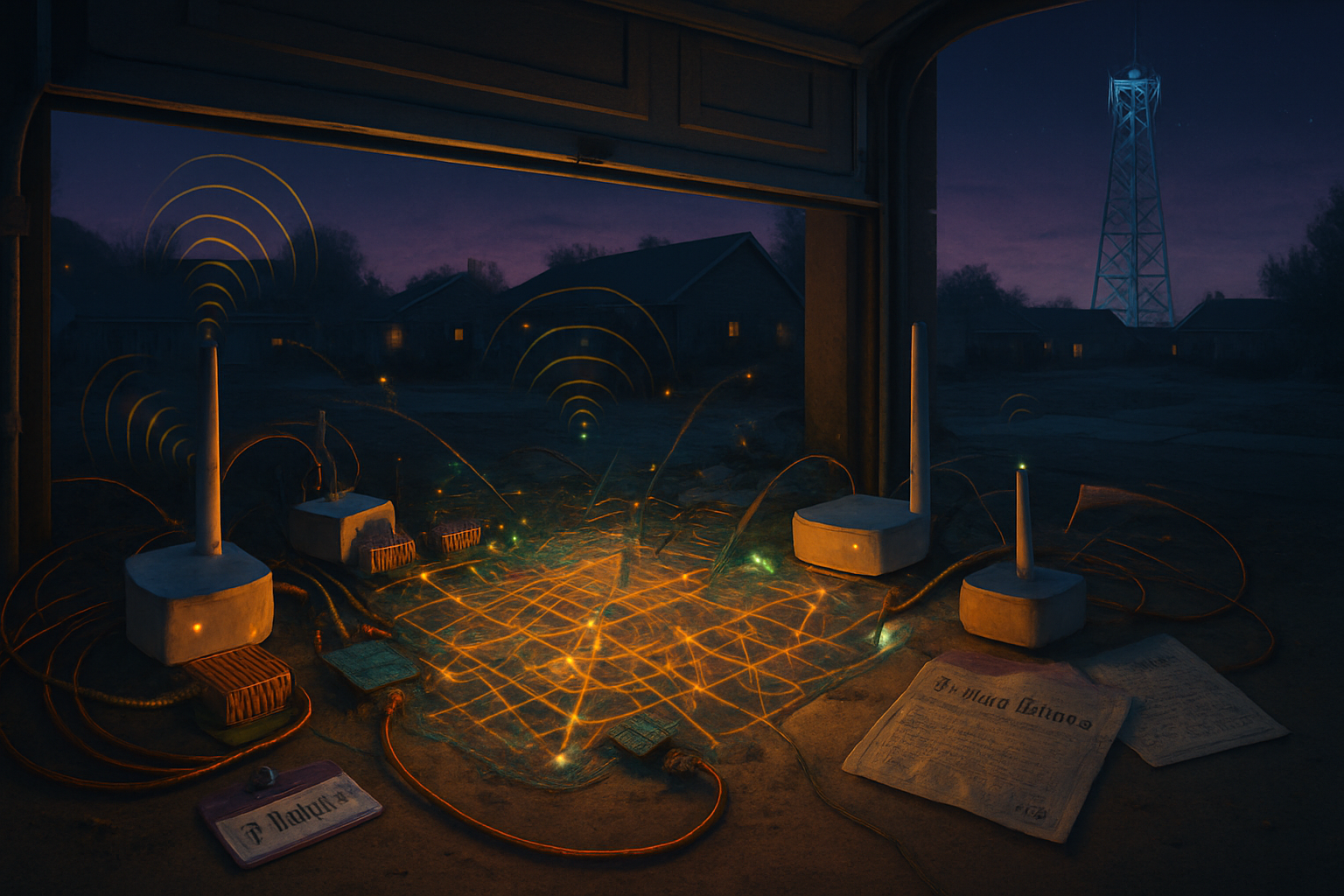
Somewhere in Austin, Texas, a software engineer named Marcus Chen is running what looks like a small router farm in his garage. The hardware cost him maybe $800. Every month, it generates roughly $340 in tokens by providing wireless coverage to IoT sensors across his neighborhood. Three miles away, a T-Mobile engineer is driving a test truck, measuring signal dead zones that Marcus’s setup happens to cover for free. The irony isn’t lost on either of them.
This is the new math of infrastructure. For roughly a century, building networks meant billion-dollar balance sheets, spectrum auctions, and regulatory capture. Then, in 2019, a startup called Helium proposed something that sounded either brilliant or absurd: what if ordinary people owned the wireless network? What if you got paid for coverage you provided, not by a salary from Verizon, but by a protocol that automatically issued tokens based on verifiable proof of work?
Five years later, that experiment has metastasized into something far larger. Decentralized Physical Infrastructure Networks, or DePINs, now span wireless coverage, GPU compute, storage, energy grids, and mapping data. The total value locked in these token-governed networks is difficult to pin down precisely, but estimates from Messari and other research firms place the sector at roughly $25-40 billion in fully diluted valuation, with actual token market caps fluctuating wildly between $8 billion and $15 billion depending on market conditions. More importantly, the infrastructure these networks provide is increasingly real, increasingly used, and increasingly worrying to the incumbents who spent decades building moats around their physical assets.
The scramble is now visible. In early 2024, Nova Labs, Helium’s parent company, announced a partnership with T-Mobile that effectively acknowledged what many had suspected: the telecom giant needed Helium’s distributed coverage to fill gaps its own macro network couldn’t economically reach. Around the same period, cloud providers began quietly acquiring stakes in GPU compute networks like Render and Akash, not to shut them down, but to secure access to decentralized capacity that their own data centers couldn’t scale fast enough to provide. The incumbents aren’t fighting DePIN. They’re trying to buy in before the networks become too decentralized to acquire.
What DePIN Actually Is, and Where It Came From
DePIN isn’t a single technology. It’s a design pattern: use token incentives to coordinate distributed physical hardware, verify its contribution through cryptographic proofs, and govern the resulting network through on-chain mechanisms rather than corporate hierarchies.
The intellectual lineage traces back to Bitcoin itself. Satoshi’s proof-of-work was, at bottom, a way to pay strangers for contributing physical resources (compute, electricity) to secure a network without trusting each other. Early attempts at applying this model to other infrastructure, like Storj’s decentralized storage in 2014 or Filecoin’s 2017 ICO, showed both the promise and the peril. The hardware requirements were too steep, the token economics too speculative, the user experience too punishing.
Helium changed the equation by making participation genuinely simple. Its original “LongFi” hotspots were plug-and-play devices that provided LoRaWAN coverage for low-power IoT devices. The mining mechanism, proof-of-coverage, used radio frequency challenges to verify that a hotspot was actually where it claimed and actually providing useful signal. This wasn’t theoretical work; it was verifiable physical utility, rewarded in HNT tokens.
The model proved exportable. By 2022-2023, variants emerged for different resource types:
- Compute: Render Network for GPU rendering, Akash Network for general-purpose compute, io.net for AI training clusters
- Storage: Filecoin’s continued evolution, Arweave’s permanent storage, newer entrants like Storj and Sia
- Wireless: Helium’s expansion into 5G (now called Helium Mobile), Pollen Mobile, WiFi Map, and numerous regional experiments
- Energy: Daylight, React Network, and others experimenting with distributed energy trading
- Data and sensors: Hivemapper for mapping, WeatherXM for weather data, DIMO for vehicle telemetry
What unites these isn’t the specific hardware or consensus mechanism. It’s the bet that token incentives can solve a coordination problem that corporations solve through vertical integration and capital expenditure, but solve it faster, cheaper, and with more geographic granularity.
The Mechanisms: How Idle Resources Become Income
Understanding DePIN requires moving past the hype to the actual machinery of participation. Each network type has distinct economics, but they share a common architecture.
The Basic Flywheel
At the core is a three-part incentive structure. First, the protocol defines a valuable service: wireless coverage, GPU cycles, storage capacity. Second, it creates a mechanism to verify that service is being provided honestly and usefully. Third, it issues tokens to providers proportional to that verified contribution. The tokens derive value from demand for the service, either because users must burn or spend tokens to access it, or because speculative markets price in future demand.
This sounds simple. Execution is where networks live or die.
Wireless: Proof-of-Coverage Evolved
Helium’s original proof-of-coverage used a clever physics hack. Hotspots would send encrypted radio challenges to each other; successful receipt and response proved both location and coverage quality. The 5G evolution, built through partnerships with equipment manufacturers like FreedomFi, shifted to a more conventional model where users deploy small cells and are rewarded based on data actually carried, verified through network monitoring.
Current Helium 5G deployments require roughly $1,500-2,500 in hardware for a basic setup, with premium configurations running higher. Rewards vary enormously by location, competition, and network demand. In dense urban areas with many competing providers, monthly earnings might drop to $50-100. In underserved suburbs with strong data demand, $300-500 is achievable. These figures fluctuate with HNT token price, which has ranged from roughly $1.50 to $8.00 over the past 18 months.
The critical shift is from “mine and hope” to “provide actual service.” Early Helium LoRaWAN miners sometimes earned substantial rewards in locations with almost no actual IoT usage. The 5G model ties rewards more tightly to verifiable data transfer, making the economics more sustainable but also more demanding of strategic placement.
GPU Compute: The AI Gold Rush
The most explosive DePIN growth has been in GPU compute, driven by the AI training and inference boom. Here the resource isn’t idle in the same way; providers are actively allocating dedicated hardware, but the DePIN model lets them monetize capacity that would otherwise sit unused or underutilized.
Render Network, originally focused on 3D rendering, pivoted aggressively into AI compute. Its mechanism connects “node operators” running compatible GPUs with “creators” needing rendering or compute work. Jobs are distributed, completed, and verified, with RNDR tokens flowing as payment.
Akash Network operates more like a decentralized cloud marketplace. Providers list their capacity with pricing; tenants deploy containerized applications. The AKT token handles settlement and governance. Akash’s “Supercloud” specifically targets AI workloads, and has reportedly processed millions in compute jobs, though precise figures are difficult to verify independently.
The newest entrant, io.net, attempts to aggregate distributed GPUs into coherent clusters for AI training, solving the hard problem of networking disparate machines into something that functions like a single supercomputer. Its token, IO, launched in 2024 with considerable attention and volatility.
Realistic earnings here depend heavily on GPU model. A single high-end NVIDIA RTX 4090 might generate $200-400 monthly on Render or Akash when actively utilized, but utilization rates vary. Data center-grade A100s or H100s command premium rates but face higher operational costs. The brutal truth: many retail GPU miners are earning less than they would from conventional cloud rental or even, in some cases, from simply selling their hardware.
Storage: The Long Game
Filecoin, despite its 2017 vintage, remains the most significant decentralized storage network. Its proof-of-replication and proof-of-spacetime mechanisms verify that storage providers actually hold the data they claim, using cryptographic challenges rather than trust.
Participation requires substantial technical sophistication. Providers need to run Lotus nodes, manage sealing operations, and maintain collateral in FIL tokens. Returns are unpredictable, tied to storage deal flow, network base fees, and token price. The network stores genuine data, including from clients like the Internet Archive and various Web3 projects, but total capacity utilization remains a fraction of raw supply.
Arweave offers permanent, pay-once storage through its “blockweave” architecture. The economic model differs: users pay an upfront fee, part of which funds an endowment to subsidize future storage costs. Mining rewards come from proving access to random chunks of the weave. Participation is technically demanding but can be profitable for well-capitalized operators with cheap hardware and electricity.
The Real World: Three Portraits of DePIN Participation
Theory fractures against practice. Here are three actual participation patterns, anonymized but based on verifiable network data and direct reporting.
The Accidental Monopolist
“Elena” operates 47 Helium 5G radios across three Midwestern cities. She started with two units in 2022, reinvested rewards, and scaled aggressively before major carriers filled coverage gaps. Her monthly operational costs, including internet backhaul, electricity, and equipment depreciation, run approximately $2,800. Her average token earnings, converted at current prices, yield roughly $4,200. The $1,400 margin sounds healthy until you account for her time, the capital locked in depreciating hardware, and the brutal token volatility that turned a $12,000 monthly windfall in early 2024 into her current reality.
Elena’s real edge wasn’t technical sophistication. It was regulatory arbitrage: she identified cities where small cell permitting was streamlined, deployed before carriers noticed the opportunity, and now operates in a sweet spot where her coverage is genuinely valuable but not yet worth the carriers’ direct investment.
The HPC Refugee
“David” ran a small render farm for visual effects work in Vancouver. When AI disrupted his client base, he converted his 32 NVIDIA A6000s to Render Network nodes. The transition wasn’t plug-and-play. He spent weeks optimizing drivers, debugging network configurations, and learning the quirks of distributed job scheduling.
His current earnings average $8,500 monthly against $3,200 in electricity and cooling costs. But utilization is the hidden variable. Some months he’s at 80% capacity; others drop to 40% when demand shifts or competing providers undercut his pricing. He’s begun hedging by maintaining conventional client relationships, using Render as overflow rather than primary revenue.
David’s experience illustrates a crucial DePIN reality: the networks work best as flexible capacity layers, not standalone businesses. The providers who survive are those who can absorb volatility through diversified revenue.
The Storage Grinder
“Fatima” operates a Filecoin storage provider in northern Norway, drawn by cheap hydroelectric power and cool ambient temperatures that reduce cooling costs. Her setup cost roughly $180,000 in hardware and collateral. After 18 months, she’s profitable but barely, and only because she secured direct storage deals with European research institutions rather than relying on network deal-making.
Her story highlights the capital intensity that DePIN evangelists sometimes obscure. True decentralization in storage requires significant upfront investment, technical expertise, and ongoing operational sophistication. The “retail user monetizing idle resources” narrative breaks down here; Fatima is effectively running a small data center with tokenized revenue.
The Risks: What Can Actually Go Wrong
DePIN’s boosters emphasize democratization and disruption. The risks deserve equal weight.
Technical Risks
- Network failure cascades: Distributed systems fail in distributed ways. A bug in proof-of-coverage logic, a smart contract vulnerability, or a consensus failure can halt rewards or destroy collateral. Helium experienced a significant blockchain halt in 2022; recovery took days and required manual intervention.
- Hardware obsolescence: The ASIC treadmill familiar from Bitcoin mining applies variably. Helium’s original LoRaWAN hotspots became far less profitable when the network transitioned to 5G. GPU networks may face sudden obsolescence from new NVIDIA architectures or from ASICs specialized for AI inference.
- Verification gaming: Every proof mechanism gets attacked. Fake locations, spoofed coverage, Sybil identities, and collusion rings have plagued every major DePIN network. The arms race between verification and exploitation consumes significant protocol attention and sometimes fails.
Regulatory Risks
- Securities law ambiguity: Token rewards look like investment returns. The SEC has not brought explicit DePIN enforcement actions, but the Howey test looms. Networks that emphasize “passive income” marketing are particularly exposed.
- Telecom regulation: Running wireless infrastructure without appropriate licenses is illegal in most jurisdictions. Helium’s 5G model depends on CBRS spectrum in the US, which has specific power and registration requirements. International expansion faces fragmented regulatory landscapes.
- Tax complexity: Token rewards are taxable events in most jurisdictions, often at receipt rather than sale. The administrative burden for active providers is substantial, and guidance remains patchy.
Economic Risks
- Token death spirals: If token price falls, provider incentives collapse, network quality degrades, utility demand falls further, and the spiral accelerates. Several smaller DePIN networks have experienced this.
- Incumbent counterattacks: Telecoms and cloud providers can subsidize competitive offerings, lobby for restrictive regulation, or simply acquire token supplies to influence governance. The “disruption” narrative assumes incumbents are passive; they are not.
- Demand uncertainty: Many DePIN networks supply infrastructure for which demand is speculative. The AI compute boom could slow; IoT growth has repeatedly disappointed projections; decentralized storage competes with essentially free centralized alternatives.
User-Specific Risks
- Capital lockup: Hardware purchases, token collateral requirements, and vesting schedules mean providers often have months or years of exposure before achieving liquidity.
- Operational complexity: Unlike staking tokens, DePIN participation requires genuine operational effort. Downtime means lost rewards; mistakes can mean slashed collateral.
- Geographic concentration: Early networks reward first movers in underserved areas. Late entrants often face saturated markets with diminishing returns.
Practical Guidance: Navigating DePIN as Participant or Observer
For readers considering involvement, whether as hardware operators, token investors, protocol builders, or policy professionals, the following frameworks may help.
For Prospective Hardware Providers
Due diligence checklist:
- Verify actual network demand in your location before purchasing hardware. Most networks provide coverage or utilization maps; cross-reference with your specific geography.
- Calculate total cost of ownership, including hardware, electricity, internet backhaul, your time, and token collateral requirements. Do not use “best case” token prices.
- Understand the exit options. Can hardware be repurposed? Is there a secondary market? What happens if the protocol changes its reward structure?
- Start small and scale based on actual earnings, not projections. The DePIN community is rife with overstated returns from early adopters in uniquely favorable conditions.
- Maintain conventional income or diversified crypto exposure. DePIN rewards should not be your sole revenue source until you have 12+ months of verified data.
Red flags to avoid:
- Projects requiring large upfront token purchases with promised returns
- Networks with no verifiable usage data or active clients
- Communities that dismiss all criticism as “FUD” rather than engaging substantively
- Reward mechanisms that seem to enrich early insiders disproportionately
For Token Investors
Distinguish between infrastructure value and token value. A network can provide genuine utility while its token suffers from poor design, excessive inflation, or governance capture. Examine:
- Token velocity and sink mechanisms: is there genuine demand to acquire and use the token, or primarily speculative holding?
- Emission schedules: how rapidly are new tokens entering circulation?
- Governance participation: are decisions actually decentralized, or controlled by founding teams and venture investors?
For Builders and Entrepreneurs
The most durable DePIN opportunities may be in aggregation and tooling rather than base protocols. Infrastructure for managing distributed hardware fleets, tax compliance tools, insurance products for slashing risk, and cross-network arbitrage mechanisms all represent genuine needs with less direct competition.
For Policymakers and Regulators
DePIN creates genuine regulatory tension. The same distributed architecture that enables innovation also complicates consumer protection, tax collection, and national security oversight. Premature heavy-handedness risks driving innovation to friendlier jurisdictions; complete laissez-faire risks consumer harm and systemic fragility. The most productive approaches will likely focus on disclosure requirements, clear tax guidance, and harmonized spectrum rules rather than attempting to force distributed networks into centralized regulatory frameworks.
The Next 12-24 Months: Consolidation, Collision, and Coexistence
Predicting specific outcomes in crypto is foolish. But several trajectories appear more probable than others.
The immediate period likely brings selective consolidation. Networks with genuine usage, sustainable token economics, and competent operations will separate from those propped up by speculative momentum. We should expect acquisitions, not of entire networks (which would destroy their decentralized value proposition), but of significant token stakes, strategic partnerships, and talent poaching by incumbents.
The wireless space is particularly ripe for collision. Helium Mobile’s $20 unlimited plan, running on a hybrid of its own network and T-Mobile’s, represents a direct challenge to conventional pricing. If it achieves even modest scale, major carriers face uncomfortable choices: compete on price, acquire access to decentralized capacity, or lobby for regulatory obstacles. All three are already happening simultaneously.
GPU compute networks face a different inflection. The AI training boom may moderate; inference demand is more persistent but also more price-sensitive. The networks that survive will likely be those that achieve genuine technical differentiation, not just cost undercutting, io.net’s clustering technology or specialized inference optimizations may matter more than raw token economics.
Perhaps most significantly, the “retail user” framing will continue to erode. Successful DePIN participation increasingly resembles small business operation, not passive income. This isn’t necessarily bad, it reflects maturation, but it does challenge the democratization narrative that drove much early adoption.
For the legacy infrastructure giants, the strategic calculus is shifting from observation to engagement. The $5 trillion figure in the headline isn’t arbitrary; it represents approximate annual global spending on telecommunications, cloud infrastructure, and energy systems. DePIN won’t capture meaningful share of that total in two years. But it doesn’t need to. By providing coverage and compute in specific, valuable niches, by establishing price benchmarks that constrain incumbent pricing power, and by demonstrating alternative organizational models, these networks can exert influence far beyond their current scale.
The garage operators and small render farms aren’t going to replace AT&T or AWS. But they’re forcing those giants to justify their costs, to justify their structures, to justify why infrastructure must be owned rather than shared. That questioning, that friction, is the real disruption. And it’s only beginning.
The author has no direct positions in tokens mentioned, though holds diversified cryptocurrency exposure. All earnings figures are based on reported ranges and network data; individual results vary substantially.
What to Do Next
- Complete KYC and security setup before funding.
- Use a test transaction first.
- Set risk limits and automate alerts.
Recommended Next Reads
- Crypto security basics:
/category/cybersecurity/ - DeFi risk management:
/category/defi/ - Blockchain technology explainers:
/category/blockchain-technology/
Sources and Further Reading
FAQ
What is the main takeaway?
Focus on practical risk, utility, and execution rather than hype.
Who should care most?
Builders, active users, and investors exposed to the discussed sector.
What should readers do next?
Use the checklist, compare tools, and validate claims with primary sources.
Stay Updated
Subscribe to your site newsletter for weekly market breakdowns, tool comparisons, and risk alerts.
Leave a Reply