
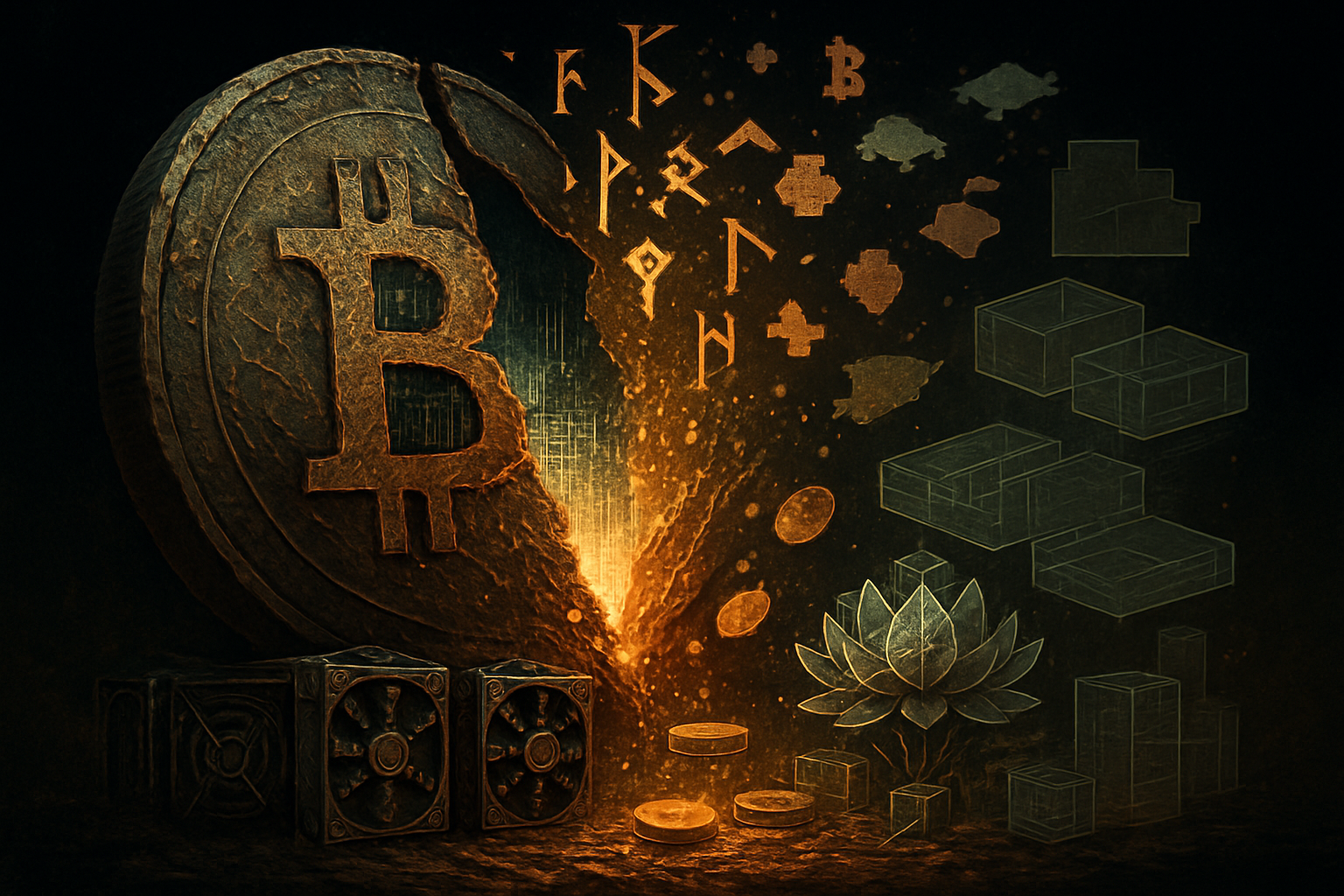
The Runes Resurrection: How Bitcoin’s UTXO Renaissance Is Rewriting Miner Economics
Something strange is happening on Bitcoin’s blockchain. In early April 2024, the network’s fourth halving slashed miner rewards from 6.25 to 3.125 BTC per block, threatening to squeeze already-thin margins across the mining industry. The typical post-halving narrative predicted hashrate drops, miner capitulation, and a slow grind toward equilibrium. Instead, fees spiked to levels not seen since the 2021 bull market, with some blocks generating more revenue from transaction fees than from the newly minted subsidy itself.
The culprit wasn’t a surge in peer-to-peer payments or institutional settlement. It was pixelated frogs, meme tokens, and digital collectibles etched directly into Bitcoin’s transaction outputs. Casey Rodarmor’s Runes protocol, launched at block 840,000, the very moment of the halving, had turned Bitcoin’s UTXO set into a speculative casino, and miners were suddenly collecting house money they hadn’t known existed.
This isn’t just another NFT story or token fad. It’s a fundamental restructuring of how block space gets valued, who profits from it, and what Bitcoin’s base layer might become. The questions it raises cut to the core of Bitcoin’s economic security model: if speculative inscriptions can offset halving pain today, can they sustain hashrate growth tomorrow? And at what cost to Bitcoin’s original vision?
From Digital Gold to Digital Ledger: How We Got Here
Bitcoin’s scripting language was intentionally limited. Satoshi stripped out the complex smart contract capabilities that later platforms like Ethereum would embrace, favoring simplicity, predictability, and security. For fifteen years, this design choice shaped Bitcoin’s identity: store of value, settlement layer, digital gold. Tokens lived elsewhere.
That changed in January 2023 with Ordinals. Rodarmor, a former Bitcoin Core contributor, realized that the witness data in SegWit transactions and the block size increase it enabled created slack space for arbitrary data. By inscribing content into individual satoshis, he effectively created non-fungible tokens native to Bitcoin, no sidechain required.
Ordinals exploded. Punks, Apes, and endless derivative projects flooded the chain. But the real volume came from BRC-20, a clumsy but functional token standard built on top of Ordinals by the pseudonymous developer Domo. BRC-20 used JSON inscriptions to create fungible tokens, each transfer requiring a new inscription. The UTXO set bloated. Fees soared. Bitcoin purists howled.
Rodarmor himself seemed ambivalent about what he’d unleashed. BRC-20, he argued, was inefficient and ugly, creating dust UTXOs that would burden the network for decades. His answer, announced in September 2023 and deployed at the halving, was Runes: a UTXO-native fungible token protocol that didn’t require inscriptions at all, instead using Bitcoin’s existing opcodes in a more elegant way.
The timing was theatrical and deliberate. Runes launched when miner revenue needed it most.
How Runes Actually Work (And Why They’re Different)
Understanding Runes requires grasping Bitcoin’s UTXO model, the accounting system where every transaction consumes existing “unspent transaction outputs” and creates new ones. Unlike Ethereum’s account-based model, where balances live in a global state tree, Bitcoin tracks discrete chunks of value moving through the system.
Runes embed token data directly into UTXOs using OP_RETURN outputs, a special output type that provably burns the satoshis it contains while storing up to 80 bytes of arbitrary data. This is crucially different from Ordinals and BRC-20 in several ways:
UTXO efficiency. Runes don’t create persistent inscriptions that live forever in the witness data. The token balance exists only as long as the UTXO remains unspent. When you transfer Runes, you consume the UTXO and create new ones with updated balances. No dust accumulates; no permanent bloat.
Protocol simplicity. A Rune etching (creation) or transfer requires a single transaction with structured OP_RETURN data, not the multi-step inscription-and-mint dance of BRC-20. This translates directly to lower fees per operation and fewer transactions overall.
Native Bitcoin integration. Because Runes live in standard UTXOs, they interact cleanly with Bitcoin’s existing infrastructure: hardware wallets, coin selection algorithms, Lightning Network channels in theory. The mental model is closer to colored coins, an early Bitcoin experiment, than to Ethereum ERC-20s.
The tradeoff is flexibility. Runes can’t do smart contracts, automated market makers, or composable DeFi. They’re purely for issuance and transfer, digital bearer instruments with no execution environment. For speculators chasing meme coins, this limitation hasn’t mattered. For builders wanting programmable money, it remains a hard boundary.
The Fee Market Resurrection: By the Numbers
The economic impact arrived immediately and dramatically. In the first week post-halving, Runes-related transactions consistently occupied 50-70% of Bitcoin’s block space, according to data from Dune Analytics dashboards tracking the protocol. The effect on miner revenue was stark.
Consider the arithmetic. At $60,000 BTC, the halved block subsidy generates roughly $187,500 per block, or about $1.35 million daily at the target 144 blocks. In late April 2024, total daily miner revenue regularly exceeded $3 million, meaning fees were contributing more than the subsidy itself. On April 23, fees hit a single-day record of approximately $78 million across the network, with Runes transactions paying premium sat/vbyte rates to ensure inclusion.
This wasn’t merely volume; it was strategic fee bidding. Rune etchings, especially for desirable ticker symbols (limited to 13-26 characters with shorter names requiring more block confirmations), became competitive events. Miners and mining pools with direct mempool visibility could prioritize their own etching transactions, capturing value that would otherwise flow to competitors.
The comparison to Ethereum’s MEV (maximal extractable value) became unavoidable. Bitcoin’s mempool, historically a relatively simple priority queue, was developing its own value extraction dynamics. Pools like F2Pool and Antpool reportedly adjusted block template construction to capture Runes-related revenue, though the opacity of pool operations makes precise attribution difficult.
For context, BRC-20’s peak in May 2023 had driven similar fee spikes, but with critical differences. BRC-20 transactions were more numerous and individually cheaper, creating sustained congestion rather than concentrated revenue events. Runes concentrated economic activity into fewer, higher-value transactions, a pattern more favorable to miners but potentially more exclusionary for ordinary payments.
Miner Economics in the Squeeze: ASICs, Debt, and Desperation
To appreciate why Runes revenue matters, you need to understand the vise gripping Bitcoin mining. The halving didn’t occur in a vacuum; it landed atop an industry already stressed by the 2022 bear market, high energy costs, and brutal ASIC depreciation curves.
Next-generation equipment, particularly Bitmain’s S21 series and MicroBT’s M60S lineup, delivers roughly 15-20 joules per terahash, a 20-30% efficiency improvement over the prior generation. But deployment requires capital that many miners lack. Public miners carried billions in debt through the downturn; private operations faced equity crunches and hostile power markets.
The post-halving breakeven analysis is sobering. At $0.06/kWh power costs, an S19 XP (21.5 J/TH) needs Bitcoin above roughly $55,000 to break even on direct energy costs alone. Older S19j Pros and comparable rigs face breakevens near $75,000. With spot prices hovering in the $60,000-$70,000 range through mid-2024, a substantial portion of the installed hashrate was operating at or near loss without fee revenue.
Runes changed that calculus for pools and large operators with direct mempool access. The additional fee income, even if volatile, extended the operational life of older equipment and improved margins for efficient operations. Hashrate, after an initial post-halving dip of roughly 10-15%, recovered to near-record levels by June 2024, suggesting that fee revenue was indeed preventing the expected capitulation.
Whether this sustains depends on Runes volume persistence, which brings us to the MEV question.
The MEV Frontier: Block Templates and Pool Centralization Risks
Ethereum’s MEV ecosystem emerged organically: searchers discovered arbitrage opportunities, built relay infrastructure, and eventually consolidated around dominant block builders like Flashbots. Bitcoin’s path may differ, but the economic logic is identical. Wherever transaction ordering affects value extraction, specialized actors will invest in capturing that value.
Runes creates ordering value in several ways:
- Etching priority. Desirable names become available on a first-come basis within confirmation windows. Being first requires either luck or control of block construction.
- Transfer front-running. Large Rune movements might move secondary market prices, though the thinness of Rune markets limits this currently.
- Censorship and inclusion games. Pools can selectively include or exclude competing etching attempts.
The infrastructure is nascent but emerging. Several mining pools have reportedly developed proprietary block template algorithms that weight Runes transactions differently from standard fee-per-byte optimization. Ocean Pool, launched by Bitcoin Core developer Luke Dashjr with explicit anti-inscription politics, attempted to filter Ordinals and Runes, but faced immediate hashrate attrition as miners chased higher fees elsewhere.
This creates a centralization tension that Bitcoin has largely avoided. If MEV extraction requires sophisticated mempool monitoring, fast block template reconstruction, and potentially proprietary transaction flows, smaller pools and solo miners face structural disadvantages. The difference between knowing the full mempool state and seeing only what your node has gossiped becomes economically significant.
Several scenarios seem plausible over the next 12-24 months:
- Relay emergence. Specialized MEV relays for Bitcoin, perhaps adapting Ethereum’s PBS (proposer-builder separation) concepts, could democratize access to optimized block templates while concentrating builder power.
- Pool consolidation. Miners chasing fee optimization may migrate to pools with superior MEV infrastructure, accelerating the hashrate concentration already evident (two pools control roughly 50% of Bitcoin hashrate as of mid-2024).
- Protocol response. If inscription-driven fees are perceived as threatening Bitcoin’s payment functionality or decentralization, Core developers could pursue technical mitigations, though any consensus change faces extreme bar.
Real-World Impact: Who’s Winning, Who’s Hurting
The Runes economy has produced clear winners and losers beyond the speculative token traders.
Mining operators with vertical integration have captured outsized returns. Marathon Digital, Riot Platforms, and CleanSpark reported Q2 2024 results showing average transaction fees exceeding 15% of total revenue, up from historical norms of 2-5%. For Marathon specifically, April fee revenue reportedly reached $20 million, nearly matching their subsidy income. These public companies can invest in mempool analytics and direct transaction submission that smaller competitors cannot replicate.
Bitcoin payment processors and merchant services have faced operational challenges. BitPay, BTCPay Server deployments, and similar services saw confirmation times extend dramatically during peak Runes activity, forcing them to either increase their own fee estimates or accept degraded user experience. The “fee market” Bitcoin Core developers long advocated for has arrived, but its composition—speculative tokens rather than economic payments—differs from their vision.
Ordinals and BRC-20 ecosystems have experienced direct competitive pressure. Runes volume quickly surpassed BRC-20 in dollar terms, with major marketplaces like Magic Eden pivoting resources to Rune trading infrastructure. The JSON-based BRC-20 standard looks increasingly like a transitional technology, though its entrenched liquidity and community may preserve niche relevance.
Ordinary Bitcoin users face the most direct friction. A simple self-custody transfer that cost $1-2 in early 2024 might spike to $10-30 during Rune-heavy blocks. Wallet software has struggled to estimate fees accurately amid volatile demand patterns. The “store of value” narrative assumes low-cost entry and exit; high fees erode that assumption for small holders.
A concrete example illustrates the dynamic. In mid-May 2024, the Rune “DOG•GO•TO•THE•MOON” (ticker: DOG) saw explosive trading volume following an airdrop to Runestone holders. Over 72 hours, average confirmation fees exceeded 100 sat/vbyte, pushing a standard transaction above $15. During this period, Coinbase and other exchanges temporarily increased Bitcoin withdrawal fees, passing costs to users. The Rune itself traded hundreds of millions in notional volume on secondary markets, but the infrastructure toll fell broadly across the network.
Risks, Limitations, and Trade-Offs
The Runes phenomenon carries substantial risks that enthusiastic coverage often elides.
Technical and protocol risks
- UTXO set growth, while more efficient than BRC-20, still expands under Runes activity. Each transfer creates new outputs; widespread adoption could stress full node operation requirements.
- The 80-byte OP_RETURN limit constrains but doesn’t eliminate data storage. More creative or aggressive protocols might emerge, testing community norms about acceptable use.
- Wallet software complexity increases as users must track and manage Rune-bearing UTXOs alongside plain Bitcoin, raising the potential for loss or accidental spending.
Economic and market risks
- Rune markets are extraordinarily thin and manipulated. Wash trading, insider distribution, and rug pulls are rampant. The “market caps” commonly cited aggregate last-sale prices across tiny float, a meaningless metric that nonetheless drives speculative behavior.
- Fee volatility makes Bitcoin unpredictable for time-sensitive payments. Lightning Network offers relief but requires channel liquidity and operational complexity that many users avoid.
- If Rune volume collapses—perhaps through regulatory action, market fatigue, or competitive displacement—miners face a revenue cliff just as they’ve adjusted to higher baseline expectations.
Regulatory and legal risks
- U.S. regulators have not explicitly addressed Runes, but the SEC’s enforcement posture toward token issuance suggests vulnerability. Rune etchings with pre-mined allocations, marketing hype, and secondary trading look structurally similar to token sales the SEC has deemed unregistered securities offerings.
- Mining pools that actively select transactions for MEV extraction may face questions about whether they’re operating as securities exchanges or broker-dealers, particularly if Rune trading becomes their dominant revenue source.
- International variation in treatment creates jurisdictional arbitrage. Pools and marketplaces may migrate to favorable regimes, fragmenting regulatory oversight.
Social and philosophical trade-offs
- Bitcoin’s cultural identity fractures. The “digital gold” camp views inscriptions as spam, an abuse of scarce block space for casino capitalism. The “permissionless innovation” camp celebrates any valid transaction paying market fees. This tension, long theoretical, now has concrete economic stakes.
- The fee market’s composition matters for long-term security. If Bitcoin’s security budget depends on speculative tokens rather than economic payments, its value proposition as neutral settlement infrastructure weakens.
Practical Guidance: Navigating the Runes Era
For different participants, the Runes landscape requires distinct strategies.
For Bitcoin holders and transactors
-
Master fee estimation. Use wallets with dynamic fee algorithms (Sparrow, Samourai, modern Core) and consider RBF (replace-by-fee) enablement for flexibility. During known high-activity periods—Rune launches, major airdrops—batch transactions or delay non-urgent transfers.
-
Explore Lightning for small payments. Channel management has improved; services like Phoenix and Breez abstract complexity effectively. For recurring, sub-$100 payments, Lightning cost savings are substantial during base layer congestion.
-
Audit your UTXOs. If you’ve received Runes accidentally or through airdrops, understand that spending the parent UTXO may burn or transfer them. Tools like ordinals.com and Rune-specific explorers can identify holdings.
For traders and speculators
-
Assume all Rune projects are high-risk. The baseline is not “investment” but “gambling with extra steps.” Position sizing should reflect this; no Rune allocation should imperil broader financial health.
-
Verify mint mechanics. Some Runes employ fair launch models with open minting; others pre-mine substantial allocations for creators. Read the etching transaction directly if possible; don’t trust frontend representations.
-
Consider custody carefully. Rune trading requires hot wallet exposure or specialized custody. Hardware wallet support remains limited; Ledger and Trezor have announced but not fully delivered comprehensive Rune integration as of mid-2024.
For miners and pool operators
-
Invest in mempool visibility. The competitive advantage now lies in transaction flow knowledge. Consider relationships with major exchanges, wallet providers, and Rune marketplaces for direct transaction submission.
-
Evaluate MEV infrastructure build vs. buy. Several startups are developing Bitcoin-native block builder software; assess whether proprietary development or partnership serves your scale and technical capacity.
-
Model scenarios, not just current fees. Runes volume will fluctuate. Stress-test operational economics at 5%, 15%, and 30% fee revenue shares to understand vulnerability thresholds.
For developers and builders
-
Build for fee volatility. Applications assuming cheap base layer settlement need Lightning or alternative designs. The “fat protocol, thin application” era for Bitcoin may be ending.
-
Contribute to fee market research. Bitcoin’s fee estimation, RBF behavior, and mempool policy remain underexplored. Improvements here have outsized practical impact.
-
Engage with the policy debate. Whether inscriptions represent legitimate use or network abuse will shape protocol development. Technical voices are needed in this conversation.
Looking Ahead: The Next 12-24 Months
The Runes experiment will face its critical tests soon. Several developments merit close watching:
Sustained volume validation. The initial halving launch created artificial scarcity and attention. Whether Runes maintain transaction share through 2024-2025 depends on continued speculative interest, successful project launches, and exchange integration. Early indicators are mixed; volume declined significantly from April peaks by June, though remaining elevated versus pre-Runes baselines.
Regulatory clarification. The SEC’s posture toward Bitcoin-native tokens remains undefined. A decisive enforcement action against a major Rune project or marketplace would chill activity; conversely, regulatory forbearance would encourage institutional participation currently deterred by legal uncertainty.
Infrastructure maturation. Wallet integration, custody solutions, and trading infrastructure are still primitive. Progress here—particularly from established Bitcoin companies like Block, Coinbase, or hardware wallet manufacturers—would broaden participation beyond the current technically adept niche.
Protocol evolution. Rodarmor has hinted at further developments, and the competitive pressure from Runes may accelerate Bitcoin’s own feature development. Checksigfromstack, covenants, and other proposed upgrades could enable more sophisticated token functionality, potentially absorbing or redirecting inscription demand.
Mining industry consolidation. The MEV dynamics described here favor scale and technical sophistication. The next two years may see significant hashrate concentration, with implications for Bitcoin’s decentralization claims that extend well beyond fee market mechanics.
The deeper question persists: what is Bitcoin for? The original vision of peer-to-peer electronic cash assumed cheap, reliable transactions enabling everyday commerce. The digital gold narrative de-emphasized transaction volume in favor of scarcity and settlement finality. Runes and Ordinals introduce a third possibility: Bitcoin as infrastructure for digital scarcity and speculation, a neutral platform whose block space finds its highest value in markets for tokens and collectibles.
This isn’t necessarily a degradation. Markets discover value in unexpected places; Bitcoin’s security model has always ultimately depended on someone finding block space worth paying for. But the composition of that demand shapes the network’s character, accessibility, and political economy. A Bitcoin secured by global payments differs from one secured by meme coin trading, even if the hashrate graphs look similar.
Casey Rodarmor’s elegant protocol hack has forced these questions into the open. The answers will emerge not from theory but from the accumulated choices of miners, users, developers, and regulators over the coming months. What seems clear is that the era of Bitcoin as a simple, settled system has passed. The UTXO set is alive with new activity, the fee market is genuinely competitive, and the mining industry must adapt to a block space economy more complex and contested than anything Satoshi anticipated.
The resurrection is real. Whether it’s a renaissance or a reckoning remains to be written.
What to Do Next
- Save this guide and revisit it during your next allocation decision.
- Cross-check key metrics with public dashboards.
- Share with your team and define one execution step this week.
Recommended Next Reads
- Crypto security basics:
/category/cybersecurity/ - DeFi risk management:
/category/defi/ - Blockchain technology explainers:
/category/blockchain-technology/
Sources and Further Reading
FAQ
What is the main takeaway?
Focus on practical risk, utility, and execution rather than hype.
Who should care most?
Builders, active users, and investors exposed to the discussed sector.
What should readers do next?
Use the checklist, compare tools, and validate claims with primary sources.
Stay Updated
Subscribe to your site newsletter for weekly market breakdowns, tool comparisons, and risk alerts.
Leave a Reply