
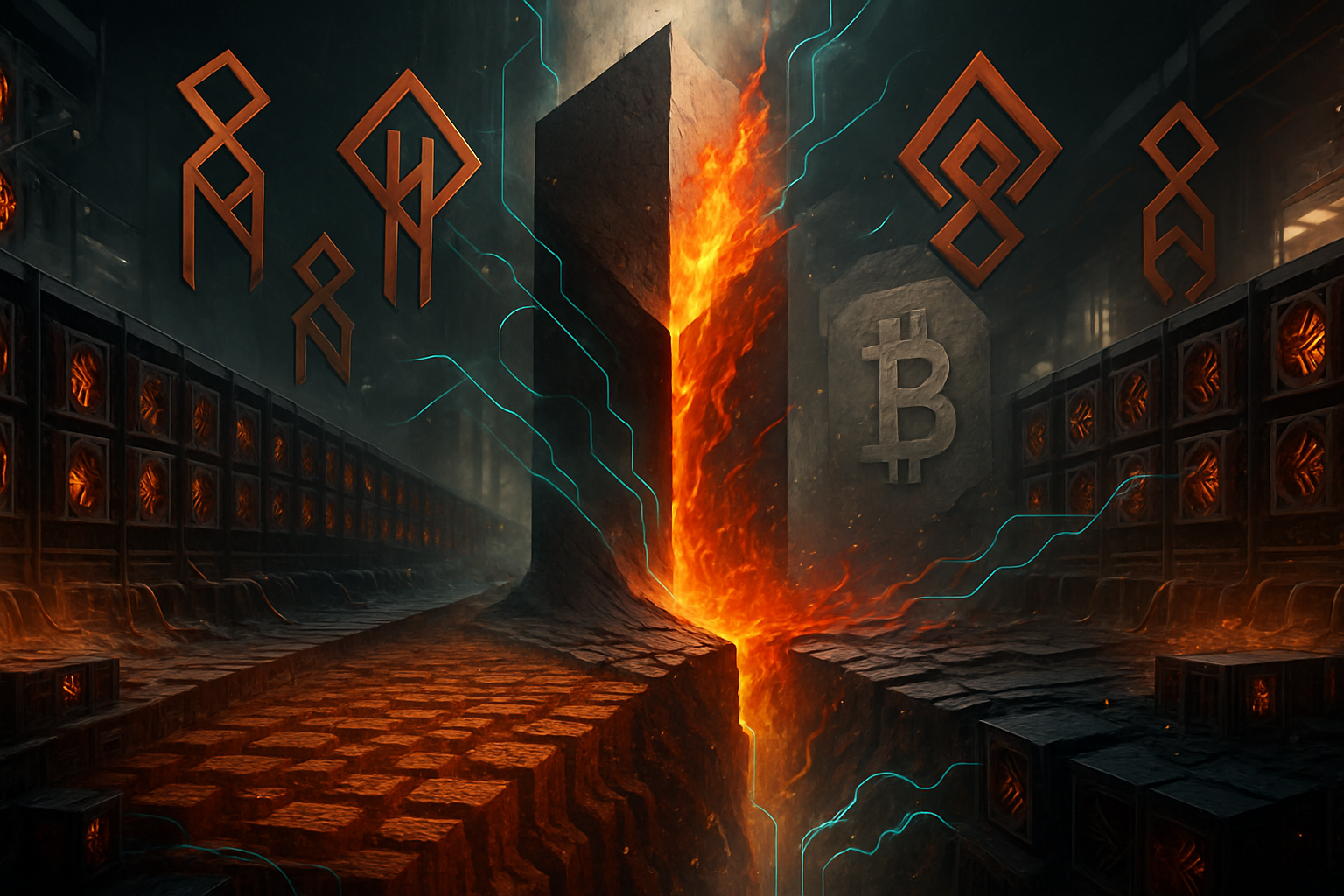
The Blockspace Wars: How Bitcoin Runes and Ordinals Are Rewriting the Miner’s Playbook
Something strange happened to Bitcoin in early 2024. The network didn’t just get busy, it got weird. On April 20th, the day of the fourth halving, transaction fees didn’t spike from some exchange meltdown or regulatory panic. They exploded because people were paying hundreds of dollars to etch tiny digital artifacts into the blockchain. The Runes protocol, launched by Casey Rodarmor alongside the halving, generated roughly 1,200 BTC in fees in its first week alone, temporarily pushing average transaction costs past $128 and making the halving block itself worth an extraordinary 40 BTC in fees atop the standard 3.125 BTC subsidy.
This wasn’t a glitch. It was a preview of Bitcoin’s economic future, and miners are still scrambling to adapt.
For over a decade, Bitcoin mining operated on a simple model: maximize hashrate, minimize energy costs, collect block subsidies. Transaction fees were pocket change, a rounding error in quarterly earnings calls. The post-halving reality, with subsidies slashed to 3.125 BTC, has made that model increasingly precarious. But the real disruption isn’t just the halving, it’s the composition of fees. Inscription protocols, Ordinals and now Runes chief among them, have created demand for blockspace that behaves nothing like traditional payment transactions. The mempool has become a two-tier market where timing, batching sophistication, and protocol-level awareness separate profitable operations from those bleeding sats.
This shift matters right now because it’s reshaping capital allocation across the mining sector, accelerating technical upgrades that were stuck in committee, and creating survival-of-the-fittest dynamics that threaten to consolidate hashrate faster than any regulatory crackdown could.
What Runes and Ordinals Actually Are (And Why They’re Different)
To understand the economic disruption, you need to grasp the technical mechanism without getting lost in the weeds.
Ordinals, launched in January 2023, exploit a quirk of Bitcoin’s Taproot upgrade. By encoding data into the witness portion of transactions, creators can inscribe digital content, images, text, even simple games, directly onto individual satoshis. Each inscription requires on-chain space, and popular collections have driven sustained demand for blockspace independent of payment use cases.
Runes, which went live at block 840,000, represents Rodarmor’s attempt to improve on this model specifically for fungible tokens. Unlike Ordinals’ one-satoshi-per-token approach, Runes uses Bitcoin’s Unspent Transaction Output (UTXO) model more efficiently, storing token balances in UTXOs rather than inscribing individual satoshis. The protocol uses OP_RETURN outputs, which are provably unspendable and don’t bloat the UTXO set as aggressively as alternatives. Etching a Rune, minting new units, or transferring balances all require on-chain transactions.
The critical economic distinction: these transactions are often price-inelastic. Someone minting a hyped Rune or inscribing a sought-after Ordinal will pay virtually any fee to secure inclusion in the next block. A coffee buyer will wait or use Lightning. This creates fee spikes that look like demand shocks but actually represent a fundamentally different demand curve.
Traditional payment demand roughly follows economic cycles, exchange volumes, and adoption trends. Inscription demand follows memes, launches, and speculative frenzies. It’s spikier, less predictable, and concentrated in specific block windows.
The Two-Tier Mempool: How Blockspace Became a Strategic Asset
Bitcoin’s mempool, the waiting room for unconfirmed transactions, has always had some stratification. But the inscription era has formalized a two-tier market that miners ignore at their peril.
Tier One: Standard Transactions. These are your typical payments, exchange withdrawals, Lightning channel operations. Users generally set fees based on mempool congestion estimates, with most wallets defaulting to conservative targets. They’re elastic, they’ll wait hours or days if fees spike.
Tier Two: Inscription Transactions. These include Rune etchings, mints, transfers, and high-value Ordinal inscriptions. They’re often time-sensitive, launch-dependent, and backed by speculative capital. During the Runes launch, some users paid 0.1 BTC or more in fees for single transactions to guarantee inclusion in specific blocks.
This bifurcation creates strategic complexity miners never faced before. A block full of high-fee inscription transactions might generate 2-4x the revenue of a block with typical payment volume. But those transactions don’t arrive uniformly. They cluster around launches, reveal events, and market movements. A miner with outdated mempool visibility might build a block from stale transaction data, missing the fee bonanza entirely.
The operational implications are substantial. Mining pools must now maintain sophisticated mempool monitoring across multiple nodes, track emerging inscription protocols for transaction patterns, and dynamically adjust block template construction. Foundry USA, Antpool, and other major pools have reportedly invested in dedicated inscription-aware infrastructure, though exact figures aren’t public.
More critically, the variance in block rewards has increased dramatically. Where pre-Ordinals miners could project revenue with reasonable confidence based on hashrate and BTC price, now a single block’s fee component can swing from 0.1 BTC to 15 BTC based on mempool composition. This rewards scale, sophisticated transaction selection, and operational flexibility, while punishing smaller operations running default software.
Hashrate Allocation: The New Calculus
The halving compressed margins across the board. At $60,000 BTC and 3.125 BTC subsidies, a miner paying $0.06 per kWh with moderately efficient hardware was already walking a tightrope. When inscription demand spikes, that same miner might see potential revenue double, but only if they can actually capture those fees.
This has accelerated several interconnected trends in hashrate allocation.
Geographic and temporal arbitrage. Miners with demand-response agreements or variable power contracts are increasingly optimizing around expected inscription demand rather than just energy prices. Some North American operations have shifted more hashrate to evening hours (US time) when Asian-driven inscription activity often peaks, though this pattern remains inconsistent.
Pool selection based on fee optimization. Solo miners and smaller farms are migrating toward pools with demonstrably superior transaction selection algorithms. This represents a reversal from the era when pool choice was dominated by fee structure (PPS vs. PPLNS) and political alignment. Now the question is: can this pool actually build blocks that capture inscription premiums?
ASIC fleet decisions. The economics favor newer, more efficient hardware not just for power efficiency but for operational flexibility. Machines that can be quickly powered up and down, or redirected across pools, command premiums. Bitmain’s S21 series and MicroBT’s M60S series, with their improved power curves and remote management capabilities, are seeing stronger demand than raw efficiency metrics alone would predict.
Public miner data from Q2 2024 illustrates this pressure. Marathon Digital reported average transaction fees comprising 8.3% of total block rewards in that quarter, up from roughly 2% in comparable pre-Ordinals periods. Riot Platforms saw even higher variance, with some weeks hitting 15% fee composition and others dropping below 3%. For context, during the Runes launch week, network-wide fees briefly exceeded subsidies, a phenomenon last seen during the 2017 peak and the 2021 China mining ban chaos.
Stratum V2: From Nice-to-Have to Survival Tool
Stratum V2, the mining protocol upgrade that’s been discussed since 2019, has suddenly become urgent. The original Stratum protocol gives pools near-total control over block template construction. Miners receive work units and return hashes, but don’t choose which transactions to include. This was fine when transaction selection was straightforward, but in the inscription era, it creates a principal-agent problem.
Pools might not optimize for the specific fee opportunities a miner’s hardware could capture. They might be slow to adopt new transaction parsing for novel inscription formats. They might simply have worse mempool visibility than sophisticated individual operations.
Stratum V2 introduces “job negotiation,” allowing miners to propose their own block templates while still pooling hashrate for reward smoothing. This matters enormously for inscription economics. A miner with superior mempool monitoring can construct blocks targeting high-fee inscription transactions, negotiate those templates with the pool, and capture premiums that would otherwise be distributed across all pool participants or lost to suboptimal selection.
The adoption curve has steepened noticeably. Braiins, the original Stratum V2 developer, reported in mid-2024 that compatible hashrate had grown from negligible levels to approximately 15-20% of network total, with acceleration following the halving. Foundry USA, which controls roughly 25-30% of network hashrate, has indicated Stratum V2 support is in development. The protocol isn’t yet dominant, but the trajectory has shifted from academic curiosity to competitive necessity.
For smaller miners, this creates a frustrating catch-22. Stratum V2 adoption requires technical investment, updated firmware, and often direct relationships with pools rather than simple hashrate marketplace connections. The miners who most need fee optimization to survive are those least equipped to implement it.
Real-World Pressure: Case Studies from the Mining Trenches
The abstract economics become concrete when you look at actual operations.
Case Study: The Wyoming Wind Farm Operation
A 12 MW wind-powered facility in Wyoming, operating since 2021 with a mix of S19j Pros and newer S21s, illustrates the new dynamics. Pre-halving, at 6.25 BTC subsidies, the operation ran profitably at roughly $0.045 per kWh effective power cost, including curtailed wind periods. Post-halving, the same economics projected marginal profitability at $60,000 BTC.
The operator’s response reveals the new playbook. First, they upgraded monitoring infrastructure to track three separate mempool nodes with different relay configurations, catching inscription transactions that standard nodes might miss. Second, they negotiated a custom arrangement with their pool (not named at their request) for partial template flexibility, short of full Stratum V2. Third, they implemented automated batching for their own UTXO management, consolidating during low-fee periods to minimize future transaction costs.
The result: during a Rune minting event in June 2024, the operation captured blocks with 4.2 BTC and 6.8 BTC in total rewards, versus the 3.125 BTC baseline. Those outlier blocks, roughly 8% of their monthly production, made the difference between quarterly profit and loss. Without inscription-aware operations, they’d have been building blocks from standard mempool views and missing the premium transactions entirely.
Case Study: The Venezuelan Small-Scale Miner
Contrast this with a 500 kWh operation in Venezuela, where subsidized power costs near zero but infrastructure is fragile. This miner, operating second-hand S17s, previously survived on minimal capital requirements and the ability to sell BTC locally at premiums. Post-halving, the old ASICs became unviable even with free power, the 3.125 BTC subsidy spread across more hashrate than ever, and the inability to capture fee premiums (no Stratum V2, no sophisticated mempool monitoring, no pool flexibility) meant watching others capture blocks worth 5-10x their own.
The operation shut down in May 2024. The miner, contacted through regional mining communities, described the frustration simply: “I was getting blocks, but they were empty blocks, cheap blocks. The big pools were eating the fees I couldn’t even see.”
Network-Level Data
Hashrate distribution data from Hashrate Index and Coin Metrics shows accelerated consolidation in the six months post-halving. The top five pools increased their collective share from roughly 70% to approximately 78%, with much of that shift occurring in April-May 2024 during peak Runes activity. This doesn’t map perfectly to inscription economics, other factors include capital access for ASIC upgrades and energy contract renegotiations, but the timing correlation is suggestive.
Average block weight utilization has also shifted. Pre-Ordinals, blocks typically ran 3.5-4.0 million weight units (of 4 million maximum). During inscription peaks, blocks routinely hit the limit, with some miners deliberately excluding low-fee standard transactions to maximize inscription fee revenue. This “fee sniping” behavior, while economically rational, contributes to payment user frustration and broader network congestion debates.
The Risks Nobody’s Pricing Correctly
The inscription-driven fee market isn’t purely opportunity. Several underappreciated risks are accumulating.
Technical Risks
UTXO set bloat. While Runes uses OP_RETURN more efficiently than some alternatives, the broader inscription ecosystem has increased UTXO creation rates. A larger UTXO set makes full node operation more resource-intensive, potentially reducing node count and network decentralization over time. Current growth rates aren’t catastrophic, but they’re directionally concerning.
Protocol ossification pressure. Every new inscription format requires wallet and node software updates. Bitcoin’s deliberately conservative upgrade culture, often called “ossification,” clashes with the rapid iteration of inscription protocols. The tension between enabling new use cases and preserving protocol stability remains unresolved.
Mempool exploitation. Sophisticated actors have begun probing mempool behavior to manipulate fee markets. Fake inscription launches, spoofed high-fee transactions that never confirm, and other games create noise that can mislead transaction selection algorithms. This attack surface is still poorly mapped.
Regulatory Risks
Securities law exposure. Runes and Ordinals enable token issuance on Bitcoin. Some issuances likely qualify as securities under various jurisdictions’ tests. Miners including these transactions in blocks face uncertain liability, particularly in enforcement-heavy jurisdictions. No major action has targeted miners specifically, but the legal theory is being developed in parallel cases.
Sanctions and compliance. Inscription protocols can embed arbitrary data, including potentially sanctioned addresses, illegal content hashes, or other problematic material. Miners’ role in confirming such transactions, even unknowingly, enters legally gray territory that hasn’t been tested in courts.
Economic Risks
Demand volatility. Inscription activity is profoundly cyclical. The Runes launch generated extraordinary fees; subsequent weeks saw 70-90% declines. Miners who invested in inscription-capture infrastructure based on April-May data face potential stranded costs if demand normalizes lower.
Payment user displacement. Persistently high fees drive payment activity to Lightning, sidechains, or alternative L1s. This isn’t inherently bad, but it changes Bitcoin’s security model if fee composition becomes overly dependent on speculative inscription demand rather than payment utility. The long-term implications for censorship resistance and network value are genuinely uncertain.
Mining-Specific Risks
Centralization acceleration. The technical and capital requirements for inscription-aware mining advantage large, sophisticated operations. This isn’t theoretical, the pool concentration data suggests it’s already occurring. A Bitcoin where fee capture requires institutional-grade infrastructure differs meaningfully from the original vision.
Small miner extinction. The Venezuelan case isn’t unique. Operations below roughly 5-10 MW, without dedicated technical staff, increasingly face negative expected returns unless they can access some form of fee premium capture. The “democratization of mining” narrative, always somewhat aspirational, looks increasingly strained.
Practical Playbook: What to Actually Do
For different participants in this ecosystem, the inscription era demands specific adaptations.
For Miners: Operational Checklist
-
Audit your mempool visibility. Are you running multiple nodes with different relay policies? Can you see transactions that standard Bitcoin Core configurations might exclude? If not, you’re flying blind.
-
Evaluate pool flexibility. Does your pool support Stratum V2 job negotiation, or at least offer custom template arrangements? If you’re on a legacy pool with no roadmap, the fee premiums you’re missing may exceed any loyalty benefits.
-
Implement strategic UTXO management. Consolidate mining rewards during low-fee periods. Batch payments to investors or partners. Every sat saved in transaction costs is a sat that improves margin.
-
Model inscription demand scenarios. Don’t base investment decisions on peak fee weeks. Run projections at 25th, 50th, and 75th percentile fee levels. If your operation only works at the 90th percentile, it’s not really viable.
-
Monitor protocol developments. New inscription formats emerge regularly. Being first to parse and prioritize a popular format can generate weeks of outsized returns before competitors adapt.
For Investors and Analysts: Evaluation Framework
Look beyond headline hashrate. Which miners are actually capturing fee premiums? Public disclosures vary in granularity, but Q2 2024 earnings calls revealed significant divergence in fee composition. Miners reporting 10%+ fee shares likely have better inscription infrastructure than those stuck at 3-4%.
Assess technical adaptability. Does the mining operation have in-house software capability, or are they entirely dependent on pool and vendor updates? The half-life of competitive advantage from any given technical improvement is shortening.
Understand energy contract flexibility. Inscription demand is time-variable. Miners with fixed output obligations or inflexible power purchase agreements can’t shift hashrate to capture peak windows even if they see them coming.
For Developers and Builders: Opportunity Mapping
Wallet and mempool tooling. Better inscription-aware fee estimation remains genuinely hard. Wallets that can distinguish “I need this confirmed in the next block regardless of cost” from “I’ll wait for lower fees” and price accordingly have clear product-market fit.
Stratum V2 implementation services. The gap between protocol specification and operational deployment is substantial. Miners need help with firmware updates, pool negotiation, and template optimization.
Cross-chain inscription bridges. As fees spike on Bitcoin, demand for inscription functionality on cheaper chains grows. The technical and economic design space for credible bridges remains underexplored.
For Policymakers: Regulatory Considerations
Avoid premature miner liability. Extending securities or content liability to block inclusion would accelerate centralization by excluding small miners who can’t afford compliance infrastructure. The network security externalities matter.
Support transparent hash rate reporting. Better data on mining economics, pool behavior, and fee composition would improve market function and regulatory targeting. Current data availability is improving but still incomplete.
Consider energy system integration. Inscription-driven demand volatility actually improves the case for demand-responsive mining as grid stabilizer, if pricing mechanisms can capture that value.
The Next 12-24 Months: Scenarios and Signals
Predicting specifics in this space is foolish, but tracking signals and preparing for plausible scenarios is essential.
Scenario One: Sustained Inscription Demand
If Runes, Ordinals, or successor protocols maintain substantial activity, fee composition stabilizes in the 15-25% range with periodic spikes higher. Mining economics permanently shift toward transaction selection sophistication. Stratum V2 adoption reaches majority share. Small-scale mining without technical differentiation becomes economically marginal. Pool consolidation continues, potentially triggering antitrust attention. Bitcoin’s identity evolves toward “digital commodity with embedded content layer,” with all the regulatory complexity that implies.
Scenario Two: Demand Collapse
Inscription interest proves cyclical and fades post-halving novelty. Fees revert toward historical lows, 2-5% of rewards. Miners who invested in capture infrastructure write off stranded costs. The halving’s margin compression dominates, triggering significant hashrate decline and difficulty adjustment. Bitcoin’s security budget debate resurfaces with renewed urgency. The infrastructure built for inscription capture gets repurposed or abandoned.
Scenario Three: Protocol Response
Bitcoin development community implements technical changes affecting inscription viability, whether deliberately (restrictions on witness data, OP_RETURN size) or incidentally (other upgrades with side effects). This creates legal and political battles over “legitimate” Bitcoin use cases. Miners face genuine forks or soft fork activation scenarios. The outcome shapes Bitcoin’s governance norms for a generation.
Key Signals to Watch
- Monthly fee composition trends, not just peak weeks
- Stratum V2 adoption metrics from Braiins and pool disclosures
- New inscription protocol launches and their fee generation
- Regulatory actions targeting token issuance on Bitcoin
- Mining difficulty and hashrate response to fee volatility
- Lightning Network growth rates as payment alternative
The most likely path is probably messier than any single scenario, some protocols thrive while others fade, regulation develops unevenly across jurisdictions, and technical evolution continues its fits-and-starts pattern.
What seems clear is that the era of simple mining economics, where hashrate and energy cost were the only variables that mattered, has ended. The miners who thrive will be those who treat blockspace as a dynamic, strategic asset rather than a passive revenue stream. The ones who don’t adapt are already learning the hard way, one empty block at a time.
What to Do Next
- Compare 2-3 relevant tools before choosing one.
- Validate fees, custody model, and jurisdiction support.
- Start small and track performance weekly.
Recommended Next Reads
- Crypto security basics:
/category/cybersecurity/ - DeFi risk management:
/category/defi/ - Blockchain technology explainers:
/category/blockchain-technology/
Sources and Further Reading
FAQ
What is the main takeaway?
Focus on practical risk, utility, and execution rather than hype.
Who should care most?
Builders, active users, and investors exposed to the discussed sector.
What should readers do next?
Use the checklist, compare tools, and validate claims with primary sources.
Stay Updated
Subscribe to your site newsletter for weekly market breakdowns, tool comparisons, and risk alerts.
Leave a Reply